Subscription Tracker in Excel: Quiet Cost of Digital Life
Why Modern Consumers Increasingly Need a Subscription System Instead of a Traditional Budget Spreadsheet – Subscription Tracker in Excel –
Introduction
Somewhere between the third streaming platform, the second cloud storage renewal, and the AI tool quietly charging another monthly fee, modern finance changed shape.
The shift happened gradually. Almost invisibly.
One subscription felt harmless. Then another solved a small inconvenience. A fitness app promised structure. A productivity platform offered efficiency. A meal delivery membership reduced friction after long workdays. An AI assistant accelerated work. A design tool simplified freelancing. A music subscription became part of daily routine. A cloud ecosystem absorbed files, photos, passwords, calendars, and backups until leaving felt impossible.
Digital life stopped being built around ownership. It became organized around access.
Across the United Kingdom, United States, and Australia, households increasingly operate inside layered subscription ecosystems that quietly redraw monthly financial reality. Entertainment, communication, productivity, wellness, work, transport, shopping, education, and even social identity now arrive through recurring payments.
Yet the most interesting part of this transformation rarely appears in traditional financial discussions.
The issue often has little to do with irresponsibility.
Many digitally active professionals earn stable incomes. They work remotely, manage projects efficiently, automate workflows, pay bills on time, and remain financially functional on the surface. Still, a growing number describe a strange sensation: financial fog.
Money disappears without creating a clear memory of where it went.
That feeling has become one of the defining emotional signatures of subscription-era finance.
The Era of Invisible Spending
Traditional spending once carried visible friction.
People physically handed over cash. Purchases felt discrete. Shopping created emotional pauses. Even online buying once involved conscious decisions.
Subscriptions removed almost every interruption.
Modern payment systems were intentionally designed to disappear into the background. Auto-renewals occur silently. Cards remain stored indefinitely. Mobile wallets complete transactions in seconds. Annual plans quietly convert into recurring cycles. Trial periods transition into charges while attention moves elsewhere.
The result feels psychologically different from ordinary spending.
A £9.99 charge rarely triggers emotional resistance. Neither does $12.99. Or AU$14.95.
The numbers appear too small to deserve scrutiny.
Individually, each platform feels manageable. Together, they often create an invisible secondary rent embedded inside digital life.
When Small Payments Become a Financial Ecosystem
This is where subscription overload becomes deceptive. The danger rarely comes from one expensive platform. It emerges from accumulation.
A remote worker in London might simultaneously pay for:
Netflix
Spotify
Amazon Prime
Canva Pro
OpenAI ChatGPT Plus
iCloud storage
Adobe Creative Cloud
a meditation app
a password manager
a gym membership
a meal delivery subscription
a language learning platform
cloud backup software
multiple AI productivity tools
Nothing appears dramatic in isolation.
Collectively, however, the recurring financial footprint can quietly exceed several thousand pounds per year.
The same pattern increasingly appears in New York apartments, Melbourne households, freelance creator studios, shared living spaces, startup environments, and digitally dependent families.
Modern financial leakage rarely looks reckless anymore.
It looks organized.
Why Subscription Spending Feels Invisible
Human psychology struggles with fragmented recurring costs.
Large purchases create emotional anchors. Small recurring payments dissolve into routine. The brain adapts quickly to repeated micro-transactions, especially when the services remain digitally integrated into daily life.
This creates what behavioral economists increasingly describe as normalization through repetition.
Once a charge becomes familiar, attention fades.
A recurring payment tracker therefore serves a deeper purpose than accounting. It interrupts automated financial behavior.
Frictionless Payment Architecture
Digital ecosystems remove purchasing resistance intentionally. Payment credentials stay stored permanently. Renewals happen while users sleep, travel, work, or scroll.
The absence of active decision-making weakens awareness.
The Small Amount Illusion
Most subscription models operate below emotional alarm thresholds.
Consumers scrutinize a £1,200 purchase. They rarely examine twelve separate £9.99 payments with equal intensity.
Yet the yearly impact may be surprisingly close.
Subscription Layering
People increasingly subscribe across overlapping categories:
multiple streaming platforms
multiple AI assistants
several cloud ecosystems
duplicate productivity apps
overlapping delivery memberships
Over time, digital redundancy becomes common.
Consumption Without Visibility
Many users genuinely forget what remains active.
A subscription expense tracker often reveals services untouched for months:
dormant gym memberships
abandoned learning apps
forgotten software trials
unused editing platforms
duplicate storage plans
Without visibility, subscriptions continue behaving like silent financial background processes.
The Rise of Subscription Fatigue
Financial stress in 2026 rarely resembles the old stereotype of chaotic overspending.
Increasingly, it feels quieter.
More ambient.
More cognitive.
People open banking apps and experience subtle confusion. Income arrives consistently, yet available cash feels thinner than expected. Savings progress slower despite stable earnings. Small renewals accumulate faster than mental tracking systems can process.
This phenomenon increasingly affects digitally sophisticated consumers rather than financially careless ones.
Freelancers experience it intensely because tools multiply alongside projects. Remote workers encounter it through software ecosystems tied to productivity culture. Families experience it through layered entertainment and convenience subscriptions shared across devices.
The fatigue becomes psychological before it becomes mathematical.
Symptoms of Digital Financial Clutter
Many people describe:
low-grade money anxiety
recurring guilt about unused services
decision fatigue
subscription clutter
mental overload from financial fragmentation
frustration during bank statement reviews
Modern finance has become deeply connected to attention management.
And subscription overload quietly drains both money and mental bandwidth.
Why Traditional Budget Spreadsheets No Longer Work
The old budgeting spreadsheet emerged from a different economic era.
Its logic belonged to fixed expenses, predictable categories, and linear financial planning.
Modern digital spending behaves differently.
Subscriptions fluctuate constantly. New services enter monthly. Trial ecosystems encourage experimentation. Annual renewals create irregular spikes. AI tools evolve rapidly. Software stacks shift according to work demands and lifestyle changes.
Traditional spreadsheets often fail because they were designed for accounting clarity rather than behavioral visibility.
Why Old Financial Templates Feel Disconnected
They feel:
rigid
administrative
emotionally disconnected
time-consuming to maintain
visually uninspiring
detached from modern digital consumption habits
Most importantly, conventional spreadsheets rarely answer the question modern consumers actually ask:
“What is quietly draining my financial clarity?”
This explains why many people abandon budgeting systems entirely. The process feels punitive rather than illuminating.
Modern users increasingly want visibility instead of restriction.
That distinction changes everything.
The Emergence of the Subscription Visibility System
A modern subscription dashboard operates less like a bookkeeping file and more like a digital financial awareness environment.
The concept of a Subscription Visibility System reflects a broader cultural shift in personal finance.
Consumers increasingly seek:
financial calm instead of aggressive austerity
clarity instead of shame
awareness instead of obsession
streamlined decision-making instead of manual tracking
A New Generation of Financial Dashboards
This is where the modern subscription tracker Excel dashboard becomes surprisingly relevant.
Not because spreadsheets suddenly became exciting again.
But because visualization evolved.
A well-designed subscription dashboard transforms recurring expenses into something immediately understandable. Instead of scanning endless banking transactions, users interact with a clean financial visibility interface showing exactly how subscription ecosystems behave.
The experience begins to resemble fintech applications rather than accounting software.
More Than a Spreadsheet
The dashboard functions simultaneously as:
a recurring payment command center
a subscription management spreadsheet
a digital decluttering tool
a financial clarity dashboard
a recurring expense visibility system
a lifestyle finance interface
Its role extends beyond numbers.
It restores perspective.
What a Modern Subscription Dashboard Actually Tracks
The most effective subscription tracker Excel systems focus on interpretation rather than raw data entry.
Modern users want instant awareness.
Recurring Payment Tracking
A centralized overview of every active digital subscription across entertainment, work, lifestyle, wellness, and household services.
Yearly Cost Impact
This feature changes behavior dramatically.
Many users tolerate a £14 monthly service comfortably until they realize the yearly impact exceeds £168. Multiply that across multiple platforms and hidden annual spending becomes visible immediately.
Cancellation Priority Scores
Not all subscriptions carry equal value.
Some dashboards now assign cancellation priority indicators based on:
frequency of use
cost intensity
overlap with other tools
inactivity duration
This creates emotionally easier decision-making.
Last Usage Tracking
One of the most psychologically powerful features.
Users often discover they continue paying for platforms untouched for weeks or months.
Visibility interrupts autopilot behavior.
Active vs Inactive Subscription Analysis
A subscription dashboard can visually separate essential services from dormant digital clutter.
That distinction often reveals surprising patterns.
Monthly Subscription Load Monitoring
Instead of isolated charges, users see total recurring subscription pressure as a unified monthly ecosystem.
This creates financial realism.
Savings Opportunity Identification
Modern dashboards increasingly highlight:
duplicate platforms
overlapping subscriptions
high-cost low-use services
annual downgrade opportunities
The goal becomes optimization rather than deprivation.
Visual Financial Clarity Indicators
Charts matter more than many finance experts realize.
Humans process visual patterns faster than transaction lists.
Modern subscription management spreadsheets therefore rely heavily on:
spending distribution charts
subscription category breakdowns
monthly evolution graphs
active vs unused visual ratios
recurring expense heatmaps
Financial visibility becomes emotionally intuitive rather than cognitively exhausting.
The Psychological Benefits of Financial Visibility
This may be the most important shift in modern personal finance.
People rarely maintain long-term financial habits through guilt.
They maintain them through awareness.
A recurring payment tracker succeeds because it reduces ambiguity. Once users clearly see their subscription landscape, decisions become calmer and less emotionally charged.
Visibility produces psychological relief.
How Clarity Changes Everyday Financial Behavior
Users often report:
reduced financial anxiety
less end-of-month confusion
stronger spending awareness
improved confidence
greater sense of control
fewer impulsive subscription signups
The emotional effect resembles digital decluttering.
A subscription dashboard creates mental space.
That matters enormously in a world already saturated with notifications, platforms, memberships, and recurring digital obligations.
Financial calm increasingly depends on cognitive simplicity.
Real-Life Subscription Ecosystems in 2026
The average digitally connected household now operates through complex recurring payment structures.
The Freelance Creator Stack
A freelance designer in Manchester may simultaneously maintain:
Adobe Creative Cloud
Canva Pro
ChatGPT Plus
Dropbox
Spotify
Netflix
Google Workspace
a VPN service
a meal subscription app
The Remote Consultant Lifestyle
A remote consultant in Austin might combine:
Amazon Prime
YouTube Premium
cloud storage plans
AI research tools
project management platforms
wellness subscriptions
premium news memberships
language learning apps
The Connected Household Model
Meanwhile, a Sydney household may accumulate:
multiple streaming services
sports subscriptions
cloud gaming memberships
grocery delivery programs
shared family app ecosystems
fitness platforms
children’s educational subscriptions
None of these households necessarily appear financially irresponsible.
In fact, many look highly organized.
Yet recurring digital consumption often expands faster than conscious financial awareness.
That is precisely why subscription fatigue feels culturally relevant in 2026.
The issue reflects modern life itself.
Subscription Dashboards as Lifestyle Infrastructure
The language around finance is changing.
People increasingly speak about:
money clarity
financial organization
digital decluttering
financial wellness
recurring expense visibility
intentional consumption
This vocabulary matters because it reflects emotional evolution.
Finance Meets Productivity Culture
A modern subscription expense tracker no longer belongs solely to accounting culture. It increasingly belongs to productivity culture, digital wellness culture, and fintech lifestyle culture.
The dashboard becomes a form of operational infrastructure for everyday life.
Almost like a personal financial operating system.
A Tool Designed for Modern Digital Life
For freelancers, it protects unstable cash flow from silent erosion.
For young professionals, it restores visibility during busy work cycles.
For households, it creates transparency across shared digital ecosystems.
For remote workers, it reduces subscription sprawl created by platform-dependent work environments.
Most importantly, it transforms recurring expenses from vague background noise into something understandable.
And understanding changes behavior naturally.
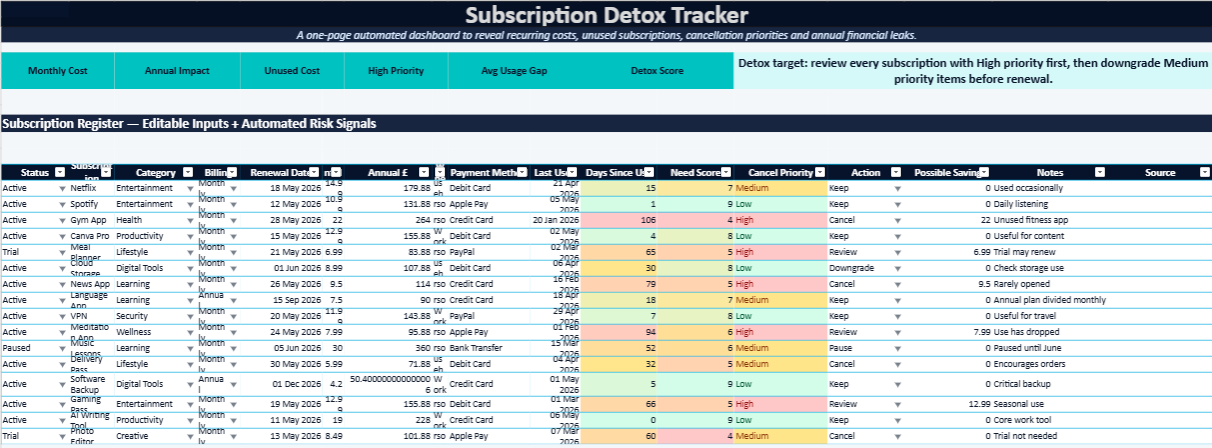
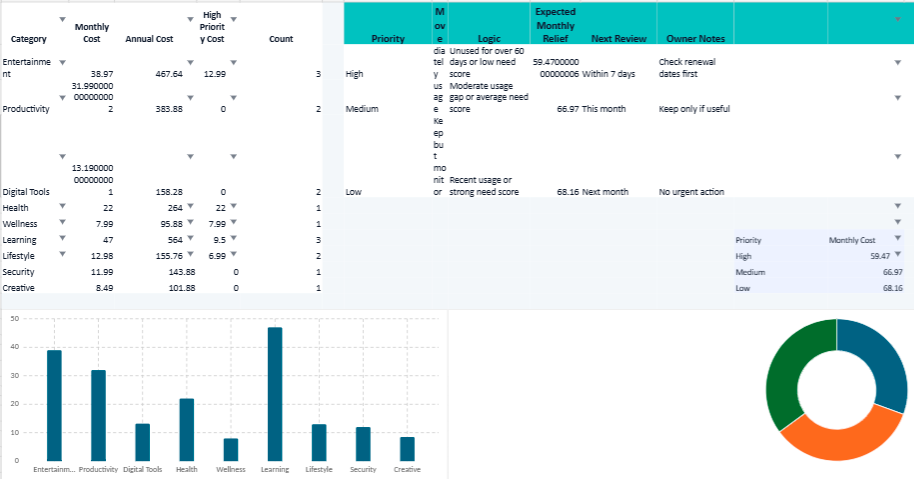
The Quiet Cost of Digital Life: A Subscription Detox Tracker in Excel
File Name
Subscription_Detox_Tracker_One_Page.xlsx
What the Excel Dashboard Helps You Track
The workbook allows users to organize:
streaming subscriptions
AI tools
software platforms
gym memberships
cloud storage services
productivity apps
delivery memberships
recurring lifestyle expenses
As subscriptions are added into the Excel dashboard, the file automatically calculates:
total monthly subscription spending
yearly financial impact
possible savings opportunities
inactive services
cancellation priorities
Very quickly, small monthly amounts begin to look very different once they are projected across an entire year.
The Business Kitchen Safety Checklist transforms daily restaurant supervision into a structured operational routine where hygiene, equipment safety, fire prevention