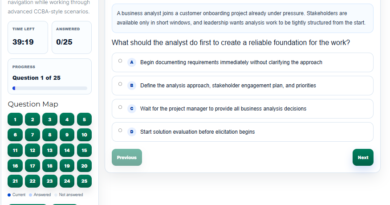
Advanced ECBA Exam Simulator: A More Natural Way to Practice Business Analysis
Studying for a business analysis exam often begins in a familiar way. Candidates read the core concepts, review summaries, memorize key distinctions, and try to build confidence through repetition. This foundation matters. Still, a point usually comes when definitions alone stop being enough. Business analysis is a discipline of judgment as much as knowledge. It asks the learner to look at a situation, understand what truly matters, and choose a response that makes sense in context.
The advanced ECBA simulator was built with that reality in mind.
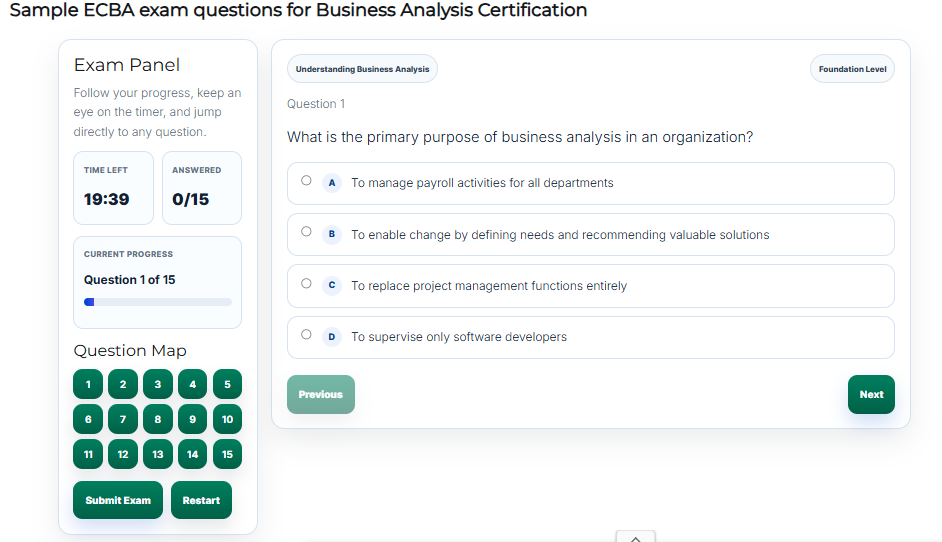
Rather than offering a short series of disconnected quiz questions, this version creates a fuller practice experience. It brings together 30 scenario-based questions, a timed session, a visual score dashboard, and a domain performance graph so that preparation feels more active, more demanding, and far more revealing. The learner does not simply review content. The learner steps into the logic of business analysis and begins to think through problems with more structure and confidence.
ECBA Exam: A Simulator That Feels Closer to Real Practice
One of the main limits of traditional revision tools is their simplicity. Many quizzes check whether a candidate recognizes a term or remembers a definition. That has some value, though it rarely captures the real nature of business analysis work. In practice, analysts are rarely asked to recite concepts in isolation. They are expected to interpret a messy situation, clarify a business need, assess stakeholder perspectives, and make sense of constraints before recommending a direction.
This simulator introduces that kind of thinking.
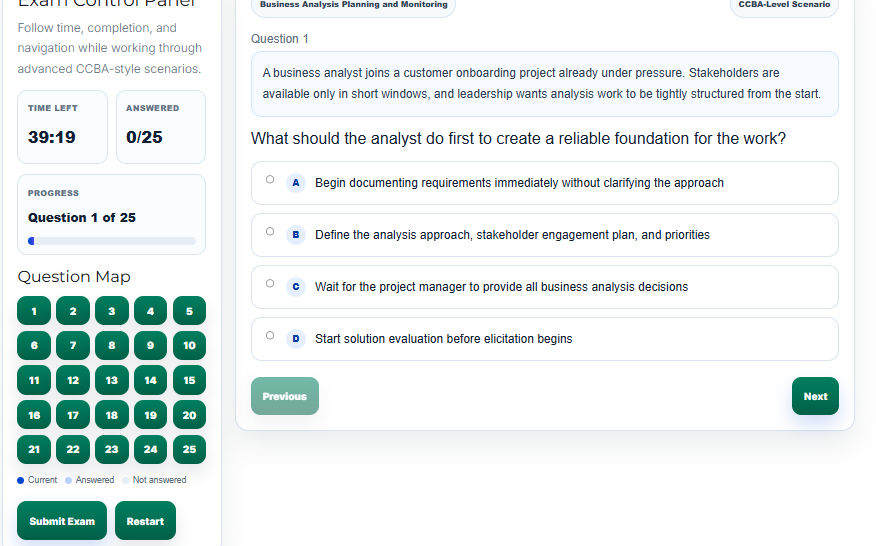
Each question is placed inside a brief practical setting. A company may be struggling with delays, poor visibility, inconsistent approvals, unclear ownership, or conflicting expectations between teams. The learner must read the situation carefully, understand what the real issue might be, and then select the most suitable answer. That small shift changes the whole experience. The task no longer feels like recalling a line from a handbook. It starts to feel like solving a real business problem.
Thirty Questions That Build More Than Familiarity
The choice to include 30 questions is important. A shorter exercise can be useful for quick revision, yet it often remains too limited to reveal deeper patterns. A larger set creates a more serious challenge. It gives the learner enough time to settle into the rhythm of the simulation, encounter different kinds of business situations, and face a broader range of analytical decisions.
Across the thirty questions, the simulator covers major business analysis themes such as:
understanding business analysis
stakeholder analysis
need
value
context
change
solution
mindset for effective business analysis
implementing business analysis
The benefit of this structure is not only coverage. It is variation. The same concept may appear more than once, though never in exactly the same way. A learner may face one question about value in an operational context, then meet the same concept later through a customer experience issue or a trade-off between efficiency and compliance. This repetition through variation makes learning stronger and more natural. The idea becomes easier to recognize in different forms, which is exactly what good analysis requires.
A Timed Format That Encourages Better Discipline
The simulator runs with a 35-minute timer, which gives the exercise a clear sense of pace. This detail may look simple, yet it changes the quality of the experience.
In untimed practice, people often feel more comfortable than they really are. They pause, second-guess endlessly, drift between tabs, or rethink a question several times without pressure. Real exam conditions feel very different. Time narrows attention. It exposes hesitation. It reveals which concepts are genuinely understood and which ones still remain unstable.
A timed environment therefore offers more than difficulty. It offers honesty.
Candidates often discover that they know more than they feared in some areas and less than they assumed in others. This kind of awareness is useful. It helps make revision more intentional. It also prepares the learner for the mental rhythm of an exam, where the challenge is not only to know the material but to stay clear-headed while moving at a steady pace.
A Score Dashboard That Gives the Result Real Meaning
Once the simulation is complete, the learner receives a visual score dashboard rather than a bare number on a screen. This makes a difference because exam preparation is not only about finding out whether the final score looks high or low. It is about understanding what the result actually says.
The dashboard highlights several elements at once:
overall score
number of correct answers
completion rate
estimated performance level
strongest domain
This richer feedback makes the result more useful. A candidate can immediately see whether the difficulty came from poor timing, weak domain knowledge, or uneven performance across topics. The experience becomes more diagnostic. It starts to answer not only How did I do? but also Where am I strong? Where am I vulnerable? What deserves attention next?
That is often where real progress begins.
A Performance Graph That Makes Weak Areas Visible
One of the strongest elements in the advanced simulator is the domain performance graph. Instead of treating the final score as one flat indicator, the graph breaks performance down by area. This visual layer gives the learner something far more valuable than a simple percentage. It shows the shape of the performance.
A candidate may realize that stakeholder-related questions feel comfortable, while context-based questions remain less secure. Another may score well on broad concepts but struggle whenever a scenario demands the distinction between a business need and a proposed solution. These details matter because they guide the next study session far more effectively than general revision ever could.
This also makes the simulator feel more professional. The learner is not left with a vague impression of success or failure. The tool provides a clearer picture of how the thinking process performed under pressure.
Explanations That Turn Mistakes Into Useful Material
After submission, the simulator presents a detailed review of the questions. This part is essential because practice without explanation has limited educational value. A score can reveal a weakness, though it cannot fix it. The explanation is where understanding begins to deepen.
For each question, the learner can see:
the answer that was selected
the correct answer
the reasoning behind the correct choice
This review stage often becomes the most useful part of the experience. It shows not only where the learner went wrong, but why the more appropriate answer makes better analytical sense. Even correct answers are worth revisiting, because they confirm whether the response was based on sound reasoning or on instinct alone.
Over time, this process sharpens judgment. The learner begins to notice recurring traps, misleading shortcuts, and common misunderstandings. The simulator therefore does more than measure performance. It teaches through performance.
A More Human Way to Build Confidence
Confidence in exam preparation can come from two very different places. One type is fragile and mostly emotional. It comes from reading a lot, hoping for the best, and feeling reassured by familiarity. The other type is quieter and far more solid. It comes from practice, correction, and repeated exposure to realistic questions.
This simulator supports the second kind.
As candidates move through practical scenarios, they start to trust their own reasoning more. Questions that once looked intimidating begin to feel manageable. The distinctions between need, value, solution, stakeholder, and context become easier to navigate. Progress becomes visible, which makes confidence feel earned rather than imagined.
That shift matters. It changes the tone of preparation. Study begins to feel less abstract and more purposeful.
Useful for Different Kinds of Learners
This advanced simulator can serve several profiles well.
A beginner can use it to move beyond passive study and start developing analytical habits. A certification candidate can use it to test readiness under time pressure. A professional entering a business analysis role can use it to strengthen structured thinking in a more practical format. Even a learner who already understands the basics can benefit from the discipline of scenario-based practice and performance review.
That versatility gives the simulator broader value. It is not merely a revision tool for one moment. It can also function as a training exercise for stronger business reasoning in general.
How to Get the Best Out of It
The simulator becomes most useful when treated as part of a method rather than a one-time test. A first attempt can serve as a diagnostic round. The purpose at that stage is simply to observe patterns. Where did uncertainty appear? Which domains caused hesitation? Which wrong answers revealed a misunderstanding rather than a careless mistake?
After that, the tool becomes even more effective.
A second attempt can follow targeted revision. A third attempt can be used to confirm whether progress is stable. In this way, the simulator becomes part of a cycle: test, review, strengthen, repeat. This rhythm tends to produce much better results than passive rereading alone.
This advanced simulator is built around practical, scenario-based questions. It is designed to feel more realistic,
more demanding, and more diagnostic than a simple quiz. You will answer 30 questions, track your progress live,
and finish with a visual score dashboard and domain performance graph.
What makes this version more advanced
30 practical questions instead of a short quiz
Case-based wording closer to real analysis situations
Domain breakdown for targeted revision
Graph of performance by business analysis domain
Full review with explanations after submission
Included domains
Understanding Business Analysis
Need, Value, Context, Change
Stakeholder and Solution
Mindset for Effective Business Analysis
Implementing Business Analysis
How to use it
Start the exam and work through all 30 questions
Use the question map to move quickly
Submit when ready or let the timer finish
Study the graph, score, and explanations carefully
Understanding Business AnalysisPractical Scenario
Question 1
0%
Final Score
Performance Dashboard
Advanced Simulator Results
Your performance summary below combines overall accuracy, domain-level analysis, and a visual chart to highlight where your business analysis reasoning is strongest and where deeper revision would be valuable.
Strategic marketing rarely rewards improvisation for long. Behind every successful campaign lies a structured understanding of positioning, customer behaviour, segmentation,
Preparing for the Certified Business Analysis Professional (CBAP) exam often begins with discipline. Candidates read the core material carefully, revisit