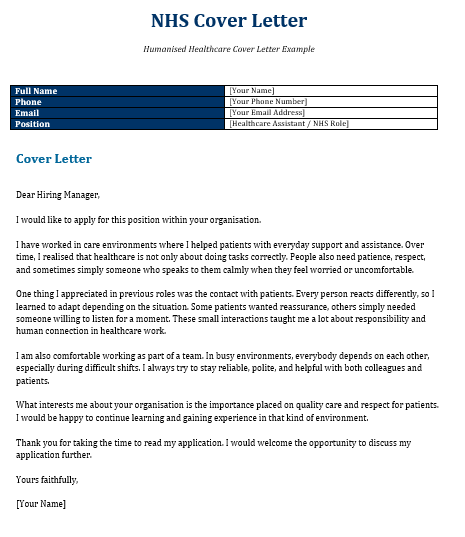
NHS Cover Letter Example: Structure, Writing & Healthcare Vocabulary
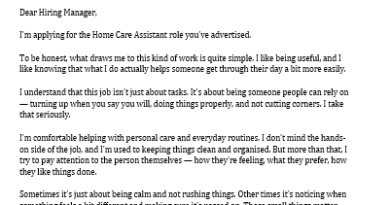
Applying for a role within the National Health Service can feel surprisingly intimidating. Many candidates spend hours perfecting their CV while leaving the cover letter until the very end, often treating it as a simple formality. In reality, the cover letter frequently becomes one of the first things recruiters remember.
Healthcare recruitment works differently from many other sectors. Qualifications matter, experience matters, yet employers also pay close attention to the way applicants communicate. A cover letter gives recruiters a glimpse of the person behind the application. It shows how someone thinks, how they express themselves, and whether they genuinely understand the human side of healthcare work.
Recruiters often pay close attention to this aspect without saying it directly.
Hospitals, clinics, care homes, and community healthcare environments operate under constant pressure. Patients arrive feeling anxious, exhausted, frightened, confused, or emotionally vulnerable. In those situations, technical ability alone rarely defines a good healthcare professional. Patience, calmness, empathy, reliability, and communication often become equally important.For this reason, NHS cover letters tend to carry more weight than candidates initially expect.
Recruiters within the National Health Service review large numbers of applications every week. Many CVs look almost identical on paper. Similar qualifications appear repeatedly. Similar duties are listed from one application to another.
The cover letter is often the only section where individuality becomes visible.
Recruiters usually try to understand several things while reading it:
Does this person sound professional?
Do they understand what healthcare work actually involves?
Can they communicate respectfully?
Do they appear emotionally mature?
Would they fit into a team environment?
Do they genuinely care about patient wellbeing?
These questions are rarely answered through certificates alone.
A healthcare environment depends heavily upon trust between staff members, patients, families, nurses, assistants, administrators, and clinicians. Employers therefore look beyond technical knowledge. They pay attention to attitude, emotional intelligence, and reliability.
The Difference Between a Generic Letter and a Convincing One
Many cover letters fail because they sound detached from reality.
Some applicants try too hard to sound impressive. Others rely heavily on online templates filled with phrases recruiters have already seen hundreds of times.
Expressions such as:
“I am highly motivated.”
“I am the ideal candidate.”
“I possess excellent communication skills.”
often appear without any real substance behind them.
The problem is not necessarily the wording itself. The issue comes from repetition and lack of authenticity. When every application sounds identical, recruiters naturally stop paying attention.
The strongest NHS cover letters usually feel more grounded. They sound like they were written by someone who understands healthcare environments from real experience rather than from a template copied online.
Healthcare Work Is Deeply Human
One aspect many applicants underestimate is the emotional dimension of healthcare work.
Patients rarely remember every technical procedure. What often stays with them is the human interaction surrounding their care.
They remember:
whether someone listened patiently,
whether staff members remained calm,
whether they felt respected,
whether someone explained things kindly,
or whether a healthcare worker simply took a moment to reassure them.
Recruiters understand this extremely well.
A candidate who demonstrates emotional awareness through their writing may leave a far stronger impression than someone using overly polished corporate language.
That is why sincerity often matters more than sophistication.
The Tone NHS Employers Usually Appreciate
Contrary to what many candidates believe, healthcare cover letters do not need dramatic language or complicated vocabulary.
In fact, excessively formal writing can sometimes create distance between the applicant and the reader.
Most NHS recruiters respond more positively to applications that feel:
respectful,
calm,
clear,
thoughtful,
and natural.
Professionalism does not come from difficult words alone. It comes from clarity, balance, and maturity.
A simple sentence written honestly often feels stronger than an exaggerated paragraph filled with corporate expressions.
Understanding the Reality of Healthcare Environments
One reason NHS employers value authentic cover letters is because healthcare work itself is unpredictable.
Some days feel manageable. Others become emotionally or physically exhausting very quickly.
Staff members may face:
emergency situations,
distressed families,
long shifts,
staff shortages,
emotionally difficult conversations,
or rapidly changing priorities.
Recruiters therefore appreciate candidates who seem realistic about the profession.
Applications that portray healthcare as permanently calm or idealised sometimes feel disconnected from reality. Employers usually prefer candidates who understand both the rewarding and demanding sides of patient care.
Compassion Is More Than Kindness
Compassion appears frequently in healthcare recruitment, yet many applications mention it without really understanding what it means in practice.
Within healthcare settings, compassion often reveals itself through small actions:
speaking gently to anxious patients,
remaining patient with elderly individuals,
listening carefully,
offering reassurance,
respecting privacy,
or simply noticing when someone feels uncomfortable.
These moments may seem ordinary, yet they shape patient experience profoundly.
Healthcare employers look for candidates capable of recognising this human dimension naturally.
Teamwork Matters Constantly in the NHS
Modern healthcare environments depend upon cooperation.
Patient care rarely comes from one individual working alone. Nurses, healthcare assistants, administrators, porters, clinicians, reception teams, and support staff constantly rely upon each other.
Because of this, NHS recruiters usually value applicants who understand teamwork realistically rather than superficially.
True teamwork in healthcare often involves:
helping colleagues during busy moments,
communicating clearly during stressful situations,
remaining dependable,
adapting quickly,
and maintaining professionalism even when pressure increases.
Applications that reflect this awareness often feel far more credible.
Why Authenticity Has Become So Important
Recruiters today read enormous numbers of applications generated from identical online templates. Many letters sound polished but emotionally empty.
Ironically, trying too hard to sound “professional” sometimes removes the personality from the application entirely.
A genuinely effective NHS cover letter usually sounds balanced:
professional without sounding robotic,
warm without becoming overly emotional,
confident without arrogance,
and realistic without negativity.
Authenticity creates trust.
Healthcare employers often prefer applicants who sound sincere and emotionally grounded rather than excessively rehearsed.
What Makes Certain Applications Memorable
Most recruiters probably forget many applications shortly after reading them. Yet certain letters remain memorable for simple reasons.
Sometimes it is because:
the applicant sounds calm and mature,
the motivation feels genuine,
the experiences feel believable,
or the tone reflects kindness naturally.
A memorable healthcare application rarely depends on dramatic storytelling. Small details often create the strongest impression.
For example, a candidate mentioning the importance of reassuring nervous patients may sound far more convincing than someone repeatedly describing themselves as “passionate” or “outstanding.”
The Emotional Pressure Behind Healthcare Roles
Healthcare work involves emotional resilience that many people only fully understand after entering the profession.
Staff members regularly encounter:
illness,
pain,
vulnerability,
frustration,
grief,
and emotional exhaustion.
Despite this, professionalism still needs to remain steady.
Recruiters therefore appreciate candidates who appear emotionally balanced. They often look for individuals capable of remaining calm, respectful, and supportive even during difficult circumstances.
A cover letter that quietly reflects emotional maturity may therefore carry significant weight.
Why Simplicity Often Works Better
Many successful NHS cover letters are surprisingly simple.
Not simplistic — simply clear, honest, and thoughtful.
Healthcare employers generally prefer communication that feels human rather than overly corporate. They spend their working lives interacting with patients, families, and staff members under real emotional pressure. Writing that feels genuine naturally becomes easier to trust.
This explains why some of the strongest applications use relatively straightforward language while still sounding highly professional.
NHS Cover Letter: Structure, Terminology and Lexical Field
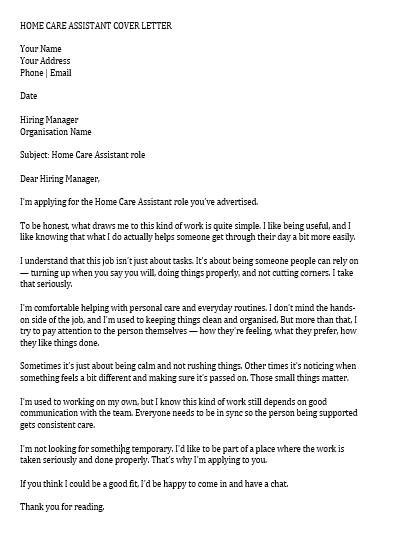
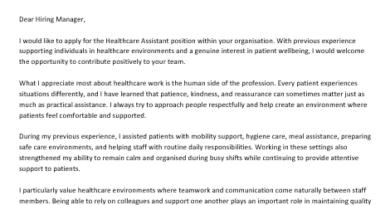
A strong NHS cover letter is not only a formal application document. It must reflect
professional maturity, patient awareness and a clear understanding of healthcare environments.
The right vocabulary helps the candidate sound credible without becoming artificial.
1. Recommended Structure
Short professional introduction
Reason for applying
Relevant healthcare experience
Patient care and communication
Teamwork and reliability
Closing with interview availability
2. Healthcare Terminology
patient wellbeing
quality care
care environment
daily support
emotional reassurance
patient dignity
professional standards
3. Human Qualities
patience
kindness
empathy
respect
calm communication
reliability
adaptability
Useful writing angle: an NHS cover letter should show that the applicant
understands the human reality of healthcare: patients may feel anxious, vulnerable or tired,
while staff members need to remain calm, supportive and dependable.
NHS Cover Letter FAQ
What should an NHS cover letter include?
An NHS cover letter should include a clear introduction, the role you are applying for,
your relevant healthcare experience, your understanding of patient care, and the personal
qualities that make you suitable for the position, such as reliability, empathy and teamwork.
How do I make an NHS cover letter sound more human?
Use natural language, short sentences and real situations from care or support work.
Avoid exaggerated phrases and focus on simple human qualities such as listening,
patience, calm communication and respect for patients.
What vocabulary should I use in an NHS application?
Useful terms include patient wellbeing, dignity, quality care, healthcare environment,
emotional reassurance, daily support, professional standards, teamwork, reliability and
compassionate care.
How long should an NHS cover letter be?
A good NHS cover letter is usually around three to five short paragraphs. It should be
detailed enough to show your motivation and experience, while remaining clear and easy
for the recruiter to read.
Should I mention NHS values in my cover letter?
Yes, but they should appear naturally. Rather than listing values mechanically, connect
them to your experience. For example, explain how you show respect, compassion and
professionalism when supporting patients or working with colleagues.
Can I use the same NHS cover letter for every role?
It is better to adapt each letter to the specific role. A Healthcare Assistant application
may focus more on patient support, while an administrative NHS role may highlight
organisation, confidentiality, communication and attention to detail.
What mistakes should I avoid in an NHS cover letter?
Avoid generic phrases, copied templates, excessive formality and unsupported claims.
A stronger letter sounds sincere, specific and connected to real healthcare situations.
How can I close an NHS cover letter professionally?
End by thanking the recruiter for considering your application and expressing your
willingness to discuss your experience further during an interview. Keep the closing
polite, simple and confident.
Healthcare rarely unfolds in perfectly controlled conditions. Corridors remain active long after schedules lose their rhythm. Conversations happen quietly behind
The Business Kitchen Safety Checklist transforms daily restaurant supervision into a structured operational routine where hygiene, equipment safety, fire prevention