CCBA Questions Exam Simulator: From Study Notes to Real Decision-Making
Preparing for the Certification of Capability in Business Analysis (CCBA) often starts in a very familiar way. Candidates read guides, review frameworks, highlight important concepts, and try to absorb as much terminology as possible. This stage matters. A solid understanding of the fundamentals gives structure to the learning process. Still, after a certain point, many candidates begin to feel the same frustration: knowing the material is one thing, using it well in a realistic situation is something else entirely.
That is where a strong simulator becomes genuinely useful, not as a shortcut, and not as a substitute for serious preparation, but as a bridge between theory and action.
A well-designed CCBA questions exam simulator helps candidates move from passive revision to active thinking. It creates an environment in which business analysis feels less abstract and more immediate. Instead of simply recognizing a concept on a page, the learner is asked to work through a scenario, weigh competing priorities, and choose the response that makes the most sense in context. This shift changes the nature of preparation. Study becomes more practical, more revealing, and far more engaging.
Moving beyond notes and definitions
Many candidates spend a great deal of time building knowledge in a static format. They read about elicitation, traceability, strategy analysis, solution evaluation, and requirements quality. They become familiar with the language of business analysis. That familiarity is useful, though it can also create a false sense of readiness.
Reading gives recognition. Practice gives perspective.
A concept can seem perfectly clear in a study guide, then suddenly feel much more complex when placed inside a realistic scenario. A question may involve conflicting stakeholder views, incomplete information, operational constraints, or competing definitions of value. In these moments, memorized knowledge alone is rarely enough. The learner has to think through the situation, identify what matters most, and make a reasoned judgment.
That is the kind of work a good simulator encourages.
A more realistic way to prepare
One of the main strengths of an advanced CCBA simulator lies in its ability to recreate the kind of thinking business analysts rely on every day. It does not simply ask candidates to repeat definitions. It places them in situations that resemble actual business challenges.
A team may be struggling with unclear requirements. A sponsor may want a solution before the real problem has been fully examined. Different stakeholder groups may disagree on priorities. A change may appear successful on paper while still failing to deliver value in practice.
These are the kinds of situations that push candidates beyond surface-level understanding.
Instead of asking what a concept means in theory, the simulator asks what it looks like in action. That difference may seem small at first, yet it changes the entire learning experience. The learner begins to connect concepts rather than store them separately. Requirements life cycle management is no longer just a topic. It becomes something visible in change control, traceability, and prioritization. Strategy analysis stops feeling like an isolated chapter and starts to feel like a way of examining real organizational challenges.
Why this angle matters for CCBA preparation
The CCBA is not only about knowing the vocabulary of business analysis. It is about showing a level of professional judgment that sits between entry-level understanding and senior mastery. Candidates are expected to think with more structure, more awareness, and more consistency. They need to recognize dependencies, question assumptions, and evaluate the implications of different decisions.
This is exactly why the transition from study notes to decision-making matters so much.
A learner may know what traceability is. A stronger learner can explain why weak traceability creates risk when priorities change. A candidate may know that stakeholder collaboration is important. A stronger candidate can recognize when one influential voice is distorting workshop outcomes and can respond with better facilitation.
That difference is subtle, though it is important. A simulator helps make that difference visible.
Turning theory into practical judgment
An advanced CCBA simulator becomes valuable when it teaches candidates how to think, not only what to remember.
Each scenario asks the learner to slow down mentally, even in a timed environment, and ask better questions. What is the real issue here? Is the stakeholder describing a need or jumping too quickly to a solution? Is this requirement clear enough to guide design and evaluation? Has value been defined too narrowly? Is one team’s success creating friction for another?
These questions are at the heart of business analysis. They require interpretation, not repetition.
Over time, repeated exposure to this style of questioning helps build better habits. The learner starts to notice patterns more quickly. Vague requirements stand out more clearly. Weak assumptions become easier to challenge. Trade-offs begin to feel easier to discuss. Progress no longer comes only from reading more. It comes from thinking better.
The importance of scenario-based questions
Scenario-based questions are especially effective because they reflect the texture of real work. Business analysis rarely happens in neat, isolated fragments. It unfolds inside organizations with competing interests, imperfect data, practical constraints, and evolving expectations.
A realistic simulator captures some of that complexity without making the experience chaotic.
The candidate may face a situation where a solution appears successful based on one metric, though dissatisfaction remains high elsewhere. Another question may involve a team asking for a tool, while the deeper issue actually lies in process design or unclear ownership. Another may require the candidate to decide whether a requirement is ready enough to move forward or still too vague to support good delivery.
This format creates a richer kind of preparation. It pushes learners to interpret context, not merely recognize terminology.
Time pressure and clearer self-awareness
A timed simulator adds another layer of value. Without time constraints, it is easy to feel more confident than one really is. A candidate can reread a question several times, hesitate freely, or circle around the same answer until it feels comfortable. In a timed setting, the decision process becomes more honest.
Time pressure reveals where understanding is solid and where it remains fragile.
Some candidates discover that they know more than they expected once they begin trusting their reasoning. Others notice that certain concepts still blur together when they need to respond quickly. Both outcomes are useful. They help transform preparation from vague effort into more focused improvement.
This kind of self-awareness is difficult to build through reading alone.
More than a score
At the end of a strong simulation, the result should do more than announce a percentage. A score matters, though the real value lies in what the score reveals.
A candidate may perform strongly in elicitation and collaboration while struggling with strategy analysis. Another may do well with planning and monitoring, yet show weaker judgment in solution evaluation. These patterns tell a more meaningful story than one final number on its own.
A good dashboard helps candidates see where their strengths already exist and where their preparation still needs depth. This makes revision more intelligent. Instead of reviewing everything in the same way, the learner can focus on the areas where more attention will matter most.
Learning through explanation
The review stage is where many learners grow the fastest. Once the exam simulation ends, each answer becomes an opportunity to reflect. Why was one response stronger than the others? What distinction did the question rely on? Was the mistake caused by a knowledge gap, a rushed interpretation, or an assumption that should have been challenged?
These moments are valuable because they turn the simulator into more than an assessment tool. They turn it into a teaching tool.
Even correct answers deserve review. Sometimes a candidate arrives at the right choice for the wrong reason. Going back through the explanation helps strengthen the logic behind the answer, which makes future decisions more reliable.
A more human way to build confidence
Confidence during certification preparation can be surprisingly fragile. It often rises and falls depending on how familiar the material feels that day. Yet familiarity is not always the same as readiness.
A simulator builds a different kind of confidence.
It allows candidates to see themselves working through problems with increasing clarity. It shows them that they can interpret a scenario, sort through ambiguity, and make a sensible decision. Over time, that experience becomes reassuring in a much deeper way than passive revision ever could.
The learner stops asking, Have I read enough? and starts asking, Can I think through this well under pressure? That is a far more useful question.
Useful for more than the exam itself
Although a CCBA simulator is clearly valuable for certification preparation, its usefulness goes beyond the exam. The habits it reinforces are directly connected to better business analysis practice. Clearer requirement thinking, better stakeholder interpretation, stronger traceability awareness, and sharper evaluation of value all contribute to more effective work in real projects.
In that sense, the simulator is not simply helping candidates prepare for a credential. It is helping them develop more dependable analytical habits.
That makes the experience feel more meaningful. It becomes less about passing a test and more about strengthening professional judgment.
CCBA Preparation
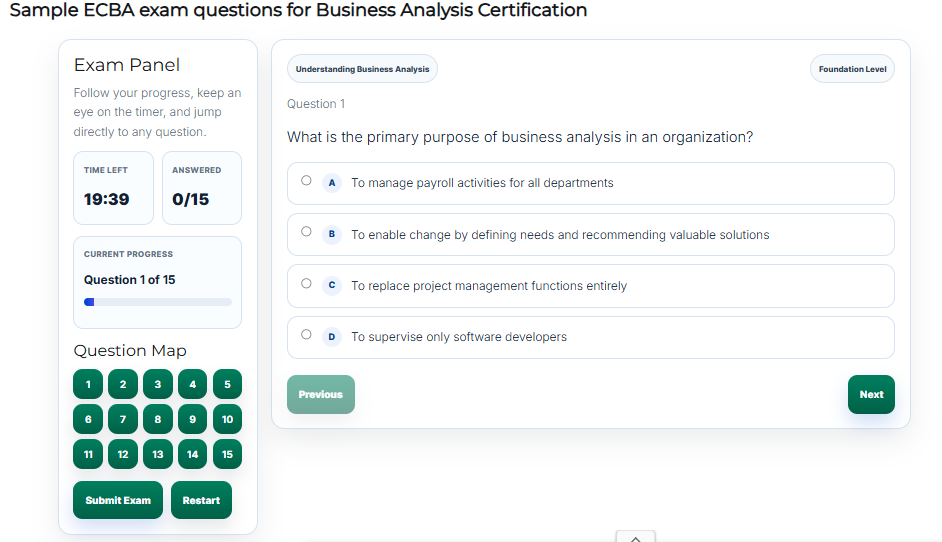
CCBA Exam Sample Questions
Sample questions help candidates move beyond theory and begin thinking the way a business analyst is expected to think in real situations. They bring structure, realism, and better judgment to CCBA preparation.
Why they matter
They expose the candidate to scenario-based reasoning, sharpen decision-making, and reveal whether concepts are truly understood or simply recognized.
What they test
Good sample questions assess planning, elicitation, requirements analysis, traceability, stakeholder collaboration, and solution evaluation.
Best use
They work best when used with review notes, explanations, and repeated timed practice rather than quick memorization alone.
What strong CCBA sample questions usually include
Realistic scenariosQuestions built around workplace situations rather than isolated definitions.
Competing optionsAnswers that appear plausible, forcing the learner to think carefully.
Analytical depthQuestions that test judgment, prioritization, and business reasoning.
Clear explanationsA strong explanation helps transform a mistake into a learning moment.
Quick preparation advice
The most useful CCBA exam sample questions are the ones that help candidates think through business situations with clarity. A strong preparation routine combines sample questions, explanation review, timed practice, and focused revision by domain.
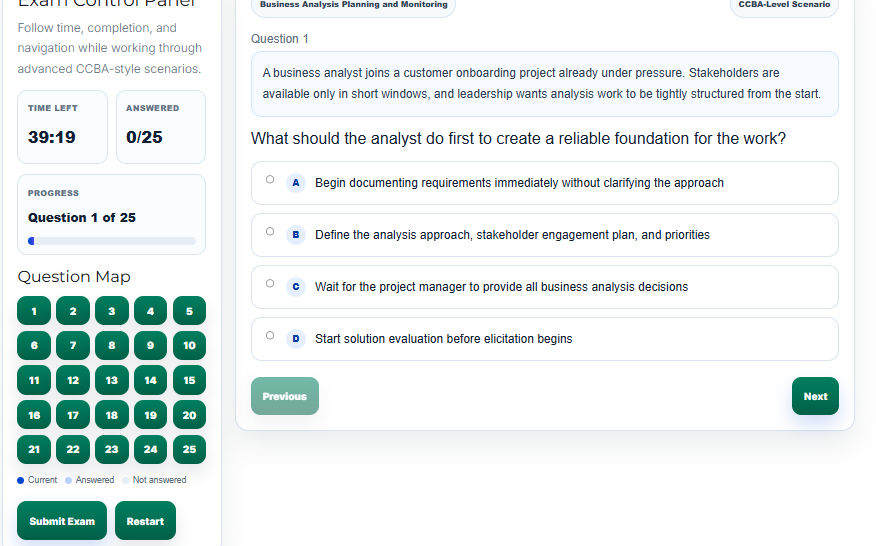
CCBA Exam Simulator Advanced
CCBA Style Simulator • Advanced Practice
CCBA Exam Simulator for Deeper Business Analysis Understanding
This advanced simulator is designed to build a realistic understanding of the Certification of Capability in Business Analysis. It uses original, scenario-based practice questions built to strengthen judgment, traceability thinking, requirement quality, stakeholder collaboration, and value-focused analysis.
Why this simulator is useful
Scenario-based questions closer to professional analysis work
Coverage aligned with CCBA-style competency areas
Original practice content built for understanding, not memorization
Detailed score dashboard with domain-level insights
Inside this version
25 advanced multiple-choice questions
40-minute timed practice mode
Question map and live progress tracking
Performance chart and full answer review
Knowledge areas reflected
Business Analysis Planning and Monitoring
Elicitation and Collaboration
Requirements Life Cycle Management
Strategy Analysis
Requirements Analysis and Design Definition
Solution Evaluation
Business Analysis Planning and MonitoringCCBA-Level Scenario
Question 1
0%
Final Score
Performance Dashboard
Your CCBA Practice Results
Review your score, strongest area, and domain-by-domain performance. The goal is to sharpen the analysis habits and decision quality expected at the CCBA level.
Correct
0/25
Completion
0%
Estimated Level
Developing
Best Area
—
Domain Performance Chart
Each bar shows your percentage score within a CCBA-style knowledge area.
Domain Breakdown
Detailed Question Review
FAQ
CCBA Exam Sample Questions FAQ
A practical FAQ section to help readers understand how CCBA sample questions work, where to look for practice material, and how to use them more effectively during preparation.
What are CCBA exam sample questions?
CCBA exam sample questions are practice questions designed to help candidates understand the style, logic, and level of reasoning expected in business analysis certification preparation. They usually focus on business scenarios, stakeholder decisions, requirements thinking, and solution evaluation rather than simple memorization.
Where to find CCBA exam questions?
CCBA practice questions can usually be found in exam simulators, business analysis training platforms, study guides, preparation courses, and dedicated certification practice pages. The most useful resources are the ones that provide original scenario-based questions with answer explanations, domain coverage, and realistic exam-style structure.
Are CCBA sample questions enough to prepare for the exam?
Sample questions are very useful, though they work best when combined with structured study. They help candidates apply concepts, test decision-making, and identify weak areas. Strong preparation usually combines reading, revision by knowledge area, timed practice, and detailed answer review.
What makes a good CCBA practice question?
A strong CCBA practice question usually includes a realistic business context, plausible answer choices, and a decision that requires judgment rather than pure recall. The best questions also include explanations that clarify why one answer is stronger than the others.
Are free CCBA exam sample questions useful?
Free CCBA sample questions can be useful for early practice, especially when they are scenario-based and clearly explained. Their value depends on quality, realism, and structure. A smaller number of well-written questions often helps more than a large set of vague or repetitive items.
How should I use CCBA exam sample questions effectively?
A practical approach is to begin with a small timed set, review every explanation carefully, identify weak domains, and then repeat the process after focused revision. This method turns sample questions into a learning tool rather than a simple score-checking exercise.
Do CCBA questions focus only on theory?
Good CCBA questions usually go beyond theory. They often test how a candidate interprets a business situation, prioritizes action, understands stakeholder impact, manages requirement changes, or evaluates whether a solution is actually delivering value.
Why do scenario-based CCBA questions feel more difficult?
Scenario-based questions feel more demanding because they test reasoning in context. Several answers may seem reasonable at first, though only one reflects the strongest business analysis response. This is what makes them valuable for deeper preparation.
Preparing for the Certified Business Analysis Professional (CBAP) exam often begins with discipline. Candidates read the core material carefully, revisit
Digital marketing evolves at a pace that leaves little room for approximation. Campaign performance, SEO visibility, advertising profitability, lead generation
Strategic marketing rarely rewards improvisation for long. Behind every successful campaign lies a structured understanding of positioning, customer behaviour, segmentation,
Digital marketing evolves at remarkable speed, transforming the way brands communicate, attract audiences, and build long-term visibility online. From SEO