The Hiring Process: A Journey Between Expectation and Discovery
Hiring rarely unfolds as neatly as it appears on paper. From a distance, the process looks orderly—applications submitted, interviews conducted, offers extended. In reality, something far more nuanced takes place. Recruitment is a gradual alignment of expectations, a sequence of interactions through which both sides attempt to reduce uncertainty while preserving possibility.
At its core, hiring is less about selecting the “right” person than about understanding who might grow into the role—and how the organisation itself will respond to that presence.
Before the First Application: The Quiet Signals
Long before a candidate clicks “apply,” the process has already begun. The way a role is written, the clarity of its scope, even the tone of its language—all these elements send signals.
A vague description attracts hesitation. An overly rigid one deters originality. Somewhere in between lies a form of clarity that invites the right kind of attention. Candidates, often without realising it, respond not only to the content of the role, but to the intent behind it.
That initial moment shapes everything that follows.
Screening as Interpretation, Not Elimination
Once applications arrive, the instinct is to sort, filter, and reduce. Yet effective screening rarely operates as a simple elimination exercise. It requires interpretation.
A CV does not speak directly. It hints. It suggests. It leaves gaps. A recruiter’s role, therefore, is not merely to match keywords to requirements, but to read between lines—detecting patterns, inconsistencies, and, occasionally, quiet indicators of potential.
Experience matters, certainly. Yet trajectory often matters more. A candidate who has progressed with intent, even imperfectly, may reveal more than one who simply accumulates roles.
At this stage, hiring begins to resemble judgment rather than process.
The First Conversation: Where Perception Takes Shape
The initial call marks a shift. What had been abstract becomes personal. A voice replaces a document. Questions replace assumptions.
For candidates, this moment often carries more weight than anticipated. It offers a first glimpse into how the organisation communicates, how it listens, how it frames its expectations. A rushed conversation can suggest indifference. An overly scripted one can feel distant. A thoughtful exchange, by contrast, creates space—for nuance, for honesty, for mutual evaluation.
Because that is what this stage becomes. Not a test, but a calibration.
Candidates assess as much as they are assessed.
Moving Beyond Competence: Understanding Approach
As the process deepens, the nature of evaluation evolves. Technical ability, while essential, becomes only one element among many.
Assessments and case studies reveal something subtler. They show how a candidate approaches uncertainty. Do they impose structure on ambiguity, or retreat from it? Do they prioritise clarity, or complexity? Do they seek understanding before action?
These are not qualities easily captured in a résumé. They emerge only through interaction.
Similarly, interviews with hiring managers extend the conversation. Here, attention shifts toward ownership and judgment. How does the candidate think about responsibility? How do they navigate constraints? How do they respond when certainty fades?
In many ways, this is where the real evaluation begins.
The Human Element in Decision-Making
By the later stages, the process has accumulated fragments—impressions, observations, partial conclusions. The challenge lies in assembling them.
Decisions are rarely straightforward. One interviewer may emphasise technical strength, another cultural alignment, a third long-term adaptability. These perspectives do not always converge naturally.
And yet, the most thoughtful hiring decisions emerge precisely from this tension. They require discussion, sometimes disagreement, and ultimately a shared conviction that extends beyond individual preference.
Hiring, at this point, becomes collective reasoning.
The Offer: More Than a Formal Step
The offer stage is often treated as a conclusion. In practice, it represents a delicate transition. From the organisation’s perspective, it formalises commitment. From the candidate’s side, it crystallises choice. Yet beyond compensation and contractual terms lies something less tangible: trust.
Clarity is essential. Ambiguity, particularly around expectations or progression, rarely disappears over time. It tends instead to resurface—often when it is least convenient.
But equally important is tone. The way an offer is presented communicates value. It signals whether the organisation sees the individual as a resource to be deployed or a contributor to be developed. That distinction, though subtle, shapes the relationship that follows.
The Overlooked Phase: Between Acceptance and Arrival
There is a moment in hiring that receives little attention, despite its importance. The period between offer acceptance and the first day.
During this interval, something fragile exists. The decision has been made, yet the experience has not begun. Doubts can emerge. Expectations can shift.
Organisations that recognise this treat preboarding as an extension of hiring, not an afterthought. A simple message, a prepared workspace, an early introduction to the team—these gestures create continuity.
They suggest that the new hire is not merely expected, but anticipated.
When Process Becomes Experience
For candidates, the hiring process leaves a lasting impression—regardless of outcome. Even those not selected carry away a perception of the organisation.
A fragmented process suggests disorganisation. A rushed one implies indifference. An overly complex one creates fatigue. By contrast, a coherent, thoughtful process signals respect—for time, for effort, for professional identity.
These impressions travel. They shape reputation more effectively than any formal statement.
Hiring Process Timeline
Recruitment Workflow
Hiring Process Timeline
This horizontal timeline offers a clear visual overview of the recruitment journey.
Each coloured block represents a stage, while the central line shows the sequence,
the expected timing, and the overall flow from application to preboarding.
8 StagesClear milestones from sourcing to final preparation
2–6 WeeksTypical total hiring duration
Visual Flowreading path for faster understanding
Candidate ClarityExpected timing at every step
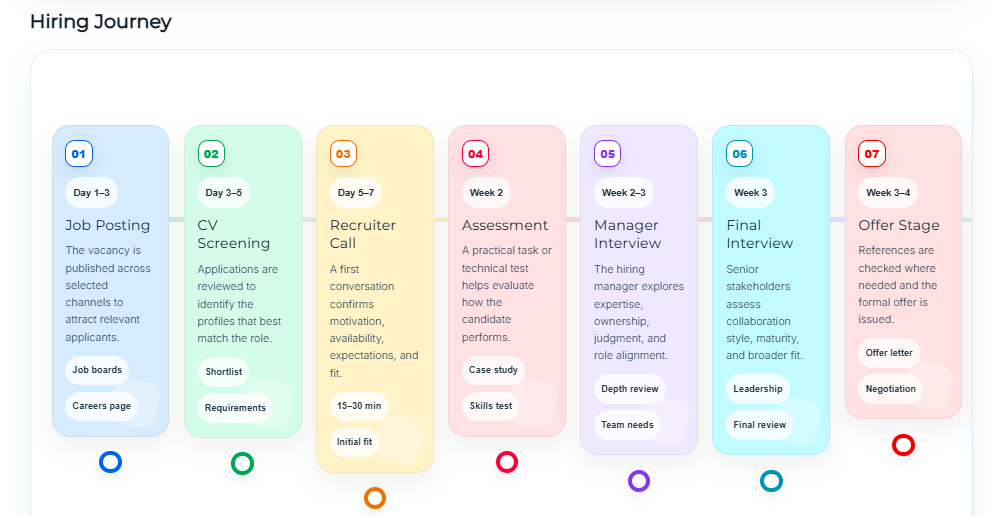
Hiring Journey
01
Day 1–3
Job Posting
The vacancy is published across selected channels to attract relevant applicants.
Job boardsCareers page
02
Day 3–5
CV Screening
Applications are reviewed to identify the profiles that best match the role.
ShortlistRequirements
03
Day 5–7
Recruiter Call
A first conversation confirms motivation, availability, expectations, and fit.
15–30 minInitial fit
04
Week 2
Assessment
A practical task or technical test helps evaluate how the candidate performs.
Case studySkills test
05
Week 2–3
Manager Interview
The hiring manager explores expertise, ownership, judgment, and role alignment.
Depth reviewTeam needs
06
Week 3
Final Interview
Senior stakeholders assess collaboration style, maturity, and broader fit.
LeadershipFinal review
07
Week 3–4
Offer Stage
References are checked where needed and the formal offer is issued.
Offer letterNegotiation
08
Before Start
Preboarding
Contracts, systems, and welcome materials are prepared ahead of day one.
IT setupDocuments
Start with visibility and sourcing
Narrow the pool to relevant candidates
Confirm baseline alignment early
Test practical ability in context
Explore depth and ownership
Validate leadership and team fit
Formalise the final decision
Prepare a smooth first day
Case Study: Rebuilding the Hiring Process in an IT Company
Hiring and Talent Strategy
Case Study: When an IT Company Realised Its Hiring Process Was the Problem
At first glance, nothing seemed seriously wrong. Applications were arriving. Interviews were being scheduled. Offers were being issued. Yet something in the process felt increasingly fragile. Candidates were dropping out midway, managers were unconvinced by final fits, and recruiters sensed a growing disconnect. What followed was not a dramatic overhaul, but a more thoughtful reworking of the hiring journey—one that placed clarity, rhythm, and human experience back at the centre.
What this case study shows
Why a hiring process can appear efficient while still feeling disjointed to candidates.
How a mid-sized IT company improved coherence without turning recruitment into a rigid script.
Why tone, timing, and continuity often matter as much as technical evaluation.
Mid-Sized IT FirmOperating in cloud integration and enterprise software delivery.
Growing FrictionCandidates withdrew, interviews felt repetitive, and final matches remained uneven.
Process RedesignLess emphasis on volume, more attention to clarity, purpose, and candidate flow.
Measured ImpactFaster hiring, lower drop-off, and stronger confidence on both sides.
A hiring process that worked on paper, but not in real life
Internally, the company had already put structure in place. Roles were documented, screening criteria were defined, and interviews followed a recognisable sequence. From a process map alone, nothing looked especially alarming. The difficulty emerged somewhere else: in the lived experience of the people moving through it.
Candidates did not describe the process as chaotic. That would have been easier to fix. What they described was something more elusive. Conversations seemed to cover the same territory more than once. Feedback often arrived later than expected. Some reached advanced stages without fully understanding what each interview was designed to assess. There was movement, yet little sense of progression.
On the other side, hiring managers faced a different frustration. Profiles often looked solid on paper, and some performed well in isolated interviews, yet the final fit felt incomplete. Recruiters, meanwhile, were trying to balance speed with quality while also managing expectations that were not always aligned internally.
The turning point came when the company stopped asking how to move candidates through the process faster and started asking a more uncomfortable question: what does this experience actually feel like from the candidate’s side?
That shift in perspective changed the discussion. Recruitment was no longer treated as a chain of operational steps to optimise in isolation. It began to be seen as a journey whose coherence mattered as much as its efficiency.
Rewriting the first impression
The first change focused on job descriptions. Previously, they had been detailed, thorough, and technically correct. Yet they were also heavy, sometimes crowded with requirements, and not always clear about the real shape of the role. Candidates could understand the duties, but not necessarily the role’s purpose.
The company rewrote them with a different discipline. Instead of saying everything, the aim was to say the most important things more clearly: what the person would be expected to solve, how the position contributed to the team, what success would look like after the first few months, and where the role sat in the broader delivery environment.
The result was subtle but meaningful. Application volume decreased slightly, yet relevance improved. The process was no longer attracting the widest possible audience. It was attracting a better-informed one.
Giving each interaction a purpose
Interview design became the next priority. Candidates had previously met several stakeholders, each with reasonable intentions, yet not always with clear boundaries. As a result, parts of the conversation repeated. The process felt longer than it needed to feel.
Under the revised model, each stage was assigned a distinct purpose. The recruiter call became a moment of orientation and alignment. The technical stage moved away from abstract testing and towards real work scenarios. Manager interviews focused more clearly on ownership, judgment, collaboration, and decision-making under practical constraints.
This did not reduce depth. It reduced duplication. For candidates, the process began to feel like forward movement rather than a restart at every stage.
What silence was quietly costing
Timing turned out to be another major signal. Internally, small delays had often seemed harmless. Discussions needed time. Calendars were busy. Decisions required consultation. From the candidate’s perspective, however, silence rarely felt neutral. It created doubt.
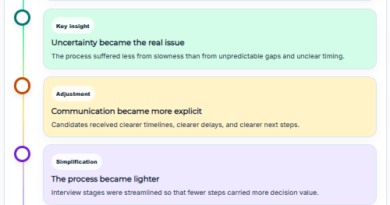
Some candidates interpreted delayed responses as loss of interest. Others simply disengaged and moved on to employers who communicated with greater consistency. The company realised that speed, in this context, was less important than visibility.
A simple operating principle was introduced: every stage would end with either a decision or a clearly communicated next step. This did not eliminate all waiting. It made the waiting intelligible. That distinction mattered more than expected.
Turning the offer into a continuation of the story
The offer stage was also reconsidered. Previously, it had been handled professionally, though somewhat transactionally. Compensation, timing, and benefits were laid out clearly, but the conversation often stopped there.
The redesigned approach gave the offer more context. Candidates were not only told what they would receive. They were shown more clearly where they would fit, how the team operated, what the first months might involve, and how the role could evolve. The offer became less like the end of a negotiation and more like the beginning of a working relationship.
That change did not transform acceptance rates overnight. It strengthened the quality of the final decision. People joined with a clearer picture, and that clarity reduced friction later.
The overlooked space between acceptance and arrival
One of the most revealing discoveries came after the formal hiring decision had already been made. The period between acceptance and day one had long been treated as a passive gap. In reality, it was a highly sensitive interval.
The company began filling that space with lighter, more intentional signals: a welcome message, a clearer outline of the first week, early administrative visibility, and occasional contact that reassured the future employee that their arrival had been anticipated rather than merely scheduled.
None of these steps were dramatic. Together, they created continuity. New hires arrived with less hesitation and a stronger sense that they were already expected within the organisation rather than simply inserted into it.
How the redesigned process looked in practice
The company did not replace its process with something radically new. It reworked the sequence so that each step contributed distinct value and the overall experience felt more coherent from beginning to end.
01
Early stage
Sharper role framing
Job descriptions were rewritten to clarify impact, context, and likely challenges.
02
Shortlisting
Better screening logic
Recruiters focused more on trajectory, adaptability, and signals of long-term fit.
03
First contact
Orientation call
The initial recruiter exchange began setting expectations instead of simply validating basics.
04
Evaluation
Practical interviews
Technical discussions moved closer to real work scenarios and away from abstract testing.
05
Decision phase
Clearer feedback rhythm
Each stage ended with either a decision or a clearly communicated next step.
06
After acceptance
Human preboarding
The space before day one was used to build confidence and continuity rather than silence.
What changed in the end
Six months later, the operational gains were visible. Yet the most valuable improvement was not purely numerical. The process felt more trustworthy, more readable, and more human for everyone involved.
Faster hiringTime-to-hire decreased as duplication and avoidable delays were reduced across the journey.
Lower drop-offCandidates stayed engaged because the process felt clearer and easier to follow.
Stronger fitManagers reported greater confidence in final selections and role alignment.
Better first daysNew hires arrived with more confidence thanks to a smoother transition into onboarding.
The broader lesson was simple. Hiring rarely becomes stronger by becoming heavier. It becomes stronger when each step has a reason, each silence is reduced, and each interaction helps both sides understand not just the job, but the relationship that may follow.
Hiring Process Case Study Timeline
Case Study
How an IT Company Rebuilt a Hiring Process That Looked Fine on Paper
This simplified timeline shows how the company moved from a fragmented recruitment journey
to a clearer and more human process. The issue was not a lack of applicants, but a lack of
continuity, visibility, and purpose across the candidate experience.
Simplified Hiring Process Timeline
01
Initial issue
Process felt fragmented
Applications were coming in, yet candidates were dropping out and final fit remained uncertain.
02
Reassessment
Candidate view became central
The company stopped focusing only on speed and began asking what the process felt like from the other side.
03
Redesign
Each step gained a purpose
Job descriptions became clearer, interviews became less repetitive, and communication improved between stages.
04
Final stages
Offer and preboarding felt more human
The offer became part of the wider conversation, and the period before day one was no longer left empty.
05
Outcome
Better flow and stronger trust
Hiring became faster, candidate drop-off decreased, and the whole journey felt more coherent.
The broader lesson was simple: hiring improved when the company stopped adding complexity and started giving
each moment more clarity, more rhythm, and a more human tone.