Home Care Assistant Cover Letter: Writing Something That Actually Feels Real
Download the Home Care Assistant Cover Letter Template in Word Format ⬇️
At first, writing a cover letter for a Home Care Assistant role seems quite simple. There’s usually a job description, a list of duties, and a few expected qualities. It can feel like all you need to do is match those points with your own experience and put it into words.
But once you look a bit closer, it becomes clear that it doesn’t really work like that.
In care, people aren’t just reading to check whether you meet the requirements. They’re trying to get a sense of how you might be in a real situation — in someone’s home, on a normal day, when things aren’t scripted. And that’s not something you can easily describe in neat, perfect sentences.
A cover letter, in that sense, isn’t really about listing skills. It’s more like a first glimpse into how you think and how you approach the job.
And that changes how it should be written.
It’s Not Just a Job — It’s a Presence
One of the biggest differences with home care is the setting. You’re not going into a workplace in the usual sense. You’re stepping into someone’s home, their personal space, their routine.
That alone changes everything.
You’re not just completing tasks. You’re becoming part of someone’s day, even if only for a short time. And that means the way you do things matters just as much as what you do.
For example, helping someone with personal care isn’t just a physical task. It requires awareness, respect, and the ability to make someone feel comfortable in a situation that can easily feel uncomfortable.
The same goes for everyday routines. Preparing a meal, assisting with mobility, tidying up — all of these things seem straightforward, but they sit within a much bigger context. People have habits, preferences, and ways of doing things that they’ve built over years.
You don’t come in and change that.
You work around it.
A strong cover letter doesn’t need to explain all of this directly, but it should reflect that understanding in a subtle way.
Why “Perfect” Writing Often Misses the Point
A lot of cover letters sound very similar. They follow a structure, use the same phrases, and aim to sound professional above all else.
There’s nothing wrong with that, on the surface.
But in care roles, it can sometimes have the opposite effect.
When a letter feels too polished, it can create a bit of distance. It sounds like something prepared, rather than something meant. And in a role that relies so much on trust and human interaction, that matters.
Employers don’t need perfect wording. They need a sense that the person behind the application understands what the job actually involves.
That’s why simpler language often works better.
Not simplistic — just natural.
Something that sounds like it could be said out loud without effort.
The Small Things Are Usually the Important Ones
If you ask people working in care what matters most, they rarely talk about big tasks first.
They talk about the small things.
Turning up on time. Not rushing. Listening properly. Noticing when something feels slightly different. Remembering how someone likes their tea. Giving space when needed, and conversation when it helps.
None of this looks particularly impressive on paper.
But in practice, it’s what makes the difference between someone feeling supported and someone feeling like they’re just being “looked after.”
A good cover letter doesn’t need to list these things one by one. But it should give the impression that the writer is aware of them.
That they’ve thought about what the job is actually like, beyond the basic description.
Reliability Isn’t Just a Word
“Reliable” is one of those words that appears in almost every application.
But in home care, it carries a very specific meaning.
It’s not just about being generally dependable. It’s about consistency.
If you say you’ll be there at a certain time, you need to be there. If a routine is expected, it needs to be followed. If something changes, it needs to be communicated clearly.
Because the person receiving care often builds their day around that.
And when that consistency breaks, even slightly, it can have a bigger impact than people expect.
So when reliability is mentioned in a cover letter, it helps if it feels grounded. Not just stated, but understood.
Working Alone — But Not Really Alone
Another part of the role that doesn’t always come across clearly is the balance between independence and teamwork.
Home Care Assistants often work alone. They move from one client to another, making decisions on the spot, dealing with small issues as they come up.
That requires confidence and organisation.
At the same time, they are part of a wider system. Other carers, supervisors, and healthcare professionals all rely on shared information to keep things running smoothly.
So even though the work is often independent, communication is essential.
A strong application reflects both sides of this — the ability to manage alone, and the awareness that you’re still part of something larger.
Trying to Sound “Right” vs. Being Clear
One of the most common difficulties in writing a cover letter is knowing how formal to be.
There’s often a tendency to aim for what sounds “right,” which usually means more formal language, longer sentences, and carefully structured paragraphs.
But that can sometimes make the message harder to connect with.
In care roles, clarity tends to matter more than formality.
Shorter sentences. Direct statements. A steady, consistent tone.
That doesn’t mean being casual. It just means not overthinking the wording.
In many cases, the simplest version of a sentence is the most effective.
There’s No Need to Say Everything
Another common mistake is trying to include too much.
It’s understandable — people want to show everything they can do, every quality they have, every reason they are suitable.
But that can make the letter feel heavy.
In reality, a few well-chosen points are usually enough.
A clear reason for applying. A sense of how the job is understood. A brief insight into how the person works. And a closing that feels natural.
That’s often all that’s needed.
Adapting Without Overcomplicating
It’s always a good idea to adjust a cover letter slightly depending on the organisation.
But that doesn’t mean rewriting everything.
Sometimes, it’s just a matter of acknowledging the type of care provided, or showing that you’ve paid attention to the role.
Even small details can make a difference.
They show that the application is intentional, not just sent out widely.
Final Thoughts
In the end, a Home Care Assistant cover letter doesn’t need to stand out in a dramatic way.
It just needs to feel genuine.
It should give the impression that the person writing it understands what the role involves, takes it seriously, and is prepared to do it consistently.
That’s what employers are really looking for.
Not perfect writing. Not impressive vocabulary.
Just someone who can be trusted to do the job properly, day after day.
What a strong Home Care Assistant cover letter should quietly show
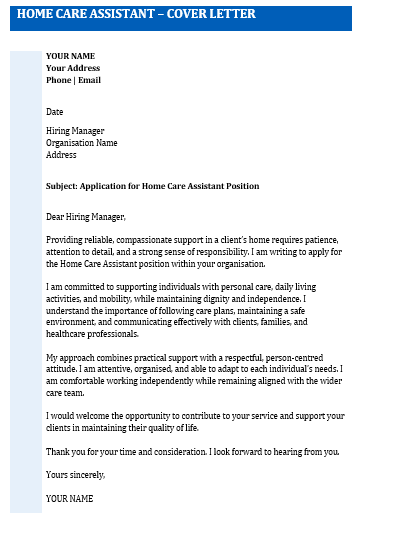
A convincing Home Care Assistant cover letter should not only mention motivation. It should make the employer feel that the candidate understands the real setting of domiciliary care, where support is delivered inside a client’s home, often around personal routines, medication reminders, meal preparation, mobility support and everyday reassurance.
Recruiters in the UK care sector usually look for signs of reliability, compassion, patience and person-centred care. A good letter shows that the applicant can follow a care plan, respect privacy, maintain dignity during personal care, notice small changes in mood or appetite, and communicate clearly with supervisors, family members and the wider care team.
Daily support
Personal care, washing, dressing, meals, light housekeeping and safe home routines.
Client wellbeing
Dignity, independence, emotional reassurance, companionship and respectful communication.
Professional care
Care plans, safeguarding awareness, confidentiality, punctuality and accurate reporting.
The best wording stays simple. Instead of sounding overly polished, the letter should feel steady, practical and human — the kind of writing that suggests the candidate can be trusted to enter someone’s home, support them with care, and leave the person feeling respected.
Editable UK examples • Human tone
Home Care Assistant cover letter examples that sound more natural
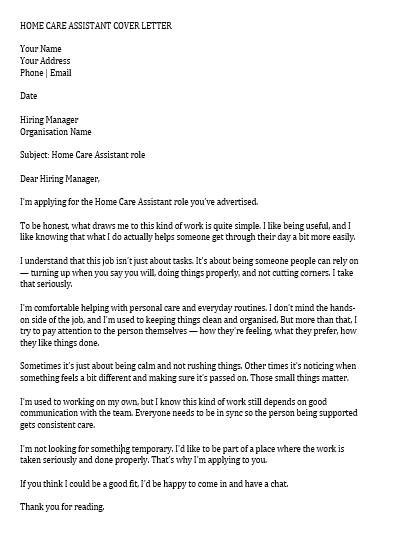
A lot of care applications end up sounding almost identical. The wording is often too polished, too structured, or filled with phrases recruiters have already read hundreds of times. In home care roles, that can create distance instead of trust.
Most employers are not expecting perfect writing. They want something that feels believable — someone who understands routines, responsibility, and the reality of supporting people in their own homes. The examples below use a simpler and more natural tone, closer to the way real candidates actually speak and write.
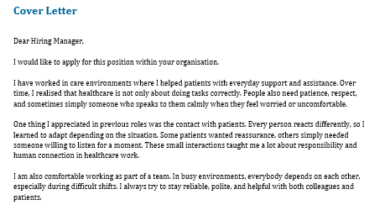
Example 1 — General Home Care Application
Dear Hiring Manager,
I saw your advert for a Home Care Assistant and thought I’d apply.
I’ve been interested in care work for a while because I like practical work that actually helps people day to day. What stands out to me about home care is that small things matter more than people think. Being on time, keeping routines steady, noticing when someone seems different — that’s usually what people remember.
I’m comfortable helping with personal care and everyday tasks, but I also understand that every person has their own way of doing things. Some clients want conversation. Others mostly want quiet support and consistency. I try to adapt instead of approaching everyone the same way.
I don’t mind working independently and I’m used to getting on with things properly without needing constant supervision. At the same time, I know communication matters in care work, especially when small details can make a difference later on.
I’d be happy to speak further if you think I could be a good fit for the role.
Yours sincerely, Your Name
Example 2 — More Experienced Candidate
Dear Hiring Manager,
After spending time working in care, I’ve realised the job is rarely about doing one big thing well. Most of it comes down to consistency.
Some visits are busy from the moment you arrive. Others are quieter. You end up learning how to adjust depending on the person and the situation. That’s probably one of the biggest parts of the role.
I’ve done a bit of everything really — helping with washing and dressing, sorting meals, supporting mobility, and making sure the home environment stays clean and safe. But honestly, the practical side becomes routine after a while. The more important part is making people feel comfortable enough that they can relax around you.
I also tend to notice small changes quite quickly. Sometimes it’s mood, appetite, or just a routine feeling slightly off. I’d rather mention something early than ignore it and realise later it mattered.
What I’m looking for now is a team that takes care seriously and values doing things properly, not just quickly.
Thank you for taking the time to read my application.
Yours sincerely, Your Name
Example 3 — Entry-Level / Beginner Profile
Dear Hiring Manager,
I’m applying for the Home Care Assistant role currently advertised by your organisation.
I know I’m still fairly new to this type of work, but I’m willing to learn and I understand the level of responsibility involved when supporting people in their homes.
What interests me about care work is that it feels useful in a very direct way. You’re helping someone get through ordinary parts of the day that might otherwise feel difficult or stressful for them.
I’m organised, calm under pressure, and comfortable with practical tasks. I also think patience matters a lot in this role. Not everybody moves at the same pace, and sometimes simply slowing things down a bit can help someone feel more comfortable.
I’d appreciate the chance to speak with you further and learn more about the role and your team.
Yours sincerely, Your Name
These examples intentionally avoid overly formal wording and rigid structure. In the UK care sector, applications often feel stronger when they sound steady, practical and realistic rather than perfectly polished.
Understanding personal finance becomes considerably more intuitive once financial flows cease to feel abstract or fragmented. Many individuals possess a