Weekly Fridge and Freezer Temperature Control Record
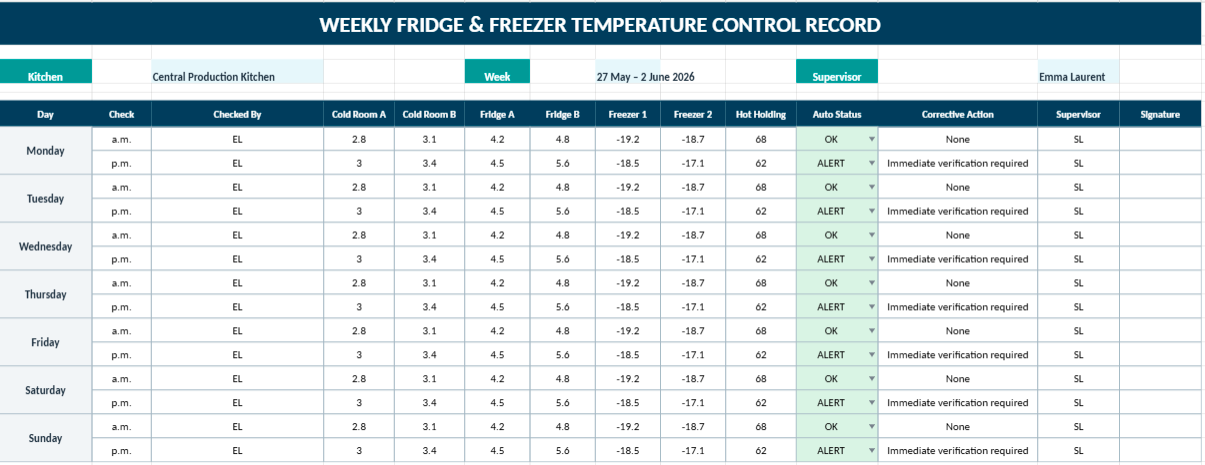
Cold chain reliability defines the true operational strength of a professional kitchen. Behind every refrigerated ingredient and frozen product stands a continuous monitoring process where temperature stability protects food quality, HACCP compliance and customer safety long before service begins. The Weekly Fridge and Freezer Temperature Control Record introduces a structured supervision system capable of revealing thermal fluctuations, documenting corrective actions and reinforcing the daily discipline required in modern catering environments. More than a simple monitoring sheet, this operational tool transforms refrigeration control into a consistent food safety strategy built around traceability, anticipation and professional reliability.
The Operational Document That Quietly Stabilises Professional Kitchens
Cold chain management rarely attracts attention when everything operates correctly. Refrigerators maintain stable temperatures, frozen products remain protected and kitchen service flows without interruption. Yet behind this apparent routine lies one of the most sensitive operational systems within the food industry. A small thermal deviation, repeated over several hours, may progressively compromise food quality long before visible spoilage appears.
This reality explains why the Weekly Fridge and Freezer Temperature Control Record remains one of the most important HACCP supervision tools in modern catering environments.
Far beyond a simple administrative table, the weekly temperature sheet creates a structured operational rhythm that helps restaurants, hotels, bakeries and institutional kitchens maintain thermal stability across all refrigeration zones. It transforms isolated checks into a continuous monitoring process capable of strengthening food safety, improving operational discipline and reinforcing long-term cold chain reliability.
Modern Kitchens Depend Upon Continuous Thermal Awareness
Professional refrigeration systems operate under constant pressure. Deliveries, repeated door openings, intensive service periods and fluctuating ambient temperatures all influence thermal performance throughout the day.
A refrigerator may appear perfectly stable during a quick inspection while developing several unnoticed temperature peaks between checks. This hidden instability represents one of the main operational risks in commercial kitchens.
The weekly temperature record introduces consistency into this environment. Instead of relying upon occasional observations, kitchen teams follow a structured routine where refrigeration behaviour becomes visible over time.
Patterns begin to emerge naturally:
- recurring fluctuations during peak service;
- unstable freezers during deliveries;
- equipment struggling overnight;
- refrigeration units reacting poorly to overload.
These operational insights often appear long before complete equipment failure occurs.
The Weekly Format Improves Operational Visibility
Daily temperature sheets remain useful for immediate supervision, yet weekly records provide a broader operational perspective.
By consolidating multiple days within a single document, managers gain a clearer understanding of refrigeration behaviour across the entire week. This structure improves the ability to identify repetitive deviations and recurring weak points.
A weekly monitoring approach also simplifies HACCP organisation. Supervisors review trends more efficiently and compare equipment performance over several operational cycles rather than isolated moments.
This broader visibility becomes particularly valuable in kitchens managing multiple refrigeration zones simultaneously.
Commercial Kitchens Rarely Depend Upon a Single Refrigeration Unit
Modern food service operations supervise a complex network of thermal environments. Each refrigeration area serves a specific operational role and requires stable temperature control to maintain food integrity.
A typical professional kitchen may monitor:
- cold rooms for meat and fish;
- dairy refrigeration units;
- frozen product storage;
- display chillers;
- preparation refrigerators;
- hot holding systems.
Each environment operates within different temperature thresholds and risk levels.
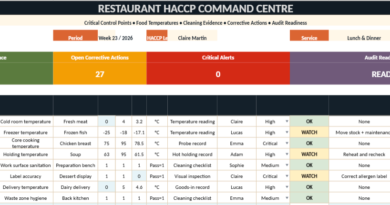
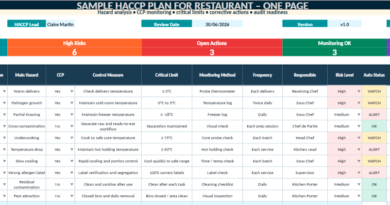
A well-designed Weekly Fridge and Freezer Temperature Control Record centralises this supervision into one coherent operational framework. Instead of scattered paperwork, kitchen teams manage all sensitive thermal zones through a structured and visually organised system.
Automated Temperature Sheets Strengthen HACCP Consistency
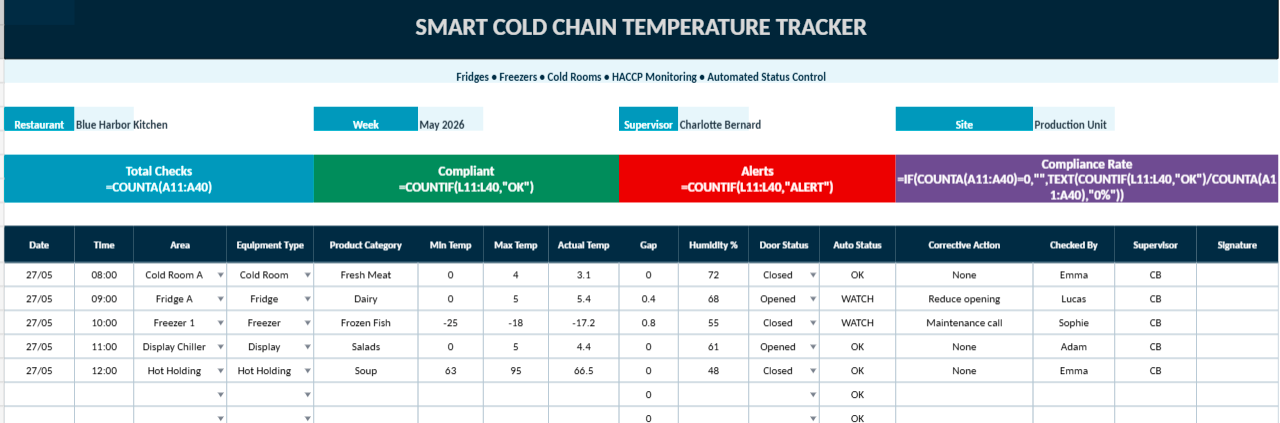
Traditional paper forms often depended entirely upon manual interpretation. Modern Excel-based temperature sheets now integrate automation features capable of improving operational accuracy significantly.
Advanced monitoring templates increasingly include:
- automatic status calculations;
- colour-coded alerts;
- compliance tracking;
- corrective action prompts;
- dashboard summaries;
- refrigeration risk indicators.
These automated systems reduce human error while accelerating decision-making.
A refrigeration unit exceeding safe thresholds immediately becomes visible through warning colours or calculated alert statuses. Supervisors no longer need to analyse every value manually during busy service periods.
This operational clarity greatly improves responsiveness.
Corrective Action Recording Reinforces Food Safety Discipline
Temperature monitoring alone does not fully protect a kitchen. The true operational value appears in the reaction that follows a deviation.
Modern weekly records therefore integrate dedicated corrective action sections allowing teams to document operational responses immediately after abnormal readings appear.
These actions may involve:
- moving products to another refrigerator;
- adjusting thermostat settings;
- reducing door opening frequency;
- isolating sensitive ingredients;
- contacting refrigeration maintenance.
This documentation demonstrates active HACCP management rather than passive record keeping.
During inspections, corrective action history often reveals the real maturity level of a kitchen’s food safety culture.
Colour-Coded Monitoring Improves Readability and Speed
Professional kitchens operate under continuous time pressure. Monitoring systems must therefore remain visually efficient.
Colour-coded Excel sheets significantly improve operational readability by making thermal conditions instantly recognisable. Green indicators confirm stable refrigeration, amber signals developing concerns and red highlights immediate HACCP intervention zones.
This visual hierarchy accelerates operational understanding without requiring lengthy interpretation.
The most effective monitoring sheets combine:
structured layouts;
automated calculations;
thermal risk indicators;
clearly separated refrigeration zones;
concise corrective action tracking.
This balance between simplicity and intelligence defines modern HACCP documentation.
Weekly Records Support Stronger Audit Preparation
Food safety inspections increasingly focus upon consistency rather than isolated readings.
Inspectors expect kitchens to demonstrate ongoing thermal supervision capable of revealing stable operational control over time. Weekly records provide precisely this form of evidence.
A well-maintained monitoring sheet demonstrates several important qualities simultaneously:
- operational discipline;
- refrigeration supervision;
- traceability;
- corrective action management;
- HACCP awareness.
Digital Excel templates strengthen this process further through automated calculations and cleaner data organisation.
The result appears more professional, easier to analyse and considerably more reliable during audits.
Refrigeration Monitoring Also Protects Financial Stability
Temperature supervision directly influences profitability within commercial kitchens.
Unnoticed thermal deviations may lead to:
- product spoilage;
- stock destruction;
- customer complaints;
- operational interruptions;
- emergency maintenance costs.
Sensitive products such as fresh meat, seafood, dairy items and prepared meals require particularly stable storage conditions. Even short-term instability may compromise both quality and financial value.
Weekly monitoring therefore functions not only as a safety measure but also as an operational cost-control mechanism.
Restaurants investing in strong refrigeration supervision generally experience fewer product losses and more stable equipment performance over time.
Digital HACCP Records Reflect the Evolution of Food Service Operations
Commercial kitchens increasingly adopt connected monitoring technologies capable of integrating refrigeration supervision into broader digital management systems.
Wi-Fi sensors, cloud-connected probes and automated temperature dashboards are gradually transforming traditional HACCP procedures into intelligent operational ecosystems.
Despite this technological evolution, structured temperature recording remains essential. Whether paper-based or digital, the weekly log sheet continues to provide the operational foundation upon which advanced monitoring systems depend.
The document itself evolves alongside the technology:
- more automation;
- clearer dashboards;
- integrated alerts;
- improved visual structure;
- stronger analytical capability.
Yet its fundamental purpose remains unchanged: protecting thermal stability across every sensitive refrigeration environment.
The Weekly Temperature Record Creates Operational Consistency
One of the greatest strengths of structured monitoring lies in the behavioural discipline it creates inside the kitchen.
Regular checks establish a continuous awareness of refrigeration conditions. Staff become more attentive to thermal behaviour, equipment stability and operational anomalies.
This consistency gradually strengthens the entire food safety culture of the establishment.
Kitchens that maintain disciplined monitoring habits generally develop:
- faster anomaly detection;
- stronger HACCP compliance;
- improved refrigeration reliability;
- greater operational confidence.
These improvements emerge progressively through routine thermal supervision rather than isolated interventions.
Refrigeration Stability Defines Professional Reliability
Customers rarely see refrigeration systems directly, yet cold chain stability influences almost every aspect of food quality behind the scenes.
Professional kitchens capable of maintaining consistent thermal control demonstrate a deeper level of operational maturity. Their monitoring systems reveal discipline, anticipation and long-term organisational stability.
The Weekly Fridge and Freezer Temperature Control Record therefore represents far more than a printable document. It becomes a silent operational safeguard connecting refrigeration management, HACCP supervision, corrective action planning and food safety culture into one structured daily routine.
In modern catering environments, thermal supervision no longer functions merely as a regulatory requirement. It increasingly defines the invisible operational backbone supporting consistency, product integrity and professional credibility.