Cash Flow Forecast Template in Excel: Anticipating Liquidity Before It Becomes a Problem
Cash flow forecasting sits at the heart of business planning. It connects sales, expenses, and timing into a single financial narrative. Whether preparing for growth, managing day-to-day operations, or seeking funding, a clear forecast helps ensure that cash remains available when it is needed most.
Cash Flow Forecast Template: A Complete Guide to Managing Business Liquidity
A business rarely collapses because it lacks ideas or customers. It collapses when it runs out of cash.
A cash flow forecast provides the visibility needed to anticipate financial pressure and maintain control over operations.
Understanding Cash Flow Beyond Profit
Financial performance is often measured through profit. Yet profit alone does not guarantee survival.
A company can record strong revenue figures while facing severe liquidity constraints. The reason lies in timing.
Cash flow reflects the actual movement of money. It captures when funds are received and when obligations must be met.
This distinction makes it one of the most critical indicators in business planning, particularly for small and growing companies.
Profit shows how well a business performs.
Cash flow shows whether it can continue operating.
Core Components of a Cash Flow Forecast Template
A cash flow forecast template structures financial data across a defined timeline, usually monthly.
Each column represents a period, while rows organize inflows and outflows into categories.
Opening Balance
The amount of cash available at the beginning of each period.
Cash Inflows
Money entering the business, including customer payments, loans, or investments.
Cash Outflows
Expenses such as salaries, rent, suppliers, and operational costs.
Closing Balance
The remaining cash after accounting for all inflows and outflows.
The Financial Logic Behind Every Forecast
Net Cash Flow = Cash Inflows − Cash Outflows
Closing Balance = Opening Balance + Net Cash Flow
This mechanism creates continuity. Each period connects to the next, forming a rolling view of liquidity.
It allows businesses to monitor whether their financial position is strengthening or weakening over time.
Why Cash Flow Forecasting Is Essential
Forecasting cash flow transforms financial management from reactive to proactive.
Instead of responding to shortages, businesses can anticipate them and act in advance.
This forward-looking approach supports key decisions, including hiring, investment, pricing strategies,
and supplier negotiations. It also plays a crucial role when seeking external financing.
In the UK, lenders and funding bodies typically require a detailed 12-month cash flow forecast
before approving loans or grants. This document demonstrates financial discipline and planning capability.
Example of a Monthly Cash Flow Forecast
Month
Opening
Inflows
Outflows
Net
Closing
January
12,000
6,000
5,000
+1,000
13,000
February
13,000
4,500
6,000
-1,500
11,500
Even a simplified model reveals important patterns. A negative net position signals pressure,
while a consistent decline in the closing balance highlights structural imbalance.
Advanced Indicators in UK Financial Practice
Basic forecasts provide visibility. Advanced models provide insight.
Burn Rate
Measures how quickly cash reserves are consumed each month.
Runway
Indicates how many months the business can operate with current cash.
Cash Buffer
Defines the minimum safe level of liquidity to avoid financial stress.
VAT Tracking
Essential in the UK to monitor output VAT versus input VAT obligations.
Common Errors That Reduce Forecast Accuracy
The reliability of a forecast depends on its assumptions. Several recurring mistakes can distort results.
Recording revenue instead of actual cash receipts
Ignoring customer payment delays
Underestimating irregular or seasonal expenses
Failing to update projections regularly
A forecast should evolve continuously. It must reflect real conditions, not static expectations.
Final Perspective: From Data to Control
A cash flow forecast template is not designed to predict the future with precision.
Its role is to provide structure, clarity, and foresight.
When used effectively, it transforms financial data into a decision-making framework.
It highlights risks early, supports strategic choices, and strengthens resilience.
Businesses that monitor cash remain stable.
Businesses that anticipate cash create growth opportunities.
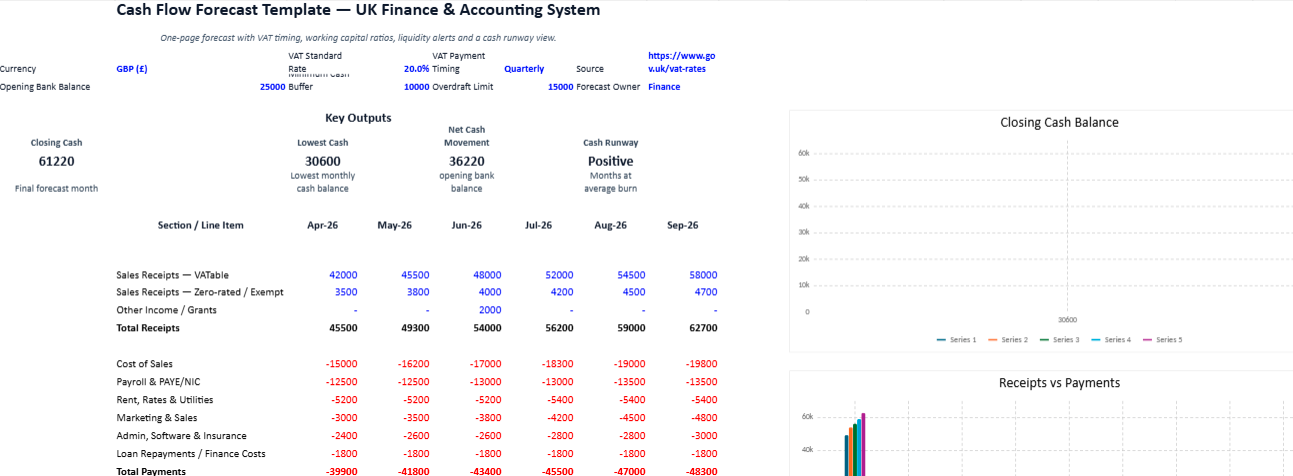
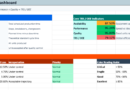
Cash Flow Forecast Dashboard — UK Finance System
Interactive one-page dashboard for forecasting receipts, payments, VAT, closing cash,
liquidity buffer and cash runway.
Closing Cash£0
Lowest Cash Balance£0
Net Cash Movement£0
Cash RunwayPositive
Closing Cash Trend
Section / Line Item
Apr-26
May-26
Jun-26
Jul-26
Aug-26
Sep-26
The dashboard updates automatically when assumptions change. The key risk signal is the lowest monthly cash balance compared with the defined buffer.
The process follows a simple logic: define the period, list expected inflows,
list expected outflows, then calculate the running balance month after month.
Step 1 — Define the forecast period
Choose a timeframe aligned with your business cycle, usually monthly over 12 months.
Step 2 — List all income sources
Group incoming cash by type and assign realistic payment timing.
Step 3 — List all expenses
Include both fixed costs and variable costs, from rent to supplier payments.
Step 4 — Calculate the running balance
Track how available cash evolves from one month to the next.
Example Structure — Simplified
Month
Opening Balance
Inflows
Outflows
Net Cash
Closing Balance
Jan
10,000
5,000
4,000
+1,000
11,000
Feb
11,000
4,500
5,500
-1,000
10,000
This simple structure already reveals useful patterns: seasonal drops,
expense spikes, delayed payments and months where liquidity becomes tighter.
Going Beyond Basic Templates
Most templates are useful starting points, but advanced cash flow models provide
stronger financial control.
Scenario analysis
Compare best case, worst case and realistic assumptions.
VAT tracking
Follow output VAT, input VAT and expected VAT payable under UK practice.
Burn rate calculation
Measure how quickly the business consumes cash each month.
Runway estimation
Estimate how many months the business can survive with current cash.
Variance tracking
Compare forecast figures with actual cash received and paid.
Modern finance teams increasingly rely on dynamic tools rather than static spreadsheets,
because traditional templates can become limited when cash movements, tax timing and
business scenarios become more complex.
Common Mistakes in Cash Flow Forecasting
Even a well-structured forecast can fail when assumptions are weak or outdated.
Confusing revenue with cash received
A sale is not cash until the payment is actually collected.
Underestimating payment delays
Late customer payments can quickly create pressure on liquidity.
Ignoring seasonal fluctuations
Some months naturally bring lower sales or higher operating costs.
Failing to update forecasts
A forecast must evolve as real figures replace assumptions.
A forecast is not a fixed document. It must evolve as your business changes.
How to Use a Cash Flow Forecast Strategically
A well-built forecast becomes a decision-making tool. It helps management
understand when to spend, when to wait and when to secure additional funding.
Decide when to hire
Check whether payroll growth is sustainable.
Evaluate investment opportunities
Test whether the business can absorb new commitments.
Negotiate supplier terms
Adjust payment timing to protect working capital.
Plan marketing campaigns
Align spending with expected cash availability.
Secure financing
Use the forecast to support funding discussions.
Accelerate collections
Identify when customer payments need to be followed up faster.
Strategic marketing rarely rewards improvisation for long. Behind every successful campaign lies a structured understanding of positioning, customer behaviour, segmentation,
Precision rarely fails loudly at the beginning. Industrial controllers, probes and calibration instruments usually continue operating while small deviations quietly