
Training Feedback Form : 4 Templates in Excel
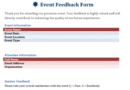
Download Training Feedback Form templates in Excel ⬇️
We’ve all experienced it—sitting through a training session, whether online or in-person, only to be handed a sheet or link at the end: the standard training feedback form. To some, it seems perfunctory. Yet others see an opportunity to share candid opinions. The reality, however, is that these forms may represent one of professional development’s most undervalued assets.
As businesses constantly evolve, so too must learning and instruction. But without insight, how can organizations verify their training truly resonates? Comments—sincere, structured remarks—provide the answer. And the inception point? The feedback form itself.
At its core, a training feedback form simply facilitates trainee voices. Properly administered, though, it acts as a strategic intelligence source. The aim transcends superficial “Did you like it?” inquiries, targeting instead what succeeded, faltered, and how future sessions may progress.
Whether paper passed hand-to-hand or a brief online questionnaire, these forms grant participants a platform. Their input, if applied conscientiously, is invaluable.
Training Feedback Form – Designing for Engagement
Let’s acknowledge honesty: people are busy. A labored feedback process will go neglected—or hastily completed. Then how do you construct one attracting full involvement?
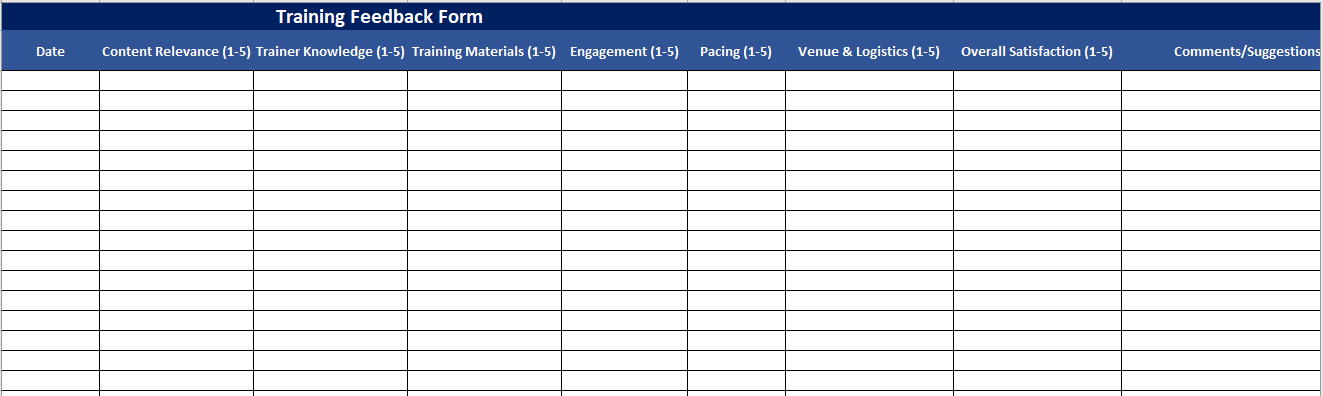
Prioritize clarity and brevity. Nobody wants a 50-question slog. Focus instead on essentials like:
- Was the material beneficial?
- Did the trainer effectively communicate?
- Was the pace appropriate?
- Did you walk away feeling as though you gained useful insights?
A Balance of Numbers and Personal Perspectives
Quantitative data is helpful for identifying patterns over time, but sometimes individuals want to expand on their experiences. For instance, commenting that “the second module progressed too rapidly” or noting how “the anecdote about client calls really resonated.”
Including both quantitative and qualitative feedback provides a fuller picture.
Anonymity Encourages Transparency
If respondents believe their identities are attached to their answers, sincerity may suffer—especially for those who did not enjoy the session.
Anonymous surveys invite candidness. This is where the most honest reflections live.
Capitalizing on the Strengths of Feedback
Organizations invest heavily in training—time, money, planning. So why wouldn’t they want to understand if efforts bore fruit?
Properly leveraging feedback can:
Spot Issues Early
Say a new module launched across five divisions. If 70% mention examples seem dated, that signals content needs updating before the sixth team experiences it.
Fine-Tune Delivery
Perhaps feedback praises content but cites disengagement during presentations. This indicates a delivery adjustment, not content revision. Awareness enables enhanced engagement going forward.
Inform Better Future Training
Occasionally, feedback influences not just past sessions but future ones. Attendees may request expanded real-world case studies or supplemental sessions. Such input benefits learning teams.
Tailor Forms to Training Type
Not all training is identical—nor should feedback forms be uniform. A technical bootcamp differs greatly from a leadership conference.
Specialized training necessitates specialized feedback. For instance:
Technical Courses
- Were the session elements comprehensible?
- Did the activities effectively build your skills?
- Was technical terminology clearly explained or did confusion remain?
Hands-on Exercises
- Did role-playing foster new understanding?
- Was engagement maintained throughout or did attention wander?
- Can you apply what you gained to your day-to-day work?
Digital Events
- Was navigation straightforward or perplexing?
- Did the presenter sustain focus online or did minds drift?
- Were additional materials still available later for review?
Tailoring feedback forms with purpose generates better outcomes.
Feedback Aids Not Just Trainers But Learners Too
Consider feedback from another view: forms prompt reflection. Responding to queries including “What stuck with you most?” or “What could be improved?” compels reexamining the session privately.
- This reinforces concepts
- It aids recall
- It enhances retention of the material
Maximizing Insights From Gathered Input
Next, once forms are submitted—whether paper copies or digital responses—what then?
The worst option is neglecting them. Best is utilization.
- Discern repeating themes
- Are certain parts universally favored?
- Is more real-world context frequently proposed?
Share feedback with instructors not to find fault but to facilitate development.
Showing staff their views make a difference—a brief note like “Thanks for your comments—we’ll extend question time moving ahead”—goes far in feeling heard.
When people see feedback spurs amendment, they’re apt to offer thoughtful perceptions again down the road.
How Technology Enables Streamlining
No more must evaluation conclude with manual compilation from printed sheets. Tools like:
- Google Forms
- Microsoft Forms
- SurveyMonkey
…now easily facilitate design, distribution, and examination of feedback.
Even better, if one’s company utilizes a learning management system (LMS), you can usually construct the structure directly into the teaching module. That way, individuals complete it before departing the webpage.
Furthermore, the information? It’s all there—organized, visualized, and prepared for your next team meeting.
Candid Chat: How to Obtain Honest Feedback
Let’s not pretend: at times persons simply click “5” all the way down the form to get it over with. That’s why design and culture matter.
- Keep the form succinct and focused
- Pose just one or two open-ended questions at the end
- Motivate managers to clarify why feedback is significant—not just for the company, but for the team
And don’t forget: if you truly want to comprehend how a training transpired, occasionally it’s worth following up with a brief 10-minute conversation. Employ the form as a starting point, not the closing word.
Constructing a Culture of Feedback
When feedback becomes a standard part of the learning process, something shifts.
- Employees stop seeing training as a “check-the-box” activity
- Trainers get better
- Materials improve
- The whole process becomes more responsive
Feedback forms play a small but important role in that transformation. They’re simple, sure. But they’re also powerful—when people believe their voice matters.
Final Thoughts
A training feedback form might seem like just another component of the training puzzle.
But it’s more than that.
It’s a mirror.
It reflects what went well, what could’ve gone better, and where we go next.
In a workplace where continuous growth is expected, learning cannot be optional. It is imperative for professional development. The feedback form following a workshop or seminar should not be an afterthought, hastily thrown together. It must be carefully crafted to truly understand how to improve future sessions and maximize engagement.
A variety of question types will elicit a diversity of responses, revealing both successes and shortcomings. No training is complete without understanding how well objectives were achieved and possibilities for enrichment explored.
By soliciting substantive feedback in nuanced ways, each event can iteratively be enhanced, ensuring employees remain enthusiastic lifelong learners.
After all, feedback is not the conclusion of a lesson—but rather the inception of progress still to come.
How to Roll Out an Effective Training Feedback System
So you want to implement a training feedback system to successfully gauge training sessions, but how do you ensure it becomes a valuable part of the process rather than just another checkbox? It requires strategy, continuity and simplicity.
Clarify Your Training Goals
Initially identify your training aims. Before designing a form, pause and assess:
What is the purpose of this training?
Do you hope to enhance technical proficiency? Strengthen communication abilities? Confirm adherence? Orient newcomers?
Your objectives should directly affect the questions posed.
For instance:
- A cybersecurity session ought to question how self-assured employees feel applying the knowledge.
- A time management training may need inquiries regarding practical takeaways.
If the questions don’t align with your goals, the feedback won’t provide what you truly need to know.
Maintain Brevity While Retaining Impact
People are happy offering feedback if it doesn’t feel like homework.
Aim for a 3 to 5 minute completion as a good rule. You don’t necessity 20 questions to gain valuable understanding.
Consider a mix of:
- 4 to 6 rating inquiries (1-5 or 1-10 scale)
- 1 to 2 open-ended questions
Keep it tidy and lucid.
Present the Form at the Right Moment
Timing is pivotal. You want feedback while fresh in participants’ recollections but not so soon they lack reflection time. Some choices include:
- Right after training ends (ideal for initial views)
- A day or two later (better for thoughtful replies)
- After a month (for long-term retention and implementation insights)
Undoubtedly, sending two forms—one promptly and one follow-up later—could afford a more nuanced view of how effectively the training actually benefited participants.
Ensure Accessibility on Any Device
Feedback forms should meet participants where they are.
Whether hurrying to a meeting or mobile, platforms like Google Forms, Microsoft Forms, and Typeform ensure participation isn’t limited by location.
Company learning management systems (LMS) can incorporate built-in modules when built for versatility. A responsive form attuned to any device markedly improves yield and quality of collected insights.
Involve Managers as Feedback Advocates
Critical partners beyond learning teams, managers can spur meaningful engagement.
By encouraging training participation and stressing feedback’s importance in one-on-ones, supervisors demonstrate priority.
When led by management, contribution gains significance for employees.
Analyze Results Thoroughly and Share Insights
Beyond a cursory review, dissecting the data exposes undercurrents.
- Recurring themes
- Unforeseen difficulties
- Exemplary quotes
These offer material for boosting subsequent offerings when relayed to impacted roles.
But circulate findings farther still to signal feedback’s impact.
Notify instructors and participants how input shapes future direction to incentivize thoughtful contributions next time.
Examples: Tailoring Feedback to the Training Format
Tailored to modality, formative questions gauged training’s success.
Assessing software mastery post-session:
- Did confidence consolidate?
- Were the practice activities helpful?
- Did they provide value for improving your skills?
The trainer skillfully conveyed even complex topics with clarity and examples. Their presentation style ensured all attendees comprehended the material.
Example 2: Leadership Development Program
- Did the program content align with your goals for strengthening your leadership abilities?
- Which insight that could immediately boost your leadership performance stood out the most?
- Would you advise others in your organization to participate in this opportunity?
Example 3: Health & Safety Compliance
- Were all safety protocols described in enough detail to understand their importance?
- Did any scenarios discussed mirror real workplace dilemmas you have faced or may face?
- Do you now feel more prepared to respond appropriately in an emergency at work after attending?
By crafting training feedback forms with care like this, you achieve more than simple data collection—you obtain the meaningful feedback necessary.
Creating a Feedback Loop That Truly Works
The most impactful feedback systems go beyond form filling. They ensure feedback leads to action.
A full feedback loop may appear as:
- Deliver a training session
- Invite feedback through a streamlined yet insightful form
- Analyze and summarize the responses
- Share insights with pertinent parties
- Modify training substance or approach based on feedback
- Communicate adjustments back to past participants
Repeating this systematically builds trust over time by demonstrating employee input matters.
Gradually, training programs strengthen in quality, relevance, and effectiveness.
⬇️
Training Feedback Form -Excel
Feedback Commences the Learning, Not Concludes It
It’s easy to view feedback forms as a final task to complete a session.
However, shifting perspectives reveals something significant:
Feedback is where genuine learning originates.
It indicates if objectives were fulfilled.
It unveils possibly unnoticed gaps.
And it provides the comprehension necessary for growth—not just of training content but of individuals.
So the next time you facilitate a session, endeavor to consider participants’ feedback forms with care.
While maintaining simplicity, conduct the review as a genuine dialog between people.
Above all, apply insights gained to future events.
For when feedback flows as discussion rather than dealings, spectacular outcomes emerge.
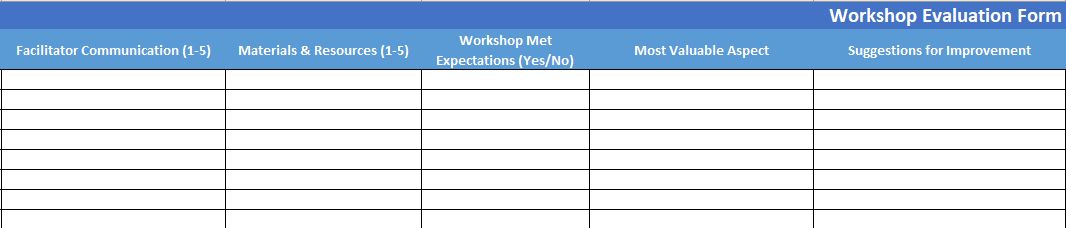
Training Feedback Form – Workshop ⬇️
⬇️
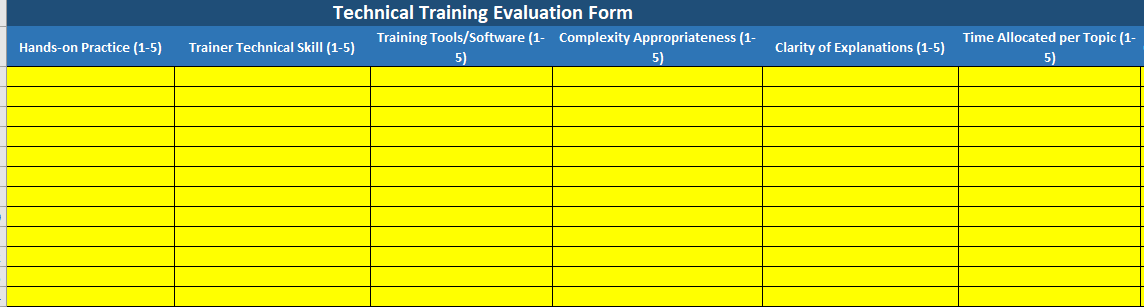
Training Feedback Form – Technical Training
⬇️
Training Feedback Form – Post-event Feedback