Sample HACCP Plan for Restaurant in Excel – Automated Food Safety Dashboard
The Premium Sample HACCP Plan for Restaurant introduces a modern approach to food safety management designed for professional kitchens operating under constant operational pressure. More than a traditional HACCP spreadsheet, this intelligent Excel system centralises hazard analysis, CCP monitoring, corrective actions, cleaning supervision and audit preparation inside one automated command centre. Refrigeration controls, cooking verification, allergen management and sanitation follow-up become part of a continuous operational workflow where every deviation, every control point and every corrective measure remains visible in real time. Structured dashboards, protected automation and dynamic monitoring transform daily HACCP management into a clearer, faster and far more reliable operational process for restaurants, hotels and commercial food service environments.
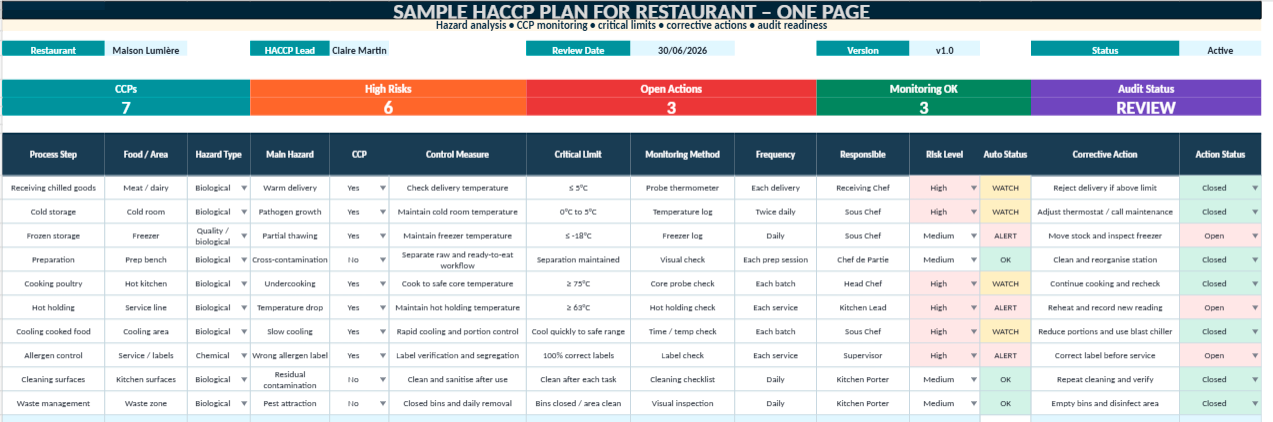
One-Page Sample HACCP Plan for Restaurant – Excel Template
A premium one-page HACCP Excel sheet designed for restaurants, commercial kitchens and food service operations.
This automated template centralises hazard analysis, CCP monitoring, critical limits, corrective actions and audit readiness inside one professional dashboard.
The Intelligent Food Safety Workbook That Transforms Restaurant Control into a Structured Operational System
Food safety in modern restaurants no longer depends upon isolated temperature checks or scattered paper forms. Professional kitchens now operate inside increasingly complex environments where refrigeration monitoring, allergen supervision, sanitation control, cooking verification and corrective actions continuously interact throughout the day. Every service period generates operational risks capable of affecting food quality, customer safety and regulatory compliance if supervision becomes fragmented or inconsistent.
This operational reality explains why restaurants increasingly move toward intelligent HACCP management systems built around structured dashboards, automated monitoring and centralised operational visibility.
The Premium Sample HACCP Plan for Restaurant reflects this evolution. More than a traditional HACCP spreadsheet, the workbook functions as a complete operational command centre designed to organise food safety supervision across the entire restaurant ecosystem.
Instead of treating HACCP as isolated paperwork completed after service, the workbook transforms monitoring into a continuous operational process connected to the real rhythm of the kitchen.
Modern HACCP Systems Depend Upon Operational Visibility
Professional kitchens generate large quantities of sensitive operational information every day. Refrigeration readings, delivery checks, sanitation records, allergen verification and corrective actions all contribute to the overall reliability of food service operations.
When these controls remain separated across multiple documents, operational supervision becomes fragmented. Important information may disappear inside disconnected records. Corrective actions may remain incomplete. Thermal deviations may become difficult to track over time.
The Premium HACCP workbook introduces a different structure entirely. The system centralises all major food safety activities inside interconnected monitoring sheets capable of communicating operationally with one another.
This creates a far more intelligent supervision environment where managers immediately identify unresolved deviations, high-risk process steps, critical control points, pending corrective actions and recurring operational weaknesses.
The result strengthens both clarity and responsiveness during daily kitchen operations.
The Dashboard Becomes the Operational Heart of the HACCP Plan
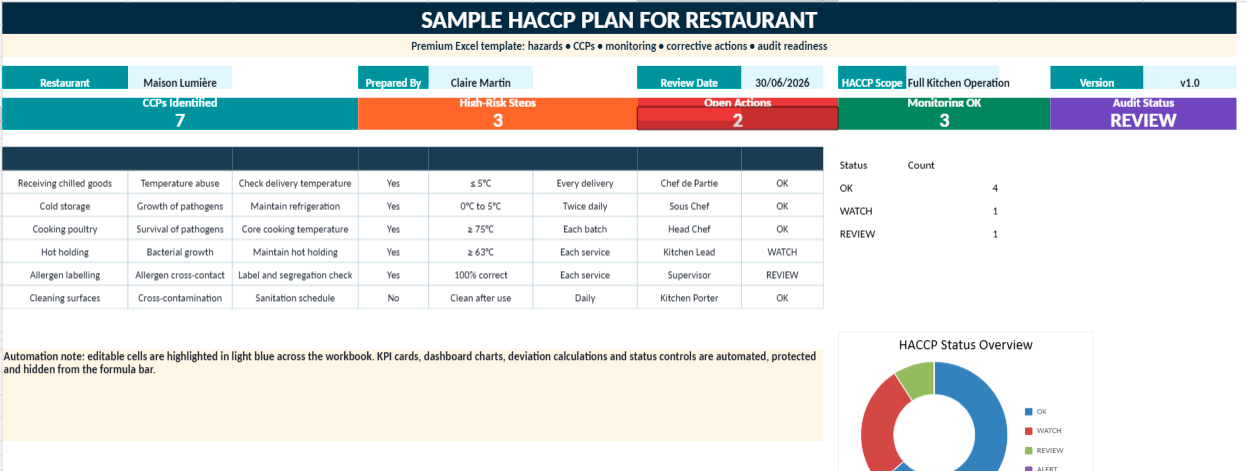
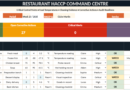
The central dashboard functions as the visual nerve centre of the workbook. Instead of forcing managers to search through multiple files, the dashboard consolidates critical information into one simplified operational overview.
Automated indicators instantly display the overall food safety condition of the establishment.
Dashboard Indicator
Operational Purpose
CCPs Identified
Displays how many critical control points are actively monitored
High-Risk Steps
Highlights process stages carrying elevated food safety risk
The HACCP Plan Matrix Organises the Entire Kitchen Workflow
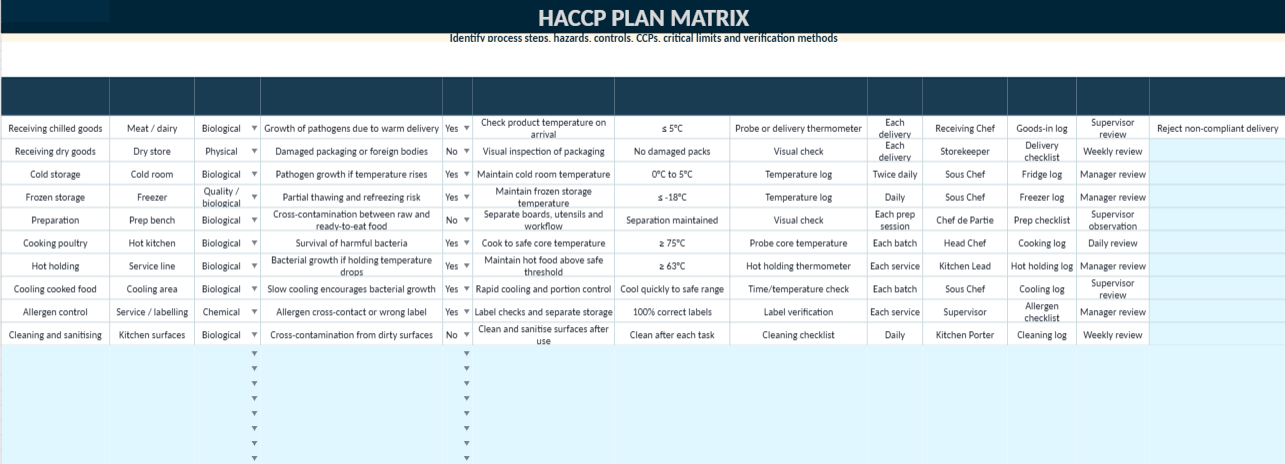
One of the strongest elements of the workbook lies in the HACCP Plan Matrix itself. This section structures food safety supervision according to the real operational flow of the restaurant.
Instead of generic HACCP theory, the matrix follows actual kitchen activities such as goods receiving, cold storage, frozen storage, food preparation, cooking, cooling, hot holding, allergen supervision and sanitation.
Each operational step receives its own structured analysis connecting hazards, controls, monitoring procedures and verification methods.
HACCP Element
Operational Role
Hazard Identification
Defines biological, chemical or physical food safety risks
Critical Control Point
Identifies process stages requiring strict operational control
Critical Limits
Defines measurable safety thresholds such as temperatures or time limits
Monitoring Method
Explains how kitchen teams supervise each control point
Verification
Confirms whether controls remain effective over time
This structure transforms the HACCP plan into a living operational document rather than static compliance paperwork.
Hazard Analysis Becomes Easier Through Automated Risk Evaluation
Risk assessment often represents one of the most difficult parts of HACCP implementation. Many kitchens struggle to prioritise hazards consistently across multiple operational stages.
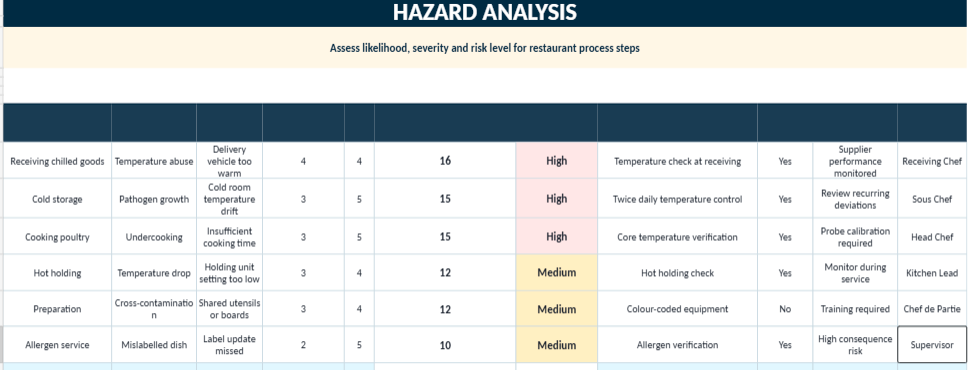
The workbook simplifies this process through an automated Hazard Analysis sheet capable of calculating risk scores dynamically.
Likelihood and severity values combine automatically to generate structured risk classifications: Low, Medium and High.
This automation improves analytical consistency while reducing manual calculation errors.
More importantly, it allows managers to visualise which process steps require the highest operational attention.
CCP Monitoring Evolves Beyond Simple Temperature Logs
Traditional HACCP systems frequently reduce monitoring to isolated temperature sheets. The Premium workbook expands this concept considerably.
The CCP Monitoring section supervises multiple operational variables simultaneously: refrigeration temperatures, cooking temperatures, hot holding controls, allergen verification, corrective actions and responsible personnel.
Automated status indicators continuously evaluate operational conditions in the background.
Automated Status
Meaning
OK
Operational conditions remain fully compliant
WATCH
Minor deviations require closer supervision
ALERT
Critical limits are exceeded and immediate corrective action becomes necessary
Because the calculations remain hidden and protected, users interact only with editable operational fields while the dashboard performs analysis automatically in the background.
Corrective Actions Become Structured Operational Workflows
Food safety systems lose credibility when corrective actions remain incomplete or poorly documented.
The workbook addresses this weakness through a dedicated Corrective Action Register capable of tracking incidents from detection to final verification.
Corrective Action Element
Operational Objective
Incident Description
Defines the operational deviation or non-compliance
Immediate Response
Protects products and stabilises the situation quickly
Root Cause Analysis
Identifies the original source of the problem
Responsible Owner
Assigns accountability for corrective execution
Verification Status
Confirms whether the corrective action solved the issue
This structure transforms corrective action management into a real operational follow-up system rather than occasional note-taking.
Over time, the restaurant builds a valuable operational history capable of revealing recurring weaknesses and long-term performance trends.
Automation Improves Reliability Without Complicating Daily Use
One of the most important strengths of the Premium HACCP workbook lies in its balance between automation and usability.
The system integrates protected hidden formulas, automated KPI calculations, dynamic status indicators, conditional formatting, automated dashboards and editable operational zones.
Kitchen teams therefore focus only on entering operational information while the workbook itself performs calculations and analysis invisibly in the background.
This approach dramatically reduces user error while preserving simplicity during busy service periods.
Audit Preparation Becomes a Permanent Operational State
Many restaurants experience intense pressure before HACCP inspections. Missing records, incomplete signatures and unresolved deviations often create unnecessary stress.
The Premium HACCP workbook reduces this problem significantly by maintaining continuous operational visibility across all critical food safety activities.
Managers immediately visualise unresolved actions, missing checks, high-risk process steps, monitoring performance and audit readiness status.
The restaurant gradually moves away from reactive inspection preparation toward continuous operational control.
The HACCP Workbook Reflects the Evolution of Modern Restaurant Management
Professional kitchens increasingly depend upon structured operational intelligence rather than fragmented paperwork. Food safety now intersects with workflow organisation, team accountability, traceability and real-time decision-making.
The Premium Sample HACCP Plan for Restaurant reflects this broader evolution.
It transforms HACCP supervision into an integrated operational ecosystem where hazard analysis, CCP monitoring, corrective actions and audit preparation continuously interact inside one intelligent Excel environment.
More importantly, it introduces clarity, structure and operational confidence into one of the most sensitive aspects of restaurant management: protecting food safety consistently, every day, under real kitchen conditions.
Premium Sample HACCP Plan for Restaurant – Excel Sheet
This Excel sheet is designed as a complete HACCP planning system for restaurants and commercial kitchens.
It brings together hazard analysis, critical control point monitoring, corrective action tracking,
cleaning supervision and audit readiness inside one structured and automated workbook.
📊 HACCP Plan Dashboard
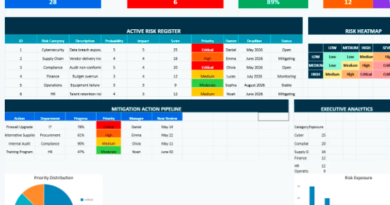
A visual dashboard summarises CCPs, high-risk steps, open corrective actions,
monitoring results and audit readiness in one clear management view.
🧩 HACCP Plan Matrix
The matrix organises each restaurant process step with hazards, control measures,
critical limits, monitoring methods, responsible staff and verification notes.
⚠️ Hazard Analysis
A dedicated risk sheet evaluates likelihood, severity and risk level to help managers
identify the most sensitive stages of the kitchen workflow.
🌡️ CCP Monitoring
The monitoring sheet tracks cold storage, freezer control, cooking temperatures,
hot holding and allergen verification with automated status indicators.
🛠️ Corrective Actions
Every deviation can be recorded with the immediate response, root cause, owner,
due date and verification status for stronger HACCP traceability.
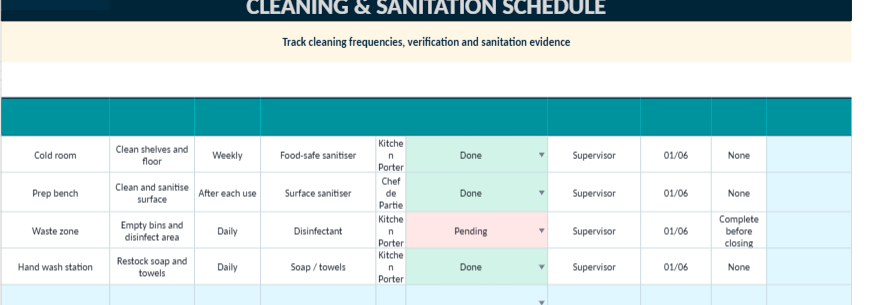
🧽 Cleaning Schedule
The sanitation sheet supports daily cleaning control, responsible staff assignment,
product tracking and verification of hygiene tasks.
This workbook transforms HACCP planning from scattered paperwork into a premium,
automated and audit-ready food safety control system.
Building a Dynamic, Automated and Visually Powerful Dashboard for Modern Marketing Teams Marketing performance no longer revolves around intuition alone.