Food Temperature Log Sheet in Excel
Temperature control defines the hidden rhythm of every professional kitchen. Behind refrigerated storage, chilled preparation zones and frozen stockrooms lies a continuous operational challenge where a few unnoticed degrees may compromise product quality, HACCP compliance and food safety standards. Modern restaurants increasingly rely upon structured Food Temperature Log Sheets to supervise thermal stability in real time, detect emerging deviations and strengthen the reliability of their cold chain management. This advanced guide explores how automated monitoring sheets, connected refrigeration control and intelligent HACCP tracking systems are transforming temperature supervision into one of the most strategic pillars of contemporary food service operations.
The Professional HACCP Record That Quietly Protects Every Commercial Kitchen
Temperature control shapes the invisible backbone of food safety. Every refrigerated ingredient, every chilled preparation and every frozen product depends upon stable thermal conditions long before a meal reaches a customer’s table. Commercial kitchens therefore operate within a delicate balance where a few unnoticed degrees may separate operational excellence from product loss, regulatory exposure or serious sanitary risk.
This reality explains why the Food Temperature Log Sheet remains one of the most important HACCP control documents in modern food service environments.
Far beyond a simple checklist, the temperature log has evolved into a strategic monitoring tool capable of documenting thermal stability, revealing recurring fluctuations and strengthening the operational discipline of restaurants, hotels, bakeries, catering facilities and institutional kitchens.
Modern kitchens no longer rely solely upon occasional visual checks. Temperature management increasingly functions as a continuous operational process supported by digital thermometers, connected probes, automated alerts and structured recording systems. The Food Temperature Log Sheet sits at the centre of this transformation.
Temperature Stability Defines the Real Reliability of a Kitchen
Many refrigeration problems emerge gradually rather than dramatically. A cold room rarely fails without warning. More often, small thermal deviations appear during deliveries, intensive service periods or repeated door openings. These fluctuations may initially seem harmless, yet they progressively weaken the stability of sensitive food products.
The challenge becomes particularly serious in high-volume kitchens where multiple refrigeration zones operate simultaneously:
- chilled preparation areas;
- frozen storage units;
- refrigerated display cabinets;
- dairy storage;
- meat preservation rooms;
- hot holding equipment.
A structured temperature logging system creates operational visibility across these sensitive environments. Instead of relying upon isolated readings, kitchen teams build a continuous thermal history capable of revealing emerging risks before they become critical incidents.
The Modern HACCP Log Sheet Extends Beyond Compliance
Traditional temperature logs once served primarily as inspection paperwork. That approach has changed considerably.
Restaurants increasingly use advanced log sheets as operational management tools rather than administrative obligations. Well-designed records help teams understand how refrigeration equipment behaves throughout the day and identify patterns associated with instability.
An effective Food Temperature Log Sheet supports several essential objectives simultaneously:
- documenting compliance;
- reducing product loss;
- improving staff accountability;
- strengthening HACCP audits;
- anticipating refrigeration issues;
- protecting food quality.
This broader operational role explains why modern kitchens invest heavily in visually structured and partially automated monitoring systems.
Automated Temperature Logs Transform Daily HACCP Management
The rise of digital monitoring has profoundly changed thermal supervision in professional catering environments.
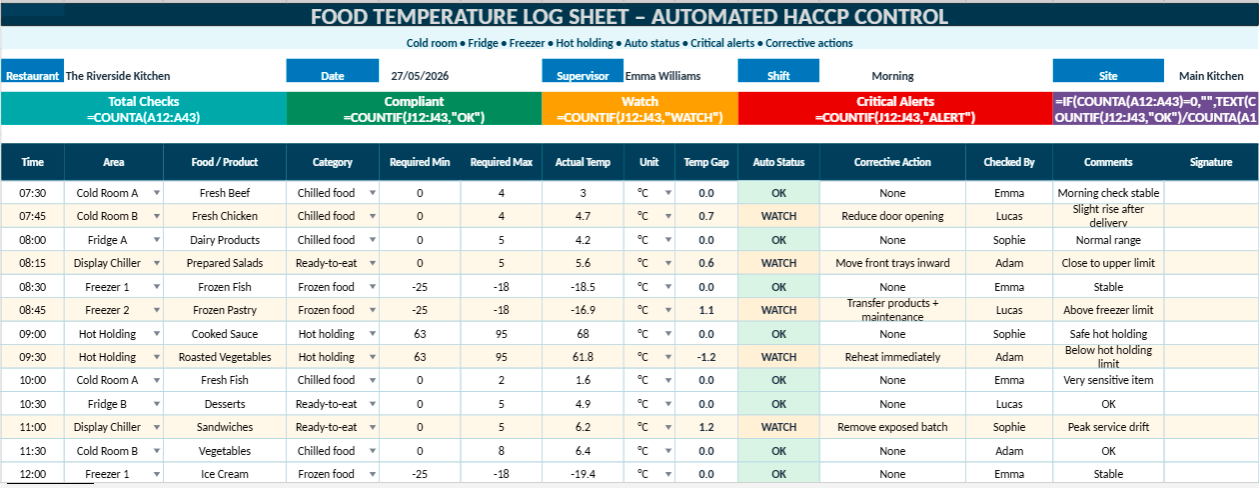
Automated Excel temperature logs now integrate:
- conditional alerts;
- compliance indicators;
- automatic status calculations;
- colour-coded risk levels;
- dashboard summaries;
- corrective action tracking.
This automation reduces manual errors while improving reaction speed. Kitchen supervisors immediately identify critical areas requiring attention instead of manually analysing dozens of isolated entries.
A colour-based system provides particularly strong operational clarity. Green status indicators confirm compliant temperatures, amber highlights early deviations and red signals immediate intervention requirements. Such visual organisation accelerates decision-making during busy service periods.
Cold Rooms Require Much More Than Occasional Checks
Cold rooms represent some of the most sensitive thermal environments within commercial kitchens. Their stability directly affects meat preservation, dairy quality, prepared foods and high-risk ingredients.
Yet cold rooms face constant operational stress:
- repeated opening cycles;
- heavy product loading;
- fluctuating external temperatures;
- ventilation strain;
- compressor fatigue.
A properly maintained temperature log sheet allows managers to monitor these conditions continuously and identify unusual behaviour before refrigeration failure occurs.
Modern HACCP procedures increasingly favour continuous monitoring rather than isolated manual inspection. This evolution pushes temperature records towards more intelligent and structured formats capable of supporting real operational analysis.
Hot Holding Monitoring Becomes Equally Critical
Cold storage often receives most attention within HACCP systems, yet hot holding temperatures play an equally important role in food safety.
Prepared dishes maintained below safe thresholds may rapidly enter bacterial danger zones. Commercial kitchens therefore monitor hot holding units with the same rigour applied to refrigeration systems.
A comprehensive Food Temperature Log Sheet integrates both cold and hot control areas within a single operational structure. This unified approach simplifies supervision while improving overall kitchen consistency.
The most effective systems create a thermal map of the kitchen where all sensitive zones remain visible within one coordinated dashboard.
Connected Probes and Digital Sensors Redefine Monitoring Standards
The emergence of Wi-Fi probes and cloud-connected temperature sensors has accelerated the modernisation of food safety management.
Restaurants increasingly install systems capable of transmitting live temperature readings directly to smartphones or cloud dashboards. These technologies allow managers to supervise refrigeration stability even outside operating hours.
Connected monitoring introduces several important operational advantages:
- real-time alerts;
- automatic historical records;
- remote supervision;
- centralised multi-site management;
- faster corrective action response.
The traditional paper-based log remains valuable, yet digital integration dramatically increases monitoring precision.
This technological evolution moves commercial kitchens closer to industrial-quality environmental supervision systems.
Corrective Actions Matter as Much as the Temperature Reading Itself
A temperature deviation alone does not define the effectiveness of a HACCP process. The real operational value appears in the response strategy implemented afterwards.
Modern temperature logs therefore include dedicated corrective action sections allowing teams to document operational decisions immediately after an incident.
Typical actions may involve:
- transferring products;
- adjusting thermostat settings;
- isolating affected batches;
- reducing door opening frequency;
- contacting maintenance services.
This documentation demonstrates active risk management during inspections and strengthens the overall credibility of the establishment’s food safety culture.
Visual HACCP Dashboards Improve Operational Clarity
Commercial kitchens operate within fast-moving environments where staff require rapid access to critical information.
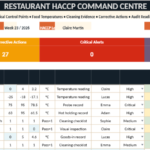
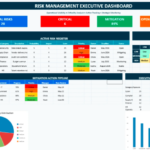
Visual dashboards integrated into Excel temperature logs greatly improve readability and operational responsiveness. Instead of scanning large volumes of numerical data, supervisors immediately recognise areas requiring attention through colours, charts and KPI indicators.
Advanced temperature log systems often include:
- compliance percentage trackers;
- thermal risk summaries;
- alert counters;
- efrigeration performance indicators;
- automated status calculations.
This visual approach supports much faster decision-making during intensive service periods.
Temperature Logging Protects More Than Regulatory Compliance
Food safety records often appear administrative from the outside. In reality, they directly influence financial stability.
A properly managed temperature monitoring system helps reduce:
- product waste;
- refrigeration downtime;
- spoilage incidents;
- emergency maintenance costs;
- customer complaints.
Restaurants handling premium products particularly benefit from strong thermal supervision. High-value ingredients require exceptionally stable environmental conditions to maintain quality standards.
The temperature log therefore becomes both a safety tool and a profitability instrument.
Multi-Fridge Monitoring Reflects the Complexity of Modern Kitchens
Large commercial kitchens rarely depend upon a single refrigeration unit. Most operations supervise multiple thermal zones simultaneously, each with different requirements and risk profiles.
A well-designed Food Temperature Log Sheet must therefore remain flexible enough to handle:
- refrigerators;
- freezers;
- blast chillers;
- display chillers;
- preparation rooms;
- hot holding equipment.
Modern one-page monitoring systems simplify this complexity through structured layouts capable of centralising all thermal supervision within a single operational document.
This consolidation improves oversight while reducing paperwork fragmentation.
Food Safety Culture Begins with Consistent Monitoring Discipline
The strongest HACCP systems are not built solely upon technology. They depend upon consistency.
Temperature logging establishes a routine of continuous observation within the kitchen environment. Staff become more attentive to refrigeration behaviour, product sensitivity and operational anomalies.
This discipline gradually shapes a stronger food safety culture across the entire establishment.
Kitchens that maintain rigorous monitoring habits generally develop greater operational stability, faster problem detection and improved sanitary resilience over time.
The Food Temperature Log Sheet Remains a Strategic Operational Tool
Commercial kitchens continue evolving towards more intelligent, connected and automated monitoring systems. Yet the fundamental objective remains unchanged: maintaining thermal stability capable of protecting food quality and customer safety.
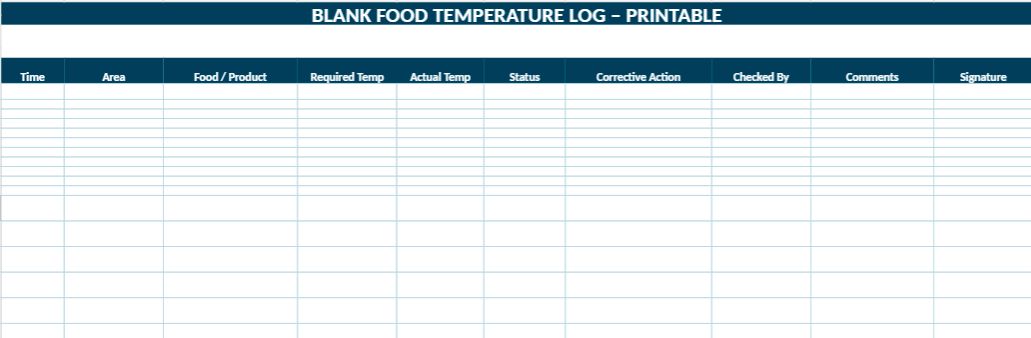
The modern Food Temperature Log Sheet no longer functions merely as a printable record. It acts as a structured operational framework connecting refrigeration control, HACCP supervision, corrective action management and real-time decision support.
In high-performance food service environments, temperature monitoring quietly becomes one of the strongest indicators of operational maturity, sanitary discipline and professional reliability.