Event Feedback Form in Excel and Word
Recommandés



Download Excel and Word Event Feedback Form ⬇️
Gatherings bring individuals together, whether a team summit, product launch, customer seminar, or community talk. Considerable effort, resources and thoughtful planning are required to coordinate such events. But once everyone departs or signs off, an important question lingers — was it worthwhile?
Beyond convenience, impact matters. Did presenters engage attention? Was the format constructive? Did attendees feel their expectations were met, or perhaps missed in unexpected ways?
Organizers rely on a basic yet potent tool to get answers — the feedback form.
Feedback: More Than Courtesy, Essential Practice
Some treat post-event surveys as a polite gesture, a mere “nice-to-have.” However, the most effective organizations approach them differently, not seeing the form as an afterthought but as a blueprint for advancement.
Form structure impacts results. General ratings and thoughts alone are insufficient. A quality feedback form invites reflection, allowing people space to express helpful and unhelpful aspects. It also encourages honesty without pressure.
First Define Objectives
Before form design, consider — what do we aim to learn?
- If testing a new format or speaker, inquire specifically about that.
- If focusing on networking, explore whether useful connections formed.
Vague questions yield vague answers; targeted questions produce meaningful feedback.
Design for Genuine Responses
People more willingly complete brief, clear, simple forms. Most attendees don’t mind offering feedback, but don’t want an exam.
A structure working well includes:
- 3–5 quick rating questions on satisfaction, speaker performance and content relevance.
- 1–2 open-ended questions such as:
- “What was the most useful part of the event?”
- “Is there anything you would change next time?”
These are all that is needed to learn from—without overwhelming those filling it out.
Timing and Delivery Matter
Timing and method of delivery play important roles.
- Sending a form immediately after the event catches impressions while still fresh.
- Following up a day or two later gives time for reflection.
- Occasionally, a second round of feedback weeks later focused on lasting takeaways provides deeper insight.
Integrating feedback into the concluding minutes, through a mobile-friendly link, or within the registration platform boosts responses. People shouldn’t need to search through emails.
Ensure Honest Responses
If anonymity is ensured, participants will feel comfortable speaking honestly.
Candid comments often yield the most useful feedback. Organizers can still respond and adapt without knowing identities—especially when something went wrong. Clear input results, especially then.
Feedback Should Lead to Action
Collecting responses means little without action. Patterns emerge quickly, showing what succeeded and what fell flat.
- Maybe a breakout session or speaker consistently impressed.
- Perhaps attendees wanted longer Q&A.
These aren’t opinions — they guide future event design.
Minor changes make major differences. Adjusting schedules, adding breaks, or regrouping topics shows feedback isn’t overlooked. Participants appreciate efforts to incorporate their perspectives.
More Than Metrics
While averages and scores can signal trends over time, they seldom convey the complete story.
It’s the written comments that provide depth. A single remark such as:
“The last section felt rushed, but I found the discussion to be the most meaningful part”
…can illuminate more than any 1–5 scale ever could.
That’s why it is important to read each response, not just the numbers.
Organizers who take the time often discover insights they didn’t anticipate.
Illustrative Examples
Imagine you are hosting a leadership retreat. Your feedback form may inquire:
- “Which session stood out most to you?”
- “Did the daily structure support meaningful interaction?”
- “What would you add or remove from future events?”
If the event emphasized technical training, questions could focus on:
- “Was the material presented in a way that matched your skill level?”
- “Did the hands-on segments help you feel more assured in applying what you learned?”
Different aims warrant different questions. That is key.
Sharing What You Learn
Attendees value knowing their feedback wasn’t disregarded.
A brief follow-up email stating:
“You spoke, we listened,”
…with three concrete changes for next time, builds trust.
It demonstrates the form wasn’t symbolic — it had purpose.
And that purpose led to action.
Culture Over Compliance
Feedback works best when it’s part of the routine — not a rule.
When people expect to be asked for their views, and understand it matters, they start to engage more openly.
Eventually, the feedback form transforms from a post-event chore into something more.
It becomes a bridge between individuals and progress.
Event Feedback Form in Excel
An event ends. The chairs are packed away. The digital room empties. But it’s the feedback form — and that’s the seed of the next moment.
Although the intention of the programmed agendas is to organise events and actions, lived experience sometimes takes unpredictable turns.
This meeting initiated such lively exchange that it flowed way beyond the end of the day and new partnerships emerged.
Listening to those serendipitous conversations can turn one meeting into the start of something greater.
When we make room to openly listen, without setting the bar too high, alternative perspectives from those who challenge our preconceptions advance us.
We are never finished with the work, but working together is how we keep hope alive.
⬇️
✅ Model Name: Event Feedback Form
To collect meaningful, structured feedback from event attendees regarding:
- Overall satisfaction
- Speaker effectiveness
- Event logistics
- Venue quality
- Suggestions for future improvements
Excel Version Overview
File: Event_Feedback_Form.xlsx
Features:
- Title Row: “Event Feedback Form” styled with a bold font and a professional color fill (
#264653) - Headers (Row 2):
- Attendee Name
- Event Name
- Event Date
- Location
- Overall Satisfaction (1–5)
- Speaker Effectiveness (1–5)
- Venue Quality (1–5)
- Event Organization (1–5)
- Most Valuable Aspect
- Suggestions for Improvement
- Styling: Clean, readable layout with auto-sized columns and header color coding
- Purpose: Ideal for digital completion, quick tabulation, and visual summary of ratings
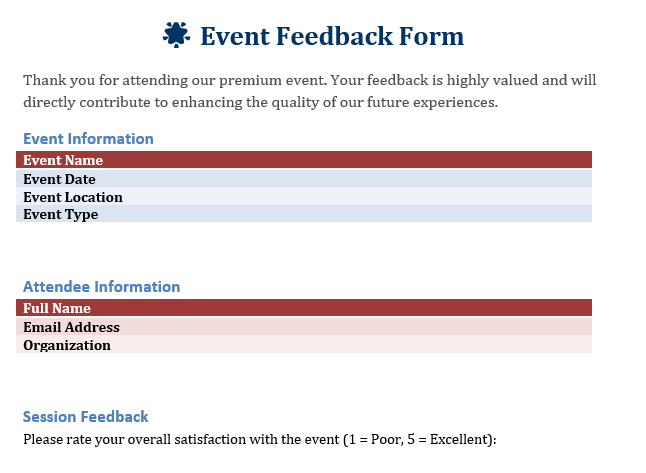
Word Version Overview
Files:
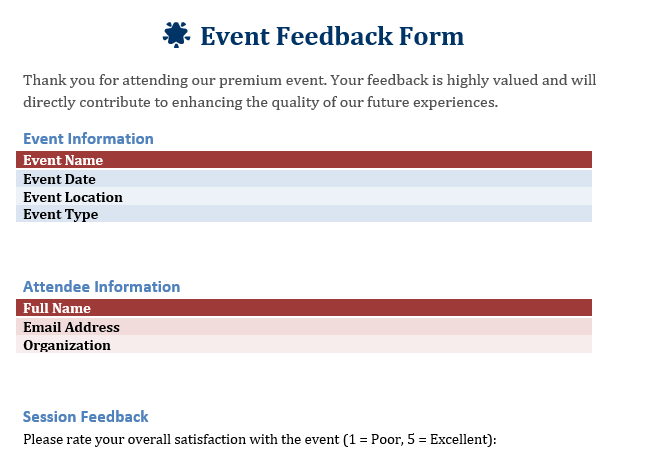
Event_Feedback_Form_Template.docx(standard version)Event_Feedback_Form_Template_Enhanced.docx(with tables)Premium_Event_Feedback_Form.docx(fully styled)
Structure:
- Title Header
- Bold, centered, professional font (“Premium” version includes visual icon)
- Introductory Paragraph
- Explains the purpose and importance of the feedback form
- Sections:
- Event Information Table: Event Name, Date, Location, Type
- Attendee Information Table: Name, Email, Organization
- Session Feedback (Free-form):
- Overall satisfaction (1–5)
- Speaker quality
- Organization & logistics
- Networking experience
- Most valuable takeaway
- Suggestions for improvement
- Would you attend again? (Yes/No)
- Closing Note
- Expresses appreciation and encourages candid input
Design Highlights :
- Colorful tables using “Colorful List Accent” Word styles
- Increased font size for readability
- Balanced layout for printed or digital use
Use Cases
- Post-event feedback for corporate workshops, product demos, networking events, training sessions, or community gatherings
- Suitable for in-person or virtual events
- Can be printed or sent digitally as a fillable document or survey form
Would you like:
- A combined report version with charts/summary?
- A fillable PDF format of the form?
- The form embedded in an email-friendly HTML format?

⬇️
Recommandés