CBAP Question Bank: Practice That Sharpens Business Analysis Judgment
Preparing for the Certified Business Analysis Professional (CBAP) exam often begins with discipline. Candidates read the core material carefully, revisit concepts several times, and try to build a strong command of the knowledge areas. This effort matters, though it rarely tells the whole story. Real progress appears when preparation moves beyond recognition and starts developing judgment.
That shift changes everything.
The real challenge in CBAP preparation does not lie in reading more pages. It lies in learning how to interpret situations, weigh priorities, and choose the most appropriate response when several options seem reasonable. This is exactly where a CBAP question bank becomes valuable. More than a revision tool, it becomes a training ground for stronger analytical thinking.
Knowledge alone rarely feels enough
Study guides create familiarity. Definitions become clearer. Frameworks begin to make sense. Terms such as traceability, elicitation, strategy analysis, and solution evaluation start to feel more natural with repetition.
Still, familiarity has limits.
Many candidates discover that understanding a concept on paper feels very different from applying it in a realistic business situation. One thing is to know what requirement prioritization means. Another is to choose the best response when stakeholders disagree, timelines are tight, and the business impact is unclear. One thing is to understand value in theory. Another is to assess whether a solution is delivering value across different stakeholder groups.
This difference explains why passive revision can only take preparation so far.
Strong question banks create a more realistic learning experience
Question banks become truly useful when they push candidates into practical thinking. Instead of asking for isolated definitions, they place the learner inside situations that feel plausible and professionally relevant.
One question may present a project where leaders are pushing for a solution before the underlying problem has been fully explored. Another may involve conflicting stakeholder expectations, unclear governance, or requirement changes with broader consequences. Some questions may focus on solution performance, where improvement in one area creates difficulty in another.
This format brings business analysis to life.
The learner no longer works with ideas in isolation. Each concept appears inside a situation, and that context forces deeper reasoning. The exercise becomes less about memory and more about interpretation.
Scenario-based questions make preparation more meaningful
Business analysis is not a discipline of abstract answers. It unfolds in environments shaped by pressure, ambiguity, competing interests, and imperfect information. Strong CBAP practice reflects this reality.
Scenario-based questions matter because they test how a candidate thinks in context. Multiple options may look acceptable at first glance. The strongest answer usually depends on understanding what matters most in that situation. Has the real business need been clarified? Are the stakeholders aligned? Is the requirement actionable enough? Is the proposed solution creating value in practice?
These are not surface-level questions. They require judgment.
Repeated exposure to this kind of thinking helps candidates strengthen the habits that matter most. Patterns become easier to spot. Weak assumptions become easier to challenge. More confidence begins to emerge, not from memorization, but from practice.
Good repetition does more than reinforce memory
The best question banks do not merely repeat the same concept in the same form. They create variation. The same underlying idea may return from a new angle, forcing the learner to think again rather than simply remember the previous answer.
Value, for example, may appear in one question as a strategic issue, in another as a stakeholder trade-off, and in another as part of solution evaluation. Traceability may first seem like a documentation concern, then reveal itself as essential for explaining change decisions and prioritization logic.
This kind of repetition builds flexibility.
Candidates start to understand not only what a concept means, but how it behaves under different conditions. That is where deeper preparation begins.
Time pressure reveals the quality of understanding
Untimed practice can feel comfortable. There is always time to pause, rethink, and revisit an answer. Real exam conditions feel different. Time creates pressure, and pressure tends to expose what is genuinely understood.
This is why a structured question bank becomes even more useful when combined with timed practice.
Speed matters, though not in a superficial way. Fast answers alone are not the objective. Clear answers under constraint matter more. A candidate who can stay composed, interpret the scenario correctly, and respond with sound reasoning is building the kind of readiness the exam demands.
Time pressure often teaches an honest lesson. Some areas feel stronger than expected. Others remain unstable. This is useful information. It gives direction to the next round of preparation.
Scores matter, though the real value lies underneath
Many candidates look at the final score first. This is natural. The number gives an immediate sense of progress. Still, the most useful question banks provide much more than a score.
Domain-level results often tell a richer story.
Performance may look strong in elicitation and collaboration, though weaker in solution evaluation. Another candidate may seem balanced across all domains while still lacking depth in strategy analysis or requirements life cycle management. These patterns matter because they make revision far more precise.
Preparation becomes more effective when candidates can see not only how they performed overall, but where their reasoning was strongest and where it still needs work.
Review is where improvement becomes real
Answering questions is only part of the learning process. Review is where understanding usually becomes sharper.
Each explanation helps reveal why one option is stronger than the others. Sometimes the gap is obvious. Sometimes the distinction is subtle. In either case, that explanation helps the candidate refine how they think about business analysis problems.
Correct answers deserve attention too. Reaching the right choice by instinct may feel satisfying, though strong preparation demands more than instinct. Reviewing the reasoning behind the answer helps make that decision more reliable next time.
This process gradually builds a more stable analytical framework.
Confidence grows differently when it is earned through practice
Confidence built only on reading can be fragile. It often depends on familiarity, and familiarity can disappear quickly when a difficult scenario appears. Confidence built through question-based practice feels different.
Repeated exposure to realistic situations helps candidates trust their own reasoning. They begin to notice improvement. Questions that once felt confusing start to feel manageable. Distinctions between stronger and weaker answers become clearer. Judgment becomes more structured.
This kind of confidence tends to last longer because it is grounded in experience rather than assumption.
Value extends beyond exam preparation
The usefulness of a CBAP question bank does not stop at certification. The thinking habits it develops remain relevant in real business analysis work. Better stakeholder interpretation, stronger requirement judgment, sharper traceability awareness, and more thoughtful evaluation of outcomes all support stronger performance in projects and transformation efforts.
Preparation, in this sense, becomes professionally useful far beyond the exam itself.
This is one of the strongest reasons to take question-based practice seriously. The process is not only helping candidates answer exam items more effectively. It is also helping them think like stronger business analysts.
More effective preparation starts with better practice
Reading remains essential. Conceptual clarity still matters. Foundations cannot be skipped. Still, real exam readiness usually grows faster when study is combined with structured, scenario-based practice.
Question banks support that growth by making preparation more active, more demanding, and more realistic. They turn revision into a process of testing, reflecting, and improving. They push candidates to use knowledge rather than merely recognize it.
This is where preparation becomes more meaningful.
A strong CBAP question bank does not simply help candidates answer questions. It helps them build the kind of judgment that business analysis requires every day.
CBAP Preparation
CBAP Question Bank
A strong CBAP question bank helps candidates move from passive reading to decision-focused preparation. It brings together scenario-based practice, domain coverage, and repeated exposure to the kind of reasoning expected in advanced business analysis work.
What it is
A CBAP question bank is a structured collection of practice questions designed to strengthen analytical judgment, exam readiness, and confidence across core business analysis domains.
Why it matters
It allows candidates to practice realistic scenarios, identify weak areas, and develop a more disciplined way of answering complex business analysis questions.
Best outcome
The goal is not only to get more answers right. It is to build stronger reasoning, sharper interpretation, and more confidence under exam conditions.
What a strong CBAP question bank usually includes
Scenario-based questionsPractice items built around real business situations and analytical decisions.
Domain coverageBalanced practice across planning, elicitation, strategy, requirements, and evaluation.
Answer explanationsClear explanations that help candidates understand why one answer is stronger.
Progress trackingA way to monitor performance, repeated mistakes, and growth by knowledge area.
How candidates use a CBAP question bank effectively
Start with a baseline testA first practice round helps reveal which knowledge areas feel strong and which still need work.
Review every explanationThe review stage often teaches more than the score itself because it clarifies logic and decision-making.
Practice by domainFocused practice by topic helps strengthen weaker areas with more precision.
Repeat under timed conditionsTimed practice builds discipline, confidence, and a better sense of exam rhythm.
Why a question bank matters for advanced preparation
At the CBAP level, success depends on more than remembering concepts. Candidates need to interpret business situations, weigh trade-offs, and recognize the most appropriate analytical response. A well-structured question bank supports exactly that kind of preparation.
CBAP Question Bank – 80 Interactive Questions
CBAP Question Bank • Interactive Model
CBAP Question Bank with 80 Interactive Questions
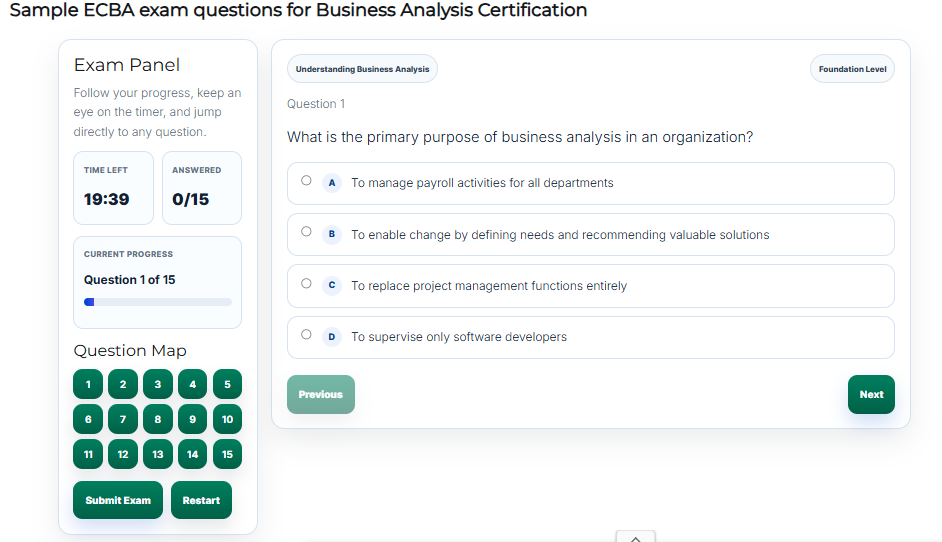
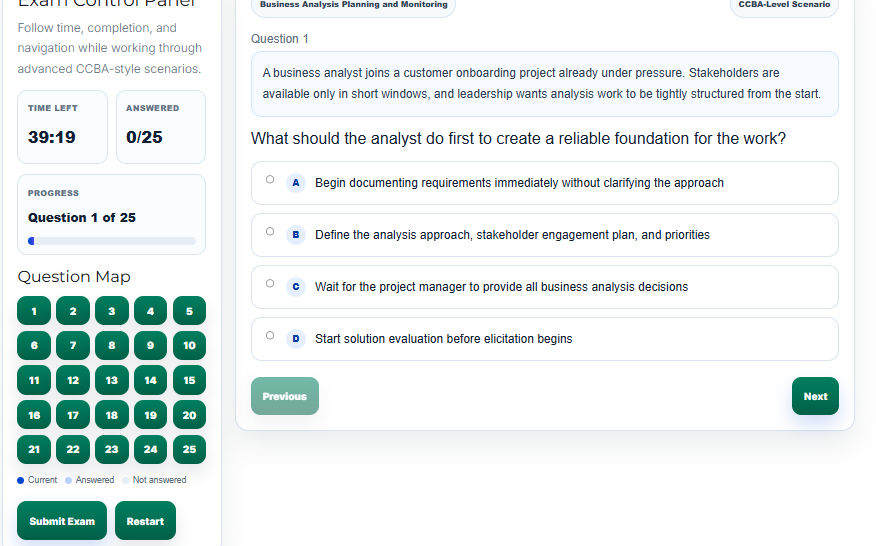
This advanced interactive model is built for deeper business analysis practice. It combines 80 original scenario-based questions, full navigation, timed practice, score tracking, domain insights, and detailed explanations to create a more serious preparation experience.
What this model includes
80 original multiple-choice questions
Scenario-based wording closer to real analysis work
Live progress, question map, and timed mode
Detailed score dashboard and full review
Knowledge areas covered
Planning and Monitoring
Elicitation and Collaboration
Requirements Life Cycle
Strategy Analysis
More coverage
Requirements Analysis and Design Definition
Solution Evaluation
Traceability and prioritization
Value and stakeholder impact
How to use it
Start the simulator
Move question by question or use the map
Submit at the end or work under time pressure
Review your strengths and weaker domains
Business Analysis Planning and MonitoringCBAP-Level Scenario
Question 1
0%
Final Score
Performance Dashboard
Your CBAP Question Bank Results
Review your score, best-performing domain, completion level, and domain-by-domain performance. Use the detailed review to see how your judgment performed across practical business analysis situations.
Correct
0/80
Completion
0%
Estimated Level
Developing
Best Area
—
Domain Performance Chart
Each bar shows your percentage score within a CBAP-style knowledge area.
Strategic marketing rarely rewards improvisation for long. Behind every successful campaign lies a structured understanding of positioning, customer behaviour, segmentation,
Digital marketing evolves at a pace that leaves little room for approximation. Campaign performance, SEO visibility, advertising profitability, lead generation
Digital marketing evolves at remarkable speed, transforming the way brands communicate, attract audiences, and build long-term visibility online. From SEO