ECBA Exam Questions Simulator: A Smarter and More Human Way to Prepare
Preparing for the ECBA (Entry Certificate in Business Analysis) can look straightforward at first glance. The certification is positioned as an entry point, so many candidates assume the exam will be simple, predictable, and heavily based on memorization. The reality is more demanding. Even at the foundational level, the ECBA asks candidates to think with clarity, interpret situations, and choose the most appropriate response in a business context.
That is exactly why an ECBA exam questions simulator matters ( sample ecbaexam questions )
A good simulator does far more than display a list of practice questions. It places the learner in a realistic exam environment. It creates pressure, reveals hesitation, highlights weak areas, and gradually builds the kind of confidence that comes from practice rather than guesswork. In other words, it helps transform study time into genuine readiness.
Why Candidates Need More Than Theory
Reading notes, reviewing concepts, and becoming familiar with business analysis terminology all remain useful. Yet many candidates discover a gap between what they recognize on paper and what they can apply in a timed exam. A concept may seem obvious when seen in a chapter or a summary sheet. The same concept can suddenly feel much less obvious when it appears inside a scenario-based question with several plausible answers.
That moment of uncertainty is common.
An ECBA simulator helps reduce it because it introduces a more active way of learning. Instead of reading passively, the candidate has to think, decide, and move forward. That process encourages sharper understanding and stronger retention. It also makes preparation feel more concrete, which is often what beginners need most.
What Makes the ECBA Challenging
The ECBA is often associated with foundational knowledge, though that should not be confused with superficial knowledge. The exam expects candidates to understand core business analysis ideas and to recognize how those ideas appear in practical situations. That means success depends on more than remembering definitions. It depends on being able to interpret what a question is really asking and identify the most suitable option.
This is where many learners struggle.
Some prepare as though the exam were a vocabulary check. They memorize terms, review flashcards, and feel reassured by familiarity. Then they encounter situational questions and realize that recognition alone does not always lead to the right answer. The difficulty is not always the content itself. Very often, it is the need to apply that content with precision.
A simulator helps bridge that gap.
The Real Value of an ECBA Exam Simulator
A strong ECBA exam simulator supports preparation in several important ways.
It recreates the rhythm of the exam
Studying from notes is calm. An exam is not. The timer changes everything. Concentration becomes more fragile. Small doubts grow larger. A question that would feel easy in a relaxed setting can feel much harder under pressure.
By practicing in a timed environment, candidates become more comfortable with the pace of the exam. That familiarity reduces stress and helps preserve mental clarity.
It reveals weak areas honestly
A learner may believe that everything is under control after finishing a chapter or watching a course module. Simulation often tells a more honest story. It exposes topics that feel understood but remain unstable in practice.
That kind of feedback is extremely valuable. It gives direction to the study process. Instead of revising everything in the same way, the candidate can focus on what actually needs attention.
It builds judgment, not only recall
Business analysis involves structured thinking. Even at the entry level, candidates must show that they can choose an appropriate response within a specific context. A simulator encourages exactly that kind of thinking. The learner starts to recognize patterns, weigh options more carefully, and understand why one answer is better than another.
It develops confidence that feels earned
Confidence based on hope is fragile. Confidence based on repetition is much stronger. After several realistic practice sessions, the learner begins to feel more composed. The exam no longer seems abstract. It becomes something familiar, manageable, and far less intimidating.
What a Good ECBA Exam Simulator Should Offer
Not every set of questions deserves the label of simulator. A simple quiz can be useful, though a real simulator should provide a richer and more disciplined preparation experience.
A strong ECBA exam simulator should include:
timed mock exams
scenario-based questions
balanced coverage of the main exam areas
clear explanations for each answer
score breakdowns by topic or domain
progress tracking across multiple sessions
a format that feels close to the real testing experience
The explanations matter especially. Practice becomes far more powerful when the learner understands not only which answer is correct, but also why the other choices are less appropriate. That deeper review is what turns mistakes into progress.
How to Use a Simulator the Right Way
A simulator – ECBA Exam Questions – is most effective when used with method. Taking random tests without reflection may create activity, but it does not always create improvement.
A better approach begins with an early diagnostic attempt. This first session establishes a starting point. The score itself matters less than what it reveals. Once the weak areas are visible, the learner can review those topics with more intention.
After that, the simulator should become part of a cycle:
test
review
correct
retest
This pattern works because it combines pressure with reflection. Every attempt uncovers something useful. Every review strengthens understanding. Over time, the candidate moves from uncertainty to greater control.
It is also important to review correct answers, not only incorrect ones. Sometimes a question is answered correctly for the wrong reason. That kind of hidden weakness can remain unnoticed unless the explanation is studied carefully.
Common Preparation Mistakes
Many candidates work hard and still prepare inefficiently. The issue is rarely a lack of effort. It is more often a matter of approach.
One frequent mistake is relying too heavily on memorization. Definitions and concepts matter, though they are not enough on their own. The exam requires more than passive recall.
Another mistake is delaying exam practice until the final stage. Candidates sometimes wait until they feel fully ready before attempting a simulator. In reality, early testing is what helps create readiness.
A third mistake is focusing only on quantity. Completing many questions can feel productive, though progress depends more on thoughtful review than on raw volume. Fifty poorly reviewed questions may help less than twenty carefully analyzed ones.
A fourth mistake is letting one low score damage motivation. Practice scores are not final judgments. They are indicators. Their purpose is to show where progress is still possible.
Why the Simulator Feels So Effective
The reason is simple. Human beings learn more deeply when they engage with a challenge rather than merely observe it. Reading introduces knowledge. Practice activates it. A simulator turns preparation into an experience. It creates tension, movement, and reflection. That combination is far more memorable than passive review alone.
For many candidates, this shift changes the whole tone of preparation. Studying begins to feel less vague. The exam becomes easier to imagine. The process becomes more structured and far less overwhelming.
That is why a simulator often feels like a turning point. It helps the learner stop asking, Have I studied enough? and start asking, Can I handle this format with confidence?
Is an ECBA Questions Simulator Enough by Itself?
A simulator is one of the strongest tools for preparation, though it should not be the only one. Solid preparation still depends on understanding the core principles of business analysis. Practice works best when supported by real study, careful reading, and focused revision.
The simulator trains performance. The study material builds depth. Together, they create a more complete preparation strategy.
Used in isolation, a simulator may show patterns without fully correcting them. Combined with serious review, it becomes much more powerful.
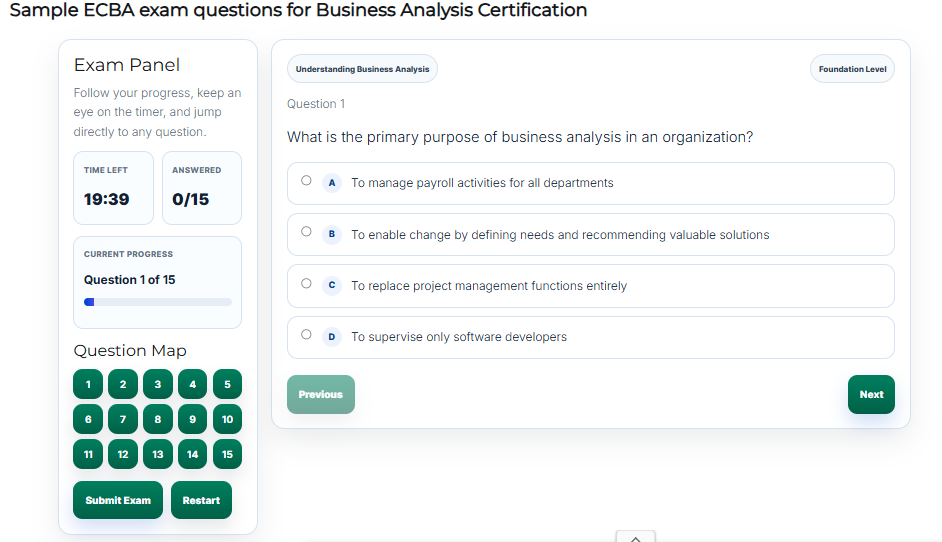
Sample ECBA exam questions for Business Analysis Certification
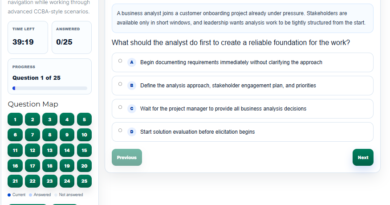
ECBA Exam Simulator
ECBA • Exam Simulator
ECBA Exam Simulator with Live Score Tracking
Train in a realistic and structured environment. This English simulator includes timed questions,
instant navigation, domain-based scoring, and a final performance dashboard to help candidates
prepare more confidently for an entry-level business analysis exam.
What this simulator includes
15 multiple-choice questions in English
Timer for a realistic practice session
Progress tracking question by question
Final score out of 100
Domain-level breakdown and answer review
How to use it
Click Start Simulator
Select one answer per question
Move between questions freely
Submit at the end or let the timer finish
Review your score and weak areas
Understanding Business AnalysisFoundation Level
Question 1
0%
Final Score
Performance Summary
Your ECBA Simulator Results
Your results below show overall performance, question accuracy, and domain-level strengths.
Use this report to guide your next revision session with more precision.
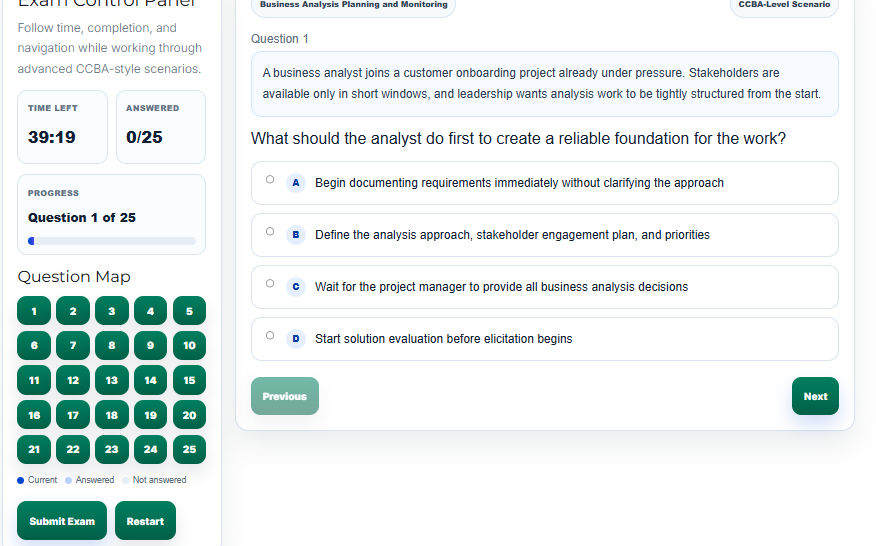
This advanced simulator is built around practical, scenario-based questions. It is designed to feel more realistic,
more demanding, and more diagnostic than a simple quiz. You will answer 30 questions, track your progress live,
and finish with a visual score dashboard and domain performance graph.
What makes this version more advanced
30 practical questions instead of a short quiz
Case-based wording closer to real analysis situations
Domain breakdown for targeted revision
Graph of performance by business analysis domain
Full review with explanations after submission
Included domains
Understanding Business Analysis
Need, Value, Context, Change
Stakeholder and Solution
Mindset for Effective Business Analysis
Implementing Business Analysis
How to use it
Start the exam and work through all 30 questions
Use the question map to move quickly
Submit when ready or let the timer finish
Study the graph, score, and explanations carefully
Understanding Business AnalysisPractical Scenario
Question 1
0%
Final Score
Performance Dashboard
Advanced Simulator Results
Your performance summary below combines overall accuracy, domain-level analysis, and a visual chart to highlight where your business analysis reasoning is strongest and where deeper revision would be valuable.
Digital marketing evolves at a pace that leaves little room for approximation. Campaign performance, SEO visibility, advertising profitability, lead generation
Digital marketing evolves at remarkable speed, transforming the way brands communicate, attract audiences, and build long-term visibility online. From SEO