Mission Report: From Structured Analysis to Real Operational Impact
Download Mission Report Template in Word ⬇️
A mission report goes beyond formal documentation. It captures how work truly unfolds, brings clarity to complex situations, and connects analysis with action. Through a structured approach, it highlights inefficiencies, reveals underlying patterns, and lays the groundwork for meaningful and sustainable improvements.
Mission Report: Structure, Value, and Practical Application
A mission report brings clarity to complex operations. It captures how work truly flows, highlights inefficiencies, and provides a structured path toward better performance.
Why a Mission Report Matters
In many organizations, inefficiencies do not come from a single failure. They emerge from small misalignments that accumulate over time.
A mission report allows decision-makers to step back, observe patterns, and reconnect processes with real performance outcomes.
How Work Actually Flows
Input
Processing
Validation
Output
Reporting
Observed gaps often appear between these steps: repeated validations, delays in transmission, and inconsistent data flow.
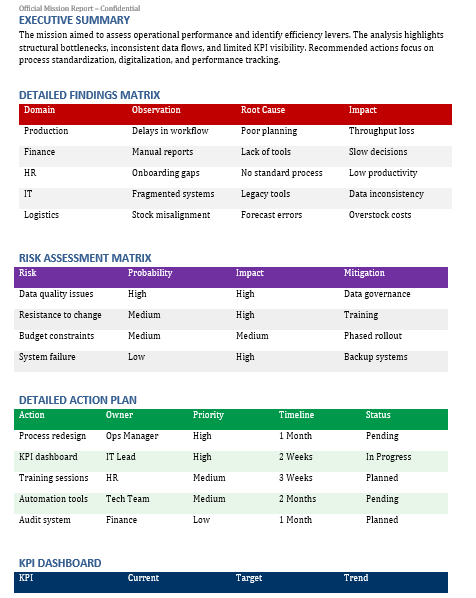
Key Findings Structure
Area
Observation
Root Cause
Impact
Production
Workflow delays
Planning misalignment
Reduced efficiency
Finance
Manual reporting
Lack of automation
Slow decisions
HR
Inconsistent onboarding
No standardized process
Delayed productivity
Operational Model Overview
Layer
Function
Weakness
Strategic
Define direction
Limited KPIs
Tactical
Plan actions
Poor coordination
Operational
Execute tasks
Process inconsistency
Transformation Approach
Stabilize processes through standardization
Improve visibility with KPI dashboards
Enhance performance through automation
Expected Impact
KPI
Current
Target
Impact
Efficiency
65%
85%
+20%
Cycle Time
12 days
8 days
-33%
Error Rate
8%
3%
-62%
FAQ – Mission Report
What is a mission report?
A mission report is a structured document that analyzes operations, identifies inefficiencies, and proposes actionable improvements.
What should a mission report include?
It typically includes context, methodology, findings, analysis, recommendations, and performance indicators.
Why is it important?
It helps organizations understand how they operate in practice and supports better decision-making.
How to write an effective mission report?
Focus on clarity, structure, and actionable insights rather than just descriptions.
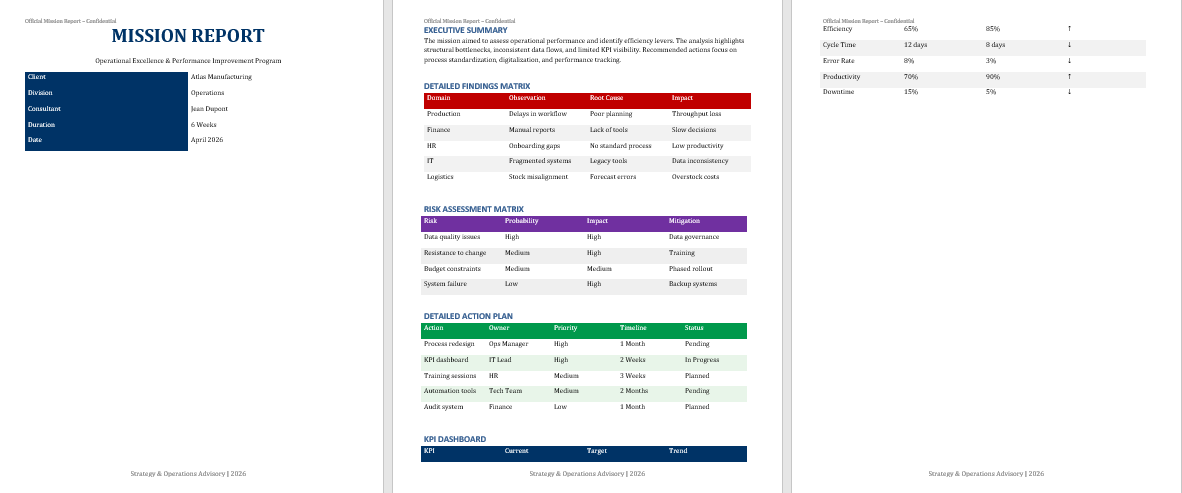
MISSION REPORT Example
Executive Summary
This report reflects the work carried out over the course of the mission with [Client Name]. What began as a focused review of operational performance gradually unfolded into a broader understanding of how the organization functions in practice.
At first glance, the issues seemed familiar: delays, inconsistencies, and a general sense that things could move more smoothly. Looking more closely, a pattern started to emerge. These were not isolated problems, but symptoms of a deeper imbalance between processes, tools, and the way teams interact.
The purpose of this report is not only to describe what was observed, but to make sense of it. The recommendations that follow are grounded in that perspective. They aim to bring more clarity, more consistency, and ultimately a more stable rhythm to daily operations.
1. Context and Objectives
1.1 Background
The mission took place in a context where the organization was actively seeking to regain control over its operational flow. There was no single point of failure, no obvious breakdown. Instead, performance seemed to be held back by a series of small frictions that, over time, had accumulated.
Rather than addressing each issue in isolation, the approach taken here was to understand how these frictions connect. Where do they originate? How do they interact? And why do they persist?
1.2 Objectives of the Mission
The work was guided by a few simple but essential questions:
How do operations actually unfold on a day-to-day basis?
Where do delays and inefficiencies tend to appear?
What explains the gap between expected performance and reality?
What can realistically be improved, without adding unnecessary complexity?
The intention was never to redesign everything, but to identify what truly matters.
2. Scope of Work
The scope was deliberately kept focused.
The mission concentrated on operational processes, performance tracking, and internal coordination. Discussions were held with several teams to capture different perspectives, and existing data was reviewed to support the analysis.
Areas such as financial auditing or legal compliance were left aside. This allowed the work to remain clear, coherent, and directly useful.
3. Methodology
The approach followed a natural progression.
It started with observation — taking the time to understand how things work in reality, beyond formal descriptions. Conversations with teams played an important role here, often revealing details that do not appear in reports.
From there, the analysis moved toward identifying recurring patterns. Certain issues appeared repeatedly, in different forms and across different departments. That repetition was a signal worth paying attention to.
Finally, the findings were discussed and refined. This step ensured that the conclusions were not only accurate, but also meaningful for those involved.
Steps tend to overlap. Some validations happen more than once. Information does not always move at the same pace as the work itself. As a result, time is lost in small increments, often unnoticed.
Individually, these moments seem minor. Together, they create a rhythm that is slower and less predictable than it should be.
5. Key Observations
A few themes came up consistently throughout the mission:
In production, delays are rarely caused by a single issue. They usually reflect a lack of alignment in planning.
In finance, a significant amount of time is spent consolidating information manually, which slows down decision-making.
In HR, onboarding practices vary from one case to another, which affects how quickly new employees become fully operational.
In IT, systems do not always communicate smoothly, creating inconsistencies in the data.
None of these observations are surprising on their own. What matters is how they connect.
6. Making Sense of the Situation
Looking at the bigger picture, three underlying dynamics become visible.
First, there is a coordination gap. Teams are working with commitment, but not always in sync.
Second, a visibility gap. Access to reliable, up-to-date information remains limited, which makes it harder to act with confidence.
Finally, an execution gap. Processes exist, but they are not always applied in a consistent way.
These are not failures. They are signs of a system that has grown without being fully adjusted along the way.
7. Risks to Consider
Any transformation effort comes with its own challenges.
Data quality will need attention. Changes may be met with hesitation. Resources will have to be allocated carefully. Systems will need to remain stable throughout the transition.
None of these risks are unusual. What matters is anticipating them and responding with clarity rather than urgency.
8. Recommendations
The direction forward does not require complexity. It requires focus.
A few priorities stand out:
Bring more consistency into key processes
Make performance easier to see and understand
Reduce manual effort where it adds little value
These actions are not independent. They reinforce one another.
9. Moving into Action
Some steps can be taken quickly.
Processes can be clarified. Basic performance indicators can be introduced. Teams can be aligned around a shared way of working.
Other changes will take more time, especially when they involve tools or systems. That is expected.
What matters most is maintaining momentum without losing coherence.
10. Closing Perspective
This mission highlights something simple, yet often overlooked.
Performance does not come from effort alone. It comes from alignment — between people, processes, and information.
When that alignment is present, work flows more naturally. Decisions become clearer. Results follow.
The recommendations in this report are intended to support that alignment. Not as a final destination, but as a starting point for something more stable and more effective over time.
A Refined Approach to Risk Visibility, Strategic Control and Operational Stability Behind the apparent stability of many organizations, uncertainty constantly
Temperature control defines the hidden rhythm of every professional kitchen. Behind refrigerated storage, chilled preparation zones and frozen stockrooms lies
The Business Kitchen Safety Checklist transforms daily restaurant supervision into a structured operational routine where hygiene, equipment safety, fire prevention
Understanding personal finance becomes considerably more intuitive once financial flows cease to feel abstract or fragmented. Many individuals possess a