CBATL Certification Guide: Courses, Sample Questions and a Smarter Way to Prepare
Starting out in software testing can feel both exciting and slightly overwhelming. Many candidates know they want to grow in quality assurance or business analysis, yet the path forward does not always look clear at first. That is precisely where a certification such as CBATL can become useful. It gives structure to the learning process and helps transform scattered knowledge into a more coherent professional foundation.
More importantly, it introduces a way of thinking that goes beyond technical execution. Good testing is not only about finding defects or following a checklist. It also involves understanding requirements, anticipating risks, interpreting business needs, and asking the right questions at the right moment. In that sense, CBATL can serve as a bridge between testing fundamentals and broader analytical judgment.
This guide explains what the certification is meant to support, why it matters in today’s project environments, how to choose useful courses, and how to make the most of sample questions during preparation. The goal is not simply to help you study harder. It is to help you study in a way that feels more focused, more practical, and far more rewarding.
What the CBATL Certification Brings to the Table
CBATL is generally suited to candidates who want to strengthen their base in testing while keeping sight of the bigger picture. It is relevant for people who do not want to learn testing in isolation, but rather as part of a broader process that includes requirements, communication, risk awareness, and quality outcomes.
That balance matters. In real projects, testing rarely happens in a vacuum. Testers interact with analysts, developers, product owners, and business stakeholders. They often work with incomplete information, changing priorities, and constraints that demand both discipline and adaptability. A certification like CBATL helps candidates understand that testing is not just a technical activity. It is also a decision-making activity.
This makes the certification especially relevant for junior testers, analysts moving closer to QA responsibilities, professionals already involved in project delivery, and career changers looking for a strong entry point into testing and business analysis related roles.
Why This Kind of Certification Matters More Than It First Appears
The value of a certification is often misunderstood. Some people see it as a line on a résumé. Others view it as a way to validate what they already know. Both views contain some truth, yet they only tell part of the story. A well-chosen certification can also shape the way a person thinks about work.
In the case of CBATL, the real value lies in the mindset it helps develop. It encourages a candidate to step back and ask better questions. What exactly is being tested? Why does this requirement matter? What risk is attached to this function? Which failure would have the greatest impact? That habit of structured thinking often makes a bigger difference than memorising terminology alone.
Another reason the certification matters is that modern delivery teams depend on stronger collaboration than before. Testing now sits much closer to analysis, design, and business value. A tester is expected not only to execute tasks, but also to interpret situations, raise concerns early, and contribute to project clarity. That is why a qualification that blends testing awareness with analytical thinking can feel especially relevant in current project environments.
What You Are Actually Learning
One of the strengths of a structured certification path is that it helps turn a broad field into clear domains of study. Instead of trying to learn everything at once, candidates can focus on a small number of essential areas that repeatedly appear in real work.
At the core, preparation usually begins with testing fundamentals. This includes understanding the main types of testing, the different levels at which testing takes place, and the role of documentation throughout the lifecycle. These concepts create the vocabulary and structure needed for everything that follows.
From there, the learning often expands toward requirements and traceability. This is a crucial step, because testing becomes far more meaningful when it is clearly connected to what the system is supposed to achieve. Learning how requirements relate to test cases, acceptance criteria, and change tracking helps candidates see testing as a form of validation rather than a disconnected exercise.
Risk-based thinking is another major area. In real-world settings, not every feature can receive the same level of attention. Some areas are more sensitive, more visible, or more likely to fail in costly ways. Good testers learn how to prioritise effort, detect where the greatest risks lie, and concentrate attention where it can create the most value.
Defect management also plays an important role. Reporting a problem is one thing. Reporting it clearly, tracking it properly, and understanding its cause is something else entirely. Candidates who learn this early often communicate better and contribute more effectively to their teams.
Finally, collaboration and communication run through the entire process. Strong testing depends on clarity, and clarity is built through discussion, review, challenge, and refinement. Learning how to work with analysts, developers, and stakeholders is just as important as understanding test terminology.
How to Choose Courses That Actually Help
Many candidates look for courses as soon as they begin preparing, which makes sense. A good course can save time, reduce confusion, and provide a more reassuring path through unfamiliar concepts. Still, not every course delivers the same value. Some overload candidates with information. Others remain too superficial. The best ones usually create balance.
A useful CBATL course should first offer structure. When learning feels fragmented, motivation tends to drop. A course that moves progressively from fundamentals to applied understanding makes revision feel more manageable and more coherent. Candidates are far more likely to retain information when each lesson builds naturally on the previous one.
It also helps when explanations are rooted in realistic situations. Abstract definitions have their place, yet concepts tend to stay with you longer when they are connected to familiar project scenarios. This is especially true in testing, where context often determines the right decision.
Practice questions with explanations are equally important. A course that only tests recall leaves too much unfinished. What makes practice valuable is the reasoning attached to it. The most helpful courses explain why one option fits, why the others fall short, and which principle lies behind the right answer. That is where confidence begins to grow.
Revision support matters as well. Short summaries, progress checkpoints, and concise reviews can make the difference between a course that feels heavy and one that feels usable. Candidates often do better when they can return to key ideas quickly without rereading everything from the beginning.
Why Sample Questions Deserve More Than a Quick Glance
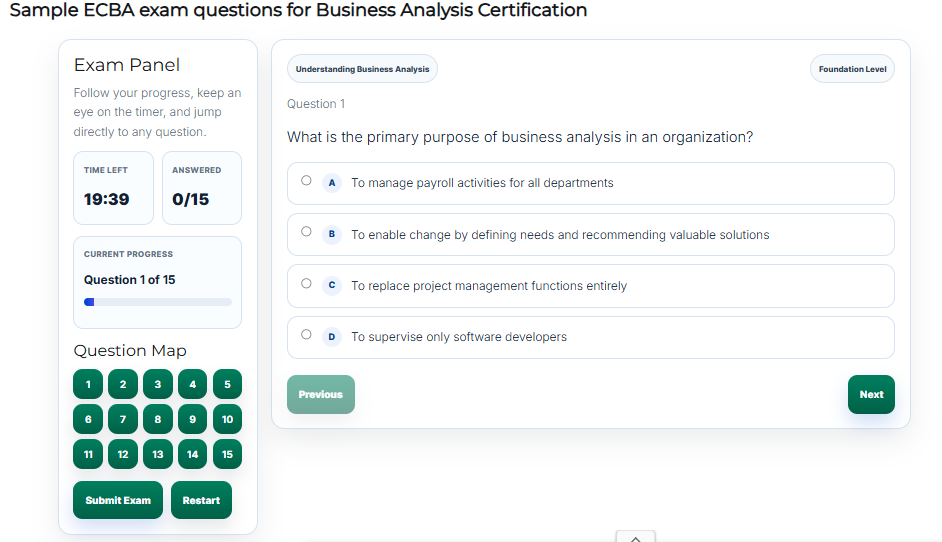
Question samples are often one of the most valuable parts of exam preparation, yet they are also one of the most misused. Too many candidates treat them as a way to test memory alone. In reality, their real value lies elsewhere. They train the mind to interpret, compare, and judge.
Sample questions expose you to the rhythm of the exam. They show how ideas are framed, how distractors are written, and how subtle wording can influence the correct choice. They also help reveal which areas feel comfortable and which still require work. That kind of feedback is difficult to get from theory alone.
At the same time, practice loses much of its value when it becomes mechanical. Memorising answers without understanding them creates a false sense of progress. Skipping explanations does the same. Even focusing only on easy questions can distort preparation, because it avoids the precise friction that helps learning deepen.
A more effective approach is slower and more reflective. After each question, it helps to pause and ask why the answer works, why the alternatives do not, and what concept the question is really trying to test. Those few extra seconds of reflection often produce more progress than rushing through twenty items in a row.
A Typical Example of the Right Mindset
Consider a question in which a testing team receives requirements that are incomplete or partly ambiguous. At first glance, several actions may seem possible. A candidate might feel tempted to start drafting test cases with the information available, or to escalate the issue immediately. Yet the strongest answer is usually the one that restores clarity first: clarifying the requirements with stakeholders before moving ahead.
Why does that matter? Because testing depends on understanding what is expected. Acting too early can introduce assumptions. Escalating too soon can create unnecessary tension. Waiting passively for perfect documentation rarely helps either. Clarification is often the most professional and productive first move. That type of reasoning reflects the deeper purpose of certification questions: not just to see what you remember, but to see how you think.
Building a Study Plan That Feels Realistic
A strong study plan does not need to be complicated. In fact, the best ones are often simple enough to follow consistently. One practical approach is to divide preparation into a few clear phases.
The first phase should focus on foundations. This is the moment to become comfortable with terminology, testing concepts, and the general logic of the lifecycle. Without that base, later topics tend to feel harder than they really are.
The second phase can move into the core domains: requirements, traceability, defect handling, communication, and risk-based thinking. This is where the subject starts to feel more connected and more practical.
The third phase should emphasise application. This means working through question samples, reading explanations carefully, and identifying recurring weaknesses. Candidates often notice at this stage that some concepts looked familiar in theory but remain shaky in practice. That discovery is useful.
The final phase is consolidation. This is the time to revisit weak areas, strengthen understanding, and practise with greater discipline. The point is not to cram more information into the last moment. It is to make what you already studied feel more stable and more accessible.
Mistakes That Quietly Hold Candidates Back
Several common mistakes can slow progress without being immediately obvious. One of the most frequent is relying too heavily on theory. Reading is necessary, yet knowledge remains fragile until it is applied. Practice gives the material depth and makes it easier to retrieve under pressure.
Another mistake is giving too little attention to requirement analysis. Testing starts long before execution. It begins with understanding what needs to be validated, what matters most, and what could go wrong if a requirement is misunderstood. Candidates who overlook this area often struggle with scenario-based questions later.
Communication is also underestimated more often than it should be. Many testing problems are not caused by a lack of effort, but by a lack of clarity. Knowing how to ask for clarification, report issues properly, and participate in reviews can shape performance just as much as technical knowledge.
Finally, revision itself is sometimes treated as optional. Yet regular review is what helps knowledge settle into place. Without it, useful concepts remain temporary. With it, confidence becomes far more durable.
Business Analysis Certification Preparation
CBATL Certification Exam Questions
Preparing for advanced business analysis certification questions calls for more than memorising concepts. It requires structured reasoning, clear command of analytical frameworks, and the ability to interpret scenario-based questions with precision. This page is designed to help candidates review the type of thinking, question patterns, and study focus often associated with high-level business analysis certification preparation.
High-level certification questions usually test judgment, structure, prioritisation, and stakeholder reasoning rather than isolated definitions.
Method
Train with realistic examples
Practice becomes more useful when sample questions are reviewed carefully and linked back to business analysis principles and decision-making logic.
Outcome
Build exam readiness with discipline
The strongest preparation sharpens both confidence and judgment, which is exactly what demanding certification questions tend to reward.
Exam preparation
What advanced certification questions usually test
Business analysis certification questions at an advanced level rarely focus on memorisation alone. They often require the candidate to evaluate stakeholder concerns, identify the most appropriate analytical action, interpret change implications, and distinguish between options that all appear partly correct.
This is why question practice should do more than confirm whether an answer is right or wrong. It should strengthen your ability to justify choices, recognise patterns, and apply core principles under exam conditions.
Question samples
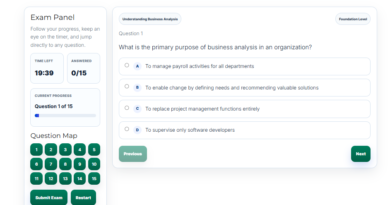
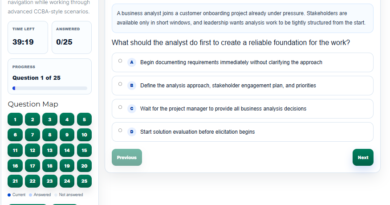
CBATL certification exam question samples
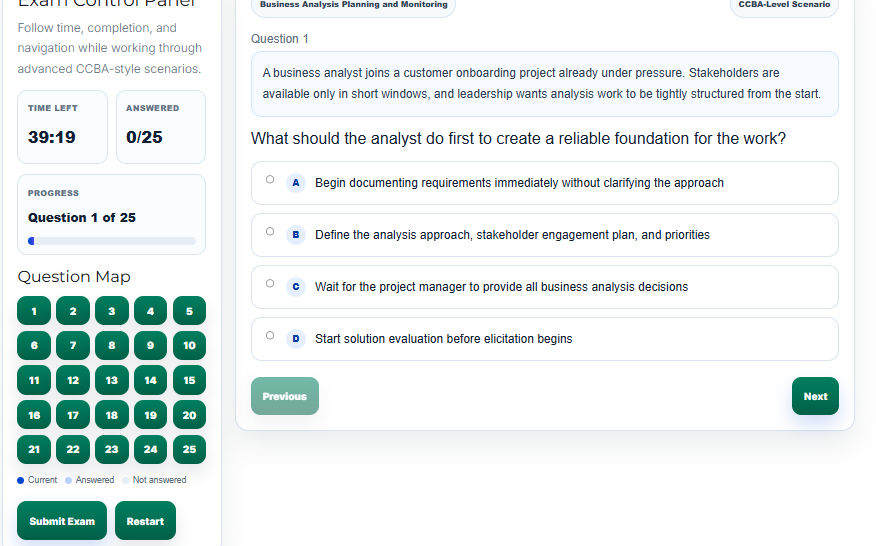
Question 1
A stakeholder group is aligned on business objectives, yet strongly divided on solution priorities. What should the analyst do first?
A. Finalise the highest-value requirement independently
B. Document the conflict and facilitate priority clarification
C. Escalate directly to sponsors without further analysis
D. Freeze requirement activity until consensus appears naturally
Suggested answer: B. Document the conflict and facilitate priority clarification.
Question 2
A proposed change creates strong benefits for one department but introduces operational strain for another. Which response best reflects sound analysis practice?
A. Move forward because benefits have already been identified
B. Reject the change because resistance is expected
C. Evaluate impacts across stakeholders before recommending action
D. Leave the decision entirely to the technology team
Suggested answer: C. Evaluate impacts across stakeholders before recommending action.
Question 3
During review, a solution appears technically sound but weak in user adoption potential. What is the most appropriate analytical concern?
A. The design should be approved because technical quality is enough
B. Adoption risk should be assessed as part of solution evaluation
C. User concerns should be addressed after implementation
D. Adoption has no impact on business value if delivery is on time
Suggested answer: B. Adoption risk should be assessed as part of solution evaluation.
Study advice
How to work with certification question samples
Read for intent
Strong exam answers often depend on recognising what the question is truly asking rather than reacting to familiar keywords.
Compare options carefully
Several choices may appear plausible. The task is to identify the option that reflects the strongest analytical judgment.
Track weak areas
Sample questions become more useful when they reveal recurring blind spots in prioritisation, stakeholder analysis, or solution thinking.
Revise the principle behind the answer
Every strong explanation should lead back to a core business analysis principle rather than a memorised phrase.
FAQ
CBATL certification exam questions FAQ
What do certification exam questions usually measure?
They usually measure judgment, structured reasoning, stakeholder awareness, and the ability to apply analytical principles to practical situations.
How should candidates use sample questions?
The most effective approach is to practise regularly, review every explanation carefully, and revisit the concepts behind difficult questions.
Why do advanced questions feel difficult even when concepts look familiar?
Difficulty often comes from choosing the best answer among several acceptable-looking options, which requires stronger judgment than recall alone.
What makes exam practice more effective?
Real progress comes from combining sample questions with concept review, pattern recognition, and consistent analysis of weak areas.
Preparing for the Certified Business Analysis Professional (CBAP) exam often begins with discipline. Candidates read the core material carefully, revisit
Digital marketing evolves at remarkable speed, transforming the way brands communicate, attract audiences, and build long-term visibility online. From SEO