PESTEL Analysis Dashboard Excel: From External Factors to Actionable Insights
Step into any meeting where strategy is being discussed, and a familiar pattern appears. The focus turns inward—products, teams, performance, targets. All essential. Yet, what often determines success sits outside the room. A regulation changes. A new technology spreads faster than expected. Consumers quietly shift their habits.
No warning, no announcement—just a gradual change that becomes obvious too late.
A PESTEL analysis exists for that exact moment. It brings attention back to what surrounds the business, to the signals that rarely shout but always matter.
Why It Feels So Relevant Today
Markets used to evolve in cycles that felt predictable. Today, the rhythm is different. Signals overlap. One change amplifies another.
A rise in energy prices affects production costs, which influences pricing, which alters consumer behavior. At the same time, environmental expectations grow, pushing companies to rethink their positioning. Add technological acceleration to the mix, and the landscape shifts even faster.
In that context, intuition alone struggles. Structure becomes necessary. That is where PESTEL earns its place—not as theory, but as a way to stay grounded while everything moves.
A Framework That Feels Surprisingly Human
Despite its structured appearance, PESTEL reflects something very natural: the way people try to understand their environment.
Each dimension captures a different kind of signal.
Political — Decisions Made Far Away, Felt Immediately
A policy decision may happen in a government office, yet its impact travels quickly. A tax adjustment, a new import rule, a change in subsidies—these elements quietly reshape entire industries.
Those who pay attention early rarely feel surprised later.
Economic — The Atmosphere Around Every Transaction
Economic conditions rarely appear as a single event. They build like weather.
Inflation creeps in. Interest rates adjust. Purchasing power shifts. Suddenly, decisions that once felt obvious require reconsideration.
Companies that sense these shifts adapt smoothly. Others react under pressure.
Social — The Slow Transformation of Expectations
What people value changes over time. Not dramatically, not overnight—but steadily.
A growing focus on sustainability. New attitudes toward work. Different consumption patterns among younger generations.
These movements rarely make headlines immediately, yet they redefine markets in the long run.
Technological — When Progress Changes the Rules
Technology does more than improve efficiency. It alters how things are done, sometimes irreversibly.
A tool becomes a platform. A process becomes automated. An industry finds itself restructured.
The challenge lies less in adopting innovation than in recognizing how deeply it reshapes the landscape.
Environmental — From Constraint to Opportunity
Environmental concerns have moved beyond compliance. They influence reputation, investment, and even customer loyalty.
What once felt like a limitation now opens strategic possibilities for those willing to rethink their approach.
Legal — The Structure That Holds Everything Together
Legal frameworks define the space within which companies operate.
Employment law, data protection, contractual obligations—each sets boundaries. Understanding them well does more than prevent mistakes. It allows confident, informed decisions.
From Observation to Clarity
The real value of PESTEL does not lie in listing factors. Anyone can do that.
What makes the difference is the ability to step back and ask better questions:
Which of these signals truly matters?
What could change if it intensifies?
Are we prepared—or simply reacting?
Some organizations use scoring systems, combining impact and likelihood. Others rely on discussion and scenario thinking. The method matters less than the discipline behind it.
When It Becomes Part of the Culture
The most effective use of PESTEL happens quietly. It does not sit in a report forgotten after a presentation.
Instead, it becomes a habit:
revisiting assumptions regularly
connecting insights across teams
adjusting decisions before pressure builds
Over time, this creates something valuable: a sense of anticipation. Not prediction, but readiness.
The Subtle Power of Visualization
Clarity improves when complexity becomes visible.
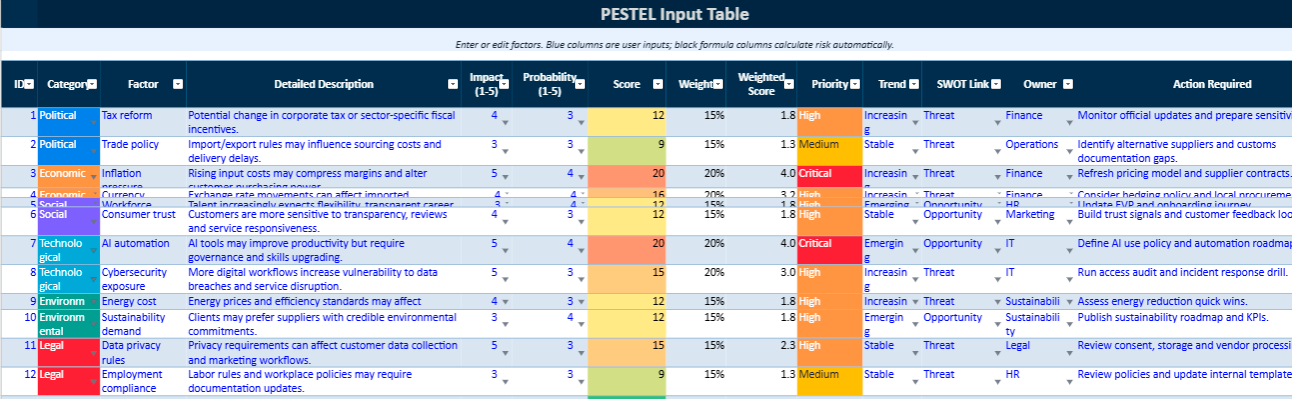
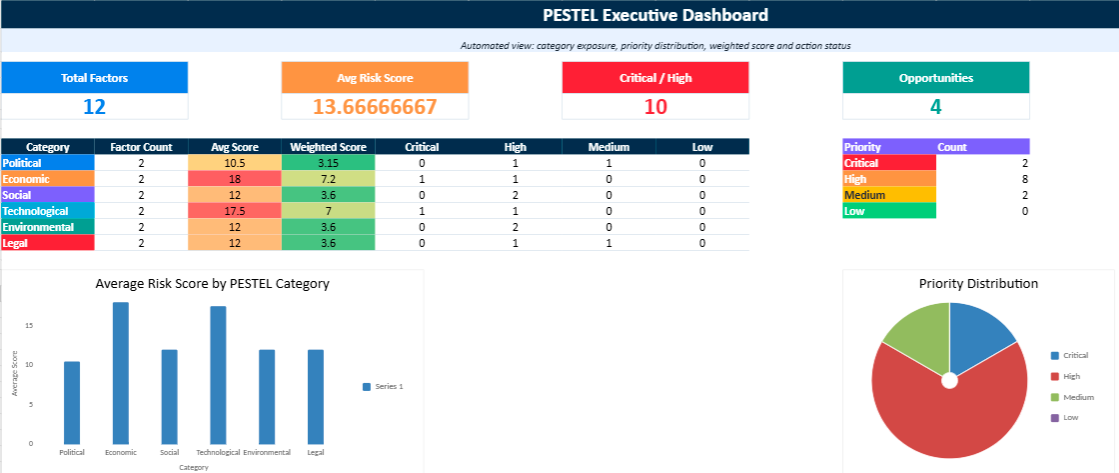
Simple tools—well-designed spreadsheets, dashboards, or visual matrices—can transform scattered observations into structured insight. A color-coded risk map, for instance, reveals priorities instantly.
The objective remains straightforward: see clearly, decide calmly.
Where Many Get It Wrong
PESTEL loses its strength when treated as a checklist.
Filling categories without prioritizing. Collecting data without interpreting it. Updating nothing while the environment evolves.
The framework works only when it remains selective, alive, and connected to decisions.
PESTEL in Practice
Fillable PESTEL Analysis Table
Use this table to identify external factors, evaluate their potential impact, and turn observations into practical business actions.
PESTEL Area
External Factor
What is changing?
Impact 1–5
Likelihood 1–5
Risk / Opportunity
Recommended Action
Political
Tax policy
New government measures may affect costs.
4
3
Risk
Monitor regulation and update pricing strategy.
Economic
Inflation
Purchasing power is under pressure.
5
4
Risk
Review cost structure and adjust offer tiers.
Social
Customer expectations
Clients expect faster, more transparent service.
4
5
Opportunity
Improve communication and customer experience.
Technological
Automation
New tools reduce manual work.
5
4
Opportunity
Invest in workflow automation.
Environmental
Energy use
Energy efficiency becomes a stronger concern.
3
4
Opportunity
Introduce measurable sustainability actions.
Legal
Data protection
Compliance obligations are becoming stricter.
5
3
Risk
Audit data processes and update policies.
High Priority
Impact and likelihood are both significant.
Medium Priority
The factor should be monitored carefully.
Low Priority
Limited impact, but still worth documenting.
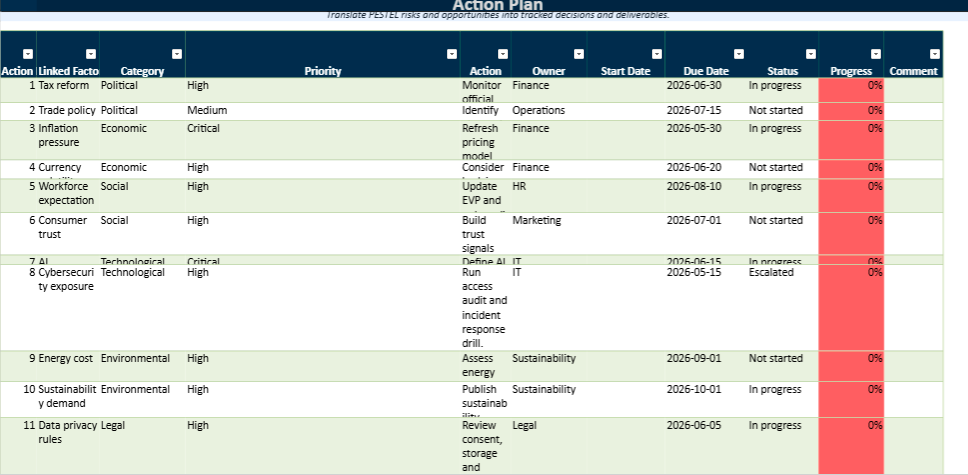
Action Plan Sheet — Where Analysis Stops Being Theory
After a solid PESTEL analysis, there is often a brief moment of clarity. Everything seems visible: risks, opportunities, signals coming from outside. Then, very quickly, reality returns—emails, meetings, operational pressure.
Without a structured follow-up, even the sharpest analysis can slowly dissolve into background noise.
The Action Plan sheet exists to prevent that. It does something simple, yet decisive: it forces the organization to commit.
A Change in Posture
At this stage, the conversation is no longer about understanding the environment. That work has been done.
The question becomes more direct, almost uncomfortable at times: Given what we know, what are we actually going to do?
That shift matters. It moves the discussion from observation to responsibility.
A regulatory change is no longer “something to watch.” It becomes an action: review contracts, adjust pricing, engage legal.
A technological trend is no longer “interesting.” It becomes a decision: invest, test, or deliberately wait.
Clarity Over Complexity
What makes this sheet effective is not sophistication. It is precision.
Each column forces a level of clarity that discussions alone rarely achieve:
The issue is named — no ambiguity about what triggered the action
The priority is stated — not everything carries the same weight
The action is explicit — vague intentions disappear quickly when written down
An owner is assigned — responsibility becomes visible
A timeline is set — time pressure introduces discipline
A status is tracked — progress can no longer be assumed
Nothing here feels revolutionary. Yet, in practice, this level of explicitness changes behavior.
What Happens Inside Teams
Once the sheet is in use, dynamics begin to shift. Subtly at first.
Conversations become shorter, more focused. Instead of revisiting the same analysis repeatedly, teams refer to what has already been decided.
Questions evolve:
Where do we stand?
What is moving slower than expected?
What requires escalation?
There is less room for approximation. More space for decisions.
A Tool That Reveals More Than It Tracks
Over time, the Action Plan sheet starts doing more than organizing actions. It reveals patterns.
Some actions move quickly. Others remain “in progress” longer than expected. Certain priorities keep reappearing.
Those signals matter. They say something about internal alignment, resource allocation, and even strategic coherence.
In that sense, the sheet becomes a mirror—not only of external challenges, but of how the organization responds to them.
Discipline Without Rigidity
There is a balance to maintain. Too much rigidity, and the sheet becomes bureaucratic. Too little structure, and it loses its purpose.
The most effective use tends to remain pragmatic:
actions are updated when needed, not excessively
priorities are adjusted when context evolves
notes capture reality rather than ideal scenarios
The objective is not perfection. It is continuity.
The Moment Where Strategy Becomes Real
Many strategic frameworks stop at analysis. They describe, categorize, interpret.
Few force a transition toward execution. This sheet does.
It introduces a simple form of accountability. Quiet, but firm. Something has been identified. A decision has been made. Someone is responsible. Time is defined.
From that point on, the strategy is no longer an idea. It becomes a sequence of actions, visible and trackable.
A Subtle but Decisive Advantage
Organizations that use this approach consistently develop a different rhythm.
They react less under pressure. They adjust earlier. They move with more intention.
Not because they predict the future better, but because they organize their response more effectively.
And in environments shaped by constant change, that difference—often discreet—tends to become a real advantage.
Understanding the Environment, Acting with Precision: A PESTEL Analysis Excel Tool
Precision rarely fails loudly at the beginning. Industrial controllers, probes and calibration instruments usually continue operating while small deviations quietly
Strategic marketing rarely rewards improvisation for long. Behind every successful campaign lies a structured understanding of positioning, customer behaviour, segmentation,