Hiring during the holidays rarely feels like a problem at first. Applications still arrive. Interviews are scheduled. On the surface, everything seems to move forward as usual. Yet, little by little, something begins to shift. Replies take longer. Schedules become harder to align. Conversations lose a bit of their usual momentum.
It is not a question of interest fading. Candidates remain engaged, and companies continue to recruit. The change lies elsewhere—in the rhythm itself.
During these periods, attention is naturally divided. Personal commitments take more space, priorities adjust, and even the most motivated candidates may find it harder to stay fully present. Within organisations, a similar pattern unfolds. Teams slow down, availability becomes uneven, and decisions take longer to settle.
Gradually, the process feels less predictable.
Hiring during the holidays therefore calls for a different kind of attention. Maintaining momentum matters, though clarity matters even more. Candidates need to understand what is happening, what comes next, and why certain steps take longer. When that clarity is present, the process remains steady—even when the pace changes.
Case Study: Hiring During the Holidays
Holiday Hiring Case Study
Hiring During the Holidays: When Timing Becomes the Real Challenge
At first, the company saw no reason to slow down. Roles remained urgent, interviews continued, and the process stayed active through the holiday season. Yet something in the rhythm began to shift. Candidates replied later, interviews moved more slowly, and strong profiles sometimes disappeared without warning. The problem was not the process itself. It was the context surrounding it.
What this case reveals
How holiday periods disrupt hiring through reduced availability and slower decision cycles.
Why predictability matters more than speed when the calendar becomes fragmented.
How lighter, clearer processes can preserve engagement during seasonal slowdowns.
Seasonal frictionCandidates stayed interested, though schedules became less stable and attention more divided.
Internal slowdownManagers travelled, teams worked with reduced capacity, and decisions took longer than usual.
Main riskThe process lost rhythm, and uncertainty began to replace momentum.
Better responseThe company focused on predictability, fewer steps, and stronger communication.
When the process stayed the same, but the context changed
The company did not suddenly develop a poor hiring process in December. The real issue was subtler. A sequence that usually worked well began to weaken because the surrounding conditions had changed.
During the holiday season, candidates remained curious about opportunities, though their availability shifted. Personal commitments expanded, attention moved in several directions at once, and even motivated applicants found it harder to stay fully present.
Inside the company, the same pattern emerged. Hiring managers were away, decision-makers became harder to coordinate, and teams operated with less continuity. None of these delays seemed dramatic on their own, yet together they changed the feel of the process.
The company eventually realised that the problem was not slowness in itself. It was the loss of rhythm. Once candidates could no longer predict what would happen next, engagement began to weaken.
The initial instinct was to compensate by moving faster wherever possible. Yet that response only created more inconsistency. Interviews were pushed forward, then postponed. Feedback was promised, then delayed. The issue deepened because the process no longer felt stable.
What changed
The company stopped trying to preserve the usual pace at all costs and started making the journey more predictable instead. If a stage would take longer, candidates were told early. If a hiring manager was unavailable, the timeline was adjusted clearly rather than left uncertain.
This shift was followed by another: the process was simplified. Wherever possible, overlapping interviews were combined, discussions became more focused, and each interaction was expected to move the decision forward rather than revisit the same ground.
The tone changed too. Candidates were given more flexibility, scheduling felt more realistic, and the process began to acknowledge the realities of the season rather than pretending they did not exist.
How the hiring process adapted during the holiday period
The revised approach did not aim to force the usual pace. It aimed to protect momentum by making the process clearer, lighter, and easier to trust.
01
Context shift
The usual rhythm weakened
Interviews and decisions slowed as candidate and team availability became less stable.
02
Key insight
Uncertainty became the real issue
The process suffered less from slowness than from unpredictable gaps and shifting expectations.
03
Adjustment
Communication became more explicit
Candidates were given clearer timelines, clearer delays, and clearer next steps throughout the journey.
04
Simplification
The process became lighter
Interview stages were streamlined so that fewer moments carried more value and less repetition.
05
Outcome
Momentum became easier to preserve
Even with slower calendars, candidates stayed engaged because the process felt more stable and more human.
What improved by the end of the season
The company did not eliminate holiday slowdowns. It responded to them more intelligently, which proved far more useful than trying to ignore them.
Lower drop-offFewer candidates disappeared mid-process because the journey felt more readable.
Better focusInterviews carried more weight because each stage had a clearer purpose.
More trustCandidates remained engaged even when timelines stretched, because uncertainty was reduced.
Smoother offersThe transition from acceptance to start date felt less fragile and less distant.
The wider lesson was simple. Hiring during the holidays does not require a completely different philosophy. It requires better awareness of context, greater predictability, and enough flexibility to keep the process human when the calendar becomes less stable.
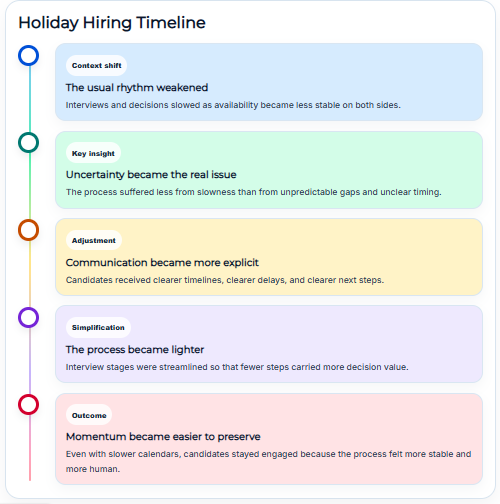
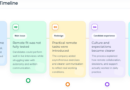
Holiday Hiring Vertical Timeline
Holiday Hiring Timeline
Context shift
The usual rhythm weakened
Interviews and decisions slowed as availability became less stable on both sides.
Key insight
Uncertainty became the real issue
The process suffered less from slowness than from unpredictable gaps and unclear timing.
Adjustment
Communication became more explicit
Candidates received clearer timelines, clearer delays, and clearer next steps.
Simplification
The process became lighter
Interview stages were streamlined so that fewer steps carried more decision value.
Outcome
Momentum became easier to preserve
Even with slower calendars, candidates stayed engaged because the process felt more stable and more human.