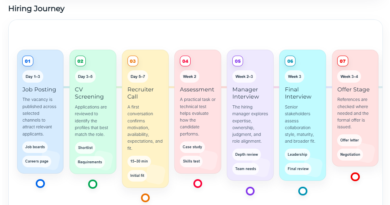
Remote hiring often begins as a simple shift in tools—video calls replace meeting rooms, shared documents replace printed files. Yet beneath that surface change lies a deeper transformation. Hiring at a distance requires more than moving interviews online; it demands a different way of evaluating, communicating, and building trust without proximity. As companies adapt to distributed work, the hiring process itself becomes a revealing test—not only of candidates, but of how clearly an organisation understands the reality of working remotely.
Remote Hiring Process Case Study
Remote Hiring Case Study
When Remote Hiring Looked Easy Until It Wasn’t
At first, the shift to remote hiring seemed straightforward. Interviews moved to video calls, documents became digital, and roles continued to be filled. Yet after a few months, the company began to notice a quieter problem: strong candidates were disengaging, some new hires were leaving early, and the process no longer reflected the reality of remote work. What followed was a more thoughtful redesign—one built around clarity, autonomy, and human connection.
What changed in this process
Remote readiness began to be assessed directly, not assumed.
Asynchronous communication became part of the hiring journey.
The gap between offer acceptance and day one became more human and more intentional.
Remote shiftHiring moved online quickly, though the process itself remained rooted in office logic.
Hidden frictionStrong interview performance did not always translate into remote success.
Process redesignThe company introduced remote-specific evaluation and clearer candidate visibility.
Better alignmentNew hires joined with a clearer sense of the role, the team, and the way work really happened.
Where the original process started to fail
The company had not neglected recruitment. The problem was subtler than that. It had simply taken an office-based hiring model and moved it online, without fully rethinking what remote work actually required from candidates.
Good interviews, weak adaptation
Some candidates looked excellent during live conversations, yet struggled once the role demanded autonomy, written clarity, and self-direction.
Communication mismatch
The process relied heavily on real-time calls, even though daily remote work depended far more on thoughtful written communication.
Culture remained abstract
Candidates heard about values and mission, but often lacked a concrete understanding of how decisions, collaboration, and support actually worked.
The waiting felt longer
Remote distance amplified uncertainty. Gaps between stages felt colder and more ambiguous without the familiarity of a physical workplace.
Preboarding was too light
Even after accepting an offer, candidates could still feel disconnected because the relationship remained largely virtual and unfinished.
The process tested the wrong things
Technical competence mattered, though remote readiness depended just as much on organisation, initiative, and comfort with asynchronous work.
How the hiring journey was redesigned
The new process did not become heavier. It became more honest. Each step was adjusted so that candidates experienced something closer to the real conditions of the role.
01
Reassessment
Remote work was treated as a context
The company stopped seeing remote hiring as a simple video version of office recruitment.
02
Evaluation
Practical tasks were introduced
Candidates completed short asynchronous exercises that reflected the autonomy expected in the actual role.
03
Communication
Writing became part of the process
Structured written prompts revealed how clearly candidates could think and communicate without live guidance.
04
Transparency
Culture was explained concretely
The team described how collaboration, decisions, and support actually worked in day-to-day remote practice.
05
Before day one
Preboarding reduced distance
Early introductions, messages, and shared materials made the future feel closer and less abstract.
What this revealed about remote hiring
The central lesson was simple: remote hiring improves when the process reflects the reality of remote work. People do not just need to be assessed. They need enough clarity to understand how they will communicate, how they will work, and how they will belong at a distance.
Why did the original process create weak alignment?+
It favoured live interview performance more than the habits that matter in remote environments: autonomy, written clarity, pacing, and comfort with less direct supervision.
What made the new process more human?+
It gave candidates clearer signals at every stage, replaced abstraction with practical visibility, and treated the time before day one as part of the relationship rather than as empty waiting.
What improved after the redesign?+
Candidates stayed engaged longer, offer acceptance felt more stable, and new hires adapted faster because expectations were more realistic from the outset.
This case study shows that remote hiring rarely succeeds through tools alone. It becomes stronger when the process mirrors the work itself and reduces uncertainty with each step. 🌍
Remote Hiring Case Study Timeline
Remote Hiring Case Study
How a Company Rebuilt Its Remote Hiring Process
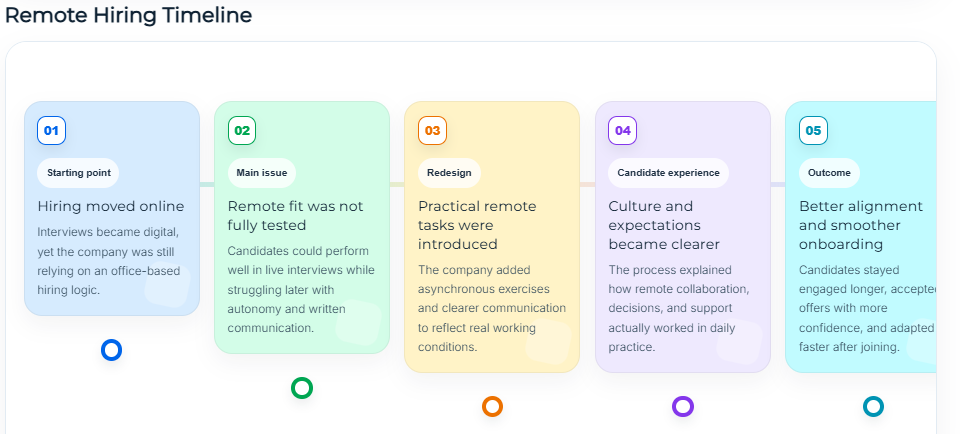
This simplified timeline shows how the company moved from a basic online recruitment model
to a more thoughtful remote hiring journey. The challenge was not technology itself, but the
need to assess autonomy, communication, and candidate clarity in a fully remote environment.
Remote Hiring Timeline
01
Starting point
Hiring moved online
Interviews became digital, yet the company was still relying on an office-based hiring logic.
02
Main issue
Remote fit was not fully tested
Candidates could perform well in live interviews while struggling later with autonomy and written communication.
03
Redesign
Practical remote tasks were introduced
The company added asynchronous exercises and clearer communication to reflect real working conditions.
04
Candidate experience
Culture and expectations became clearer
The process explained how remote collaboration, decisions, and support actually worked in daily practice.
05
Outcome
Better alignment and smoother onboarding
Candidates stayed engaged longer, accepted offers with more confidence, and adapted faster after joining.
The lesson was straightforward: remote hiring becomes stronger when the process reflects the real conditions of remote work instead of simply copying an office-based model onto a screen.