5S Audit Checklist in Excel: Optimize Workplace Efficiency Like a Pro
Recommandés





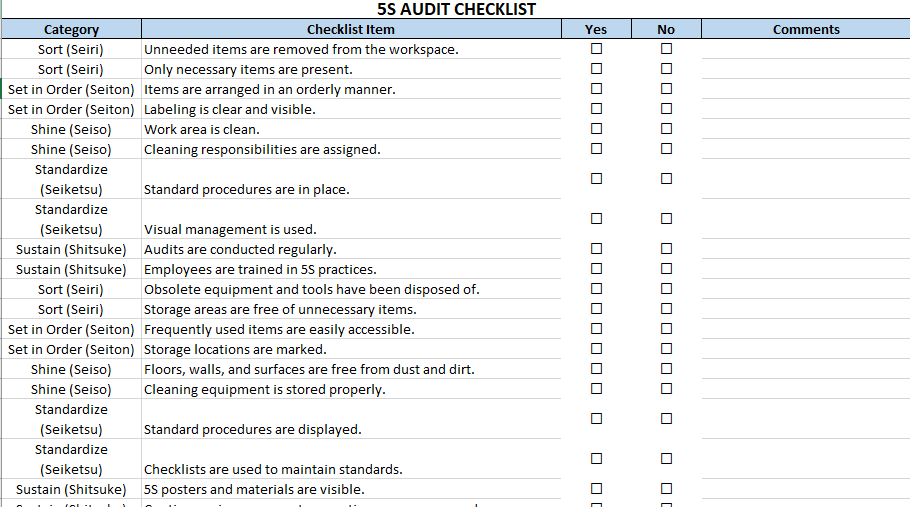
Download 5S Audit Checklist in Excel ⬇️ Embrace the checklist. Incentivize uniformity. Review regularly. And never leave achievement solely to the whims of chance.
The venerable 5S methodology from Japan offers a practical route to maintaining a clean, well-organized, high-performing workplace. However, what separates the occasional dabblers from consistent winners? Committing to recurring audits makes all the difference.
Stake:
In the fast-paced world of logistics and operations, every second is crucial. Efficiency matters greatly. Luck alone will not suffice; strategic planning, self-discipline, and precision are paramount. This is where conducting regular 5S audits proves pivotal.
Understanding the Critical 5S Components
Before beginning audits, grasp the fundamentals’ importance. These five stages comprise more than a random gamble. Each plays a vital role:
- Sorting removes extras, retaining solely necessities.
- Setting in order facilitates effortless access.
- Shining spots issues promptly through cleanliness.
- Standardizing cultivates uniformity upholding organization and tidiness.
- Sustaining entails discipline and reevaluation through consistent audits.
Consider each step a calculated choice, like studious poker. Scattered cards and rule-breaking yield clutter, bewilderment and lost income, just as in business. Neglecting these precepts courts catastrophe.
Why Conduct a 5S Audit? It’s Like Counting Cards
Implementing 5S is one thing, but sustaining it is another challenge altogether. That’s where auditing comes in. Much like observing strategies in poker, auditing gives you an edge.
A proper 5S audit ensures consistency, detects issues early, empowers workers, and tracks progress over time. Audits reveal whether your team is strategizing properly or relying on happenstance.
Components of a Robust 5S Audit
An exhaustive 5S Audit includes specifics under each category. Let’s review these, keeping your workspace optimized.
Sort (Seiri)
Questions covered:
- Are unnessecaries removed?
- Are storage areas uncluttered?
- Is what’s key obvious?
- Bonus: Temporarily flag borderline items for reconsideration.
Set in Order (Seiton)
Like arranging poker chips by value, setting in order relies on visual logic.
Checked:
- Are frequently used tools accessable?
- Is everything signed?
- Stored near point of use?
This prevents wasted movement hunting supplies.
Shine (Seiso)
Cleanliness spots small issues before they intensify.
Points checked:
- Are workspaces clean and debris-free?
- Are cleaning materials accessable?
- Are spills and faults addressed promptly?
Routine cleaning is preventative, knowing when to walk away from risk.
Standardize (Seiketsu)
Consistency forms the foundation upon which any successful endeavor is built. Like casinos utilize definitive protocols to administer games fairly, businesses must delineate and adhere to standards.
Audit areas:
- Are standard procedures conspicuously posted and religiously followed?
- Are visual indicators (signs, color codes) being employed judiciously?
- Are employees systematically trained in identical procedures?
Deviating from standardization is akin to recklessly gambling with a company’s bottom line at the whim of chance.
Sustain (Shitsuke)
Discipline is what separates the occasionally victorious from the persistently prosperous.
Checklist cornerstones:
- Are 5S evaluations being carried out methodically?
- Are employees motivated to observe protocols enthusiastically?
- Are improvement suggestions being encouraged liberally?
This represents your company’s long-term wager, ensuring prosperity instead of precariousness — that success is guaranteed rather than gambling.
Scoring Your 5S Audit
To maximize the benefits of your 5S Audit Checklist, implement a simple scoring framework. Utilize a scale of 1 to 5 to rate adherence for each item, with 5 signifying complete compliance and 1 denoting non-compliance.
Totals can be utilized to:
- Track progression through time
- Identify problematically perilous precincts
- Allocate assets more prudently
This structured approach is more constructive than haphazardly guessing and hoping for fortune.
Incentivizing Your Team Like a Loyalty Program
Gamblers admire incentives — free spins, loyalty bonuses, or VIP access. Employees are similarly stimulated.
Utilize rewards and recognition to motivate dedication to 5S principles:
- Highlight top-performing divisions in audits
- Offer small prizes or team excursions
- Acknowledge employees who consistently follow procedures
This adds a trace of competition and renders the audit feeling less like an obligation and more like a game everyone wishes to win.
Digital Tools to Support 5S Audits
In today’s technology-proficient world, there is no necessity to retain audit checklists solely on paper. Numerous digital instruments and templates exist that automate the process and facilitate trend visualization.
Before venturing all-in on custom software, evaluate leveraging among the Best freely available Excel template online for 5S audits. These templates are frequently designed through industry experts and offer pre-constructed scoring formulas, graphs, as well as progress trackers. Comparable to getting a cheat sheet at the blackjack kitchen table — completely legal and incredibly beneficial.
How 5S Assists in High-Risk Environments
From manufacturing floors toward emergency rooms, as well as data centers, 5S is applied in different high-risk environments. When mistakes can cost lives — or millions — there’s no area for clutter or confusion.
Accept, for example, the procedures of a gambling establishment floor. Everything from the placement of chips toward staff uniforms is standardized. There’s a method behind the layout and flow, and deviations are noticed instantly. That’s 5S in action — though they might not call it that.
Your workplace deserves the same strategic rigor.
Common Pitfalls in 5S Implementation
Even with the best odds, many teams fall short. Watch out for these common errors:
- Lack of leadership buy-in – Without managerial support, 5S dies quickly.
- Overcomplicating the process – Keep checklists simple and actionable.
- Failure to follow up on audits – If you’re not acting on findings, why audit at all?
A successful 5S strategy requires discipline, not just documentation.
A Culture of Continuous Improvement
Like seasoned gamblers reviewing their gameplay or counting cards to improve odds, companies must use audit insights to construct continuous improvements. The audit itself isn’t the end game — it’s the beginning.
Encourage employees to suggest new ideas, refine existing processes, and challenge outdated practices. Over time, this mindset of continuous improvement becomes embedded into the company culture.
Discipline Over Luck
Winning in the workplace takes more than good fortune; it demands diligence. Success stems not from happenstance but from systems, standards, and strategies assiduously developed and deftly employed. A veteran poker player triumphs not by trusting in luck but by scrutinizing tells, calculating odds, and prudently betting in accordance with a discerning analysis of the entire situation.
A 5S Audit Checklist judiciously implemented imbues an organization with competitive advantage. It provides not simply cleanliness but also lucidity, assurance, and governance. Just as cautiously raising or folding sustains a poker player’s edge, mastering 5S enables a team to perform at its fullest capacity.
⬇️
The 5S Checklist: Not Just a Tool, But a System for Operational Intelligence
Some checklists get filed and forgotten. Others spark transformation.
The 5S Checklist belongs in the latter camp—but only when it’s treated as more than a formality. Most online resources rehash the same list: Sort, Set in Order, Shine, Standardize, Sustain. The surface is covered, yes. But what’s missing is the substance—how to embed 5S thinking into how your teams operate, and how to use the checklist as a diagnostic and developmental tool, not just a compliance form.
That’s the gap. And it’s time to close it.
Beyond Compliance: Rethinking the Role of the 5S Checklist
Too often, companies introduce 5S with enthusiasm, then lose momentum. Why? Because the checklist becomes a box-checking exercise rather than a behavior-building framework. A high-quality 5S implementation doesn’t just keep workstations clean—it cultivates operational clarity and builds process ownership into the culture.
Here’s how to position the 5S Checklist at the center of a continuous improvement ecosystem, rather than treating it like a static document.
Structure Your 5S Checklist Like a Decision-Making Framework
At its best, a checklist prompts reflection, not robotic answers. Instead of yes/no checkboxes, use prompts that lead teams to evaluate trade-offs:
- “What prevents this area from being set in order?”
- “Which recurring issue suggests our standard isn’t working?”
- “When was the last time someone proposed an improvement here?”
This slight shift reframes the audit from observation to team-based diagnosis. Use internal links to guide readers to more in-depth guides on:
- How to Run a Root Cause Analysis
- Building Team Ownership in Lean Audits
- Coaching Supervisors for Lean Maturity
Use the 5S Audit Cycle to Drive Your Training Calendar
Instead of treating audits as endpoints, flip them into training triggers. For example, if your audit scores in “Shine” drop for three cycles, schedule a targeted team refresh:
- How to assign cleaning zones without overwhelming staff
- Integrating daily cleaning tasks into shift routines
- Preventive maintenance as part of “Shine” audits
Each area of 5S points toward a learning need, not just a performance gap. Build out internal articles from each dimension:
- Designing a Visual Workplace That Teaches Itself
- Training Templates for Standard Work in 5S
Map 5S Results to Business Outcomes
Here’s the missing angle from most articles: connecting 5S audit results to actual operational metrics.
Ask the hard questions:
- Does improved “Set in Order” correlate with reduced picking time?
- Has a stronger “Sustain” score led to fewer safety incidents?
- Are better “Sort” practices reducing over-ordering and waste?
Use dashboards or even simple Excel trackers to chart 5S scores over time and link them to cost, quality, and delivery metrics. Then explain how to do it in an article like:
- How to Build a KPI Dashboard from Your 5S Data
Tailor the Checklist by Environment
Another missed opportunity: most 5S checklists are generic. A warehouse’s 5S needs are not the same as a dental clinic’s or a fabrication floor’s.
Create modular checklist templates tailored by environment:
- 5S Checklist for High-Volume Warehouses
- 5S in Healthcare: Clean Isn’t Enough
- 5S for Office Environments Without a Factory Floor
This helps sites rank not just for broad terms like “5S checklist,” but for long-tail, high-intent queries—and keeps the article hub-worthy.
Make 5S Part of the Daily Operating Rhythm
5S should never feel like a monthly surprise. The real impact comes when it’s embedded into daily habits.
Build checklists that reflect different cadences:
- Daily: quick visual sweeps and reset
- Weekly: spot-audits by team leads
- Monthly: cross-team evaluations with improvement actions
Help readers set this up in their org with guides like:
- Creating a Layered Audit Schedule for 5S
- Designing a Visual Management Wall for Daily 5S
This transforms the checklist into a shared rhythm that reinforces accountability across roles.
Connect 5S with Broader Operational Strategies
Many treat 5S as a standalone lean practice, but it touches everything—standard work, value stream mapping, even digital transformation.
Bridge the gap by creating interlinked content pillars such as:
- How 5S Prepares Teams for Industry 4.0
- 5S and Kaizen: Aligning Daily Improvements
- Using 5S to Support Lean Daily Management
This approach ensures your article becomes the foundational hub—the one expert users and search engines return to.
Make 5S a Lens, Not a List
Checklists are useful. But lenses shape how we see everything. The 5S Checklist can evolve from a passive form into an active practice—a framework that sharpens judgment, encourages learning, and improves performance across the board.
The gap isn’t in what 5S is. It’s in how it’s taught.
This article structure is designed not only to fill that gap—but to serve as a content hub that invites readers to go deeper. With internal guides, real use cases, and environment-specific resources, expert sites can own this space while helping companies transform how they think about 5S.
Recommandés